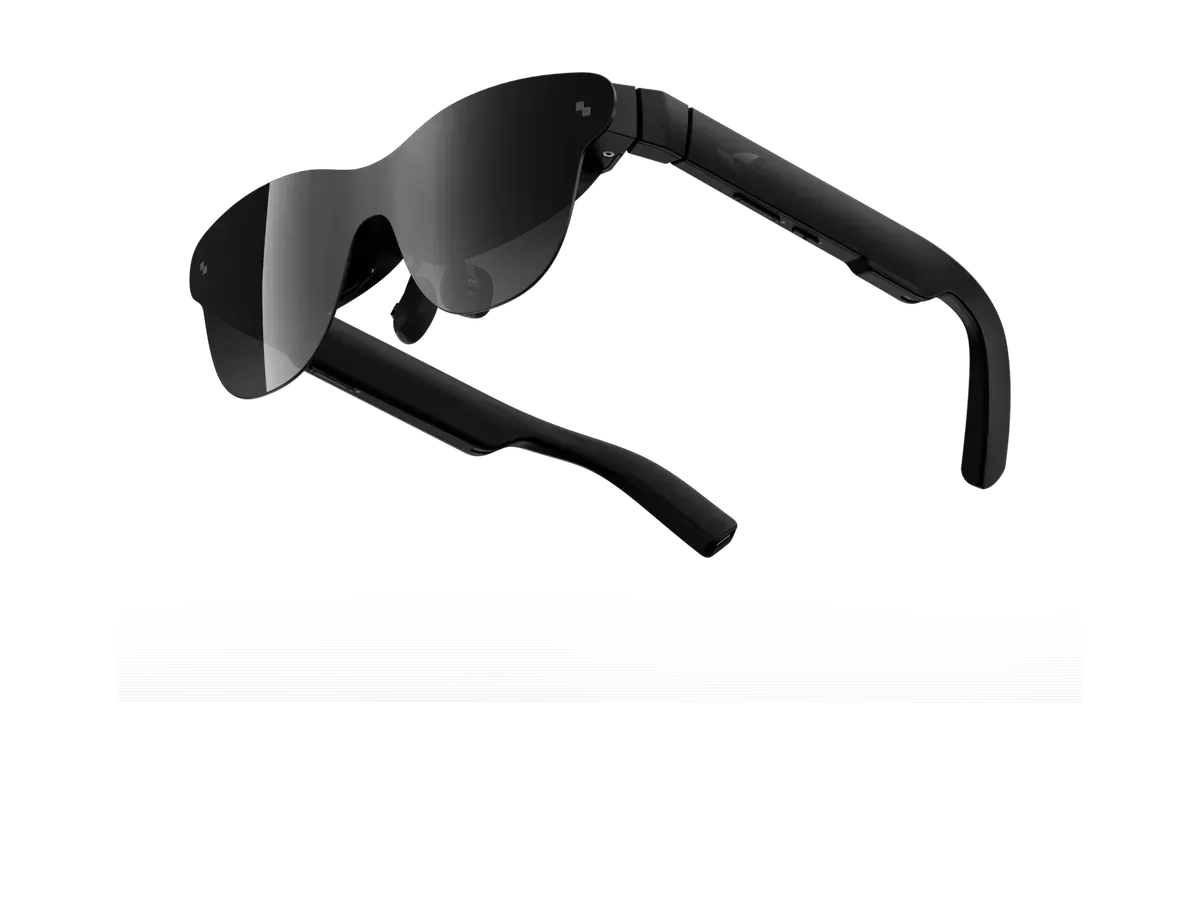
At a glance
- Display type
- Micro-OLED with HDR10 (first AR glasses with HDR10 display), Vision 4000 co-processor
- Resolution
- 1920x1080
- Field of view
- 47°
- Refresh rate
- 120 Hz
- Brightness
- 1200 nits
- Weight
- 76 g
- World's first HDR10 support in AR display glasses
- Bang & Olufsen-tuned quad-speaker audio system
- 47-degree FOV narrower than XREAL One Pro (57 deg) and Rokid Max 2 (50 deg)
- No built-in myopia adjustment -- requires magnetic prescription inserts
RayNeo Air 4 Pro
RayNeo
8.3/10 “The aggregated consensus makes the RayNeo Air 4 Pro the display-hardware bargain of 2026: the first HDR10 glasses in the category, with tandem Micro-OLED panels whose brightness, contrast, and color the entire review field praises, at a $299 price Tom's Hardware flatly called unbeatable. Tom's Guide found the flaws quickly forgiven at this price, and the SDR-to-HDR upscaling earns rare agreement that it actually works. The trade-offs owners and reviewers keep flagging: cheap-feeling build, edge blur, no dimming or IPD adjustment, and software that trails XREAL's X1 platform. If display quality per dollar is the metric, the crowd says nothing else in the category currently touches it.” Read the full review$299
Check price at Amazon- Field of view
- 47°
- Weight
- 76 g
- Brightness
- 1200 nits
The RayNeo Air 4 Pro is the world's first HDR10-enabled AR display glasses, featuring tandem Micro-OLED displays with a custom Pixelworks Vision 4000 processor for real-time SDR-to-HDR upscaling and 2D-to-3D conversion. The quad-speaker audio system is co-designed with Bang & Olufsen, delivering premium sound with minimal leakage. At just $299 and 76g, it sets a new price-to-performance benchmark in the display glasses category.
Our review
By AR Compare Team ·
The aggregated consensus makes the RayNeo Air 4 Pro the display-hardware bargain of 2026: the first HDR10 glasses in the category, with tandem Micro-OLED panels whose brightness, contrast, and color the entire review field praises, at a $299 price Tom's Hardware flatly called unbeatable. Tom's Guide found the flaws quickly forgiven at this price, and the SDR-to-HDR upscaling earns rare agreement that it actually works. The trade-offs owners and reviewers keep flagging: cheap-feeling build, edge blur, no dimming or IPD adjustment, and software that trails XREAL's X1 platform. If display quality per dollar is the metric, the crowd says nothing else in the category currently touches it.
- Display quality
- 9/10
- Comfort
- 7/10
- Battery life
- 5.5/10
- Value for money
- 9/10
- Build quality
- 6.5/10
- Software
- 7/10
The RayNeo Air 4 Pro arrived in January 2026 as the world’s first HDR10-enabled display glasses, and the crowdsourced verdict formed quickly across Notebookcheck, Tom’s Guide, Tom’s Hardware, Gizmodo, and WhatGear, along with early-owner threads. This review aggregates that record. AR Compare has not performed hands-on testing of this unit; every observation is attributed to the cited sources, and the category scores are an editorial aggregate of cited reviewer and owner sentiment.
How This Review Was Compiled
Sources include full scored reviews from five outlets, a three-month usage retrospective at Tom’s Guide, and TechRadar’s coverage of the Batman Justice Edition variant. Disagreements — chiefly over comfort and build — are preserved below.
The Display: A Genuine Category First
Reviewers converge on the panel story. The Air 4 Pro uses 0.6-inch tandem Micro-OLED panels (5.5th-generation SeeYa units) at 1920x1080 per eye, 1,200 nits peak brightness, 200,000:1 contrast, 98% DCI-P3 coverage, and 60/120Hz refresh. ReviewsTown’s assessment that it “leads on display hardware but trails XREAL on software maturity” is the aggregate in one sentence. Notebookcheck confirmed the HDR10 panels get bright and highlight light sources convincingly in HDR content; Gizmodo called the displays bright, crisp, and sharp with well-balanced audio.
The custom Pixelworks Vision4000 co-processor drives two conversion features, and the consensus splits cleanly between them: real-time SDR-to-HDR upscaling “works really well” per multiple reviews, while the 2D-to-3D conversion is less reliable — the same verdict this feature gets on XREAL’s 1S.
Audio is a quiet strength: Bang & Olufsen-tuned speakers that Notebookcheck found surprisingly capable, plus a Whisper Mode that cuts sound leakage by roughly 80% for shared spaces.
Pain Points Owners Report
Build quality. Tom’s Guide’s line — build quality is cheap, but at $299 the flaws are quickly forgiven — recurs across the record. Owners describe plasticky construction relative to XREAL and VITURE.
Fit and the nose problem. Gizmodo’s review is titled around it: eyes love these glasses, noses disagree. Larger noses push the glasses into positions that hurt comfort and can actually blur the image. Notebookcheck likewise found long-term comfort falls short despite the light 76-gram frame.
Optical and feature gaps. Edge blurriness persists, as on previous RayNeo models. There is no electrochromic dimming — competitors like the XREAL 1S and VITURE Beast have it — with plastic clip-in light blockers included instead. There is no IPD adjustment and no anchoring mode, which Notebookcheck flags as what keeps the Air 4 Pro from matching slightly premium rivals. No Dolby Vision either, though RayNeo has said Dolby Vision-capable glasses are in development.
Value
This is the review category’s rare unanimous call. Tom’s Hardware: “an unbeatable value among AR glasses,” noting the closest competitor, the XREAL One, streets around $449 with better build but is not worth the $150 premium for most buyers. Tom’s Guide’s three-month verdict called it the best way to binge HDR10 video and game on your face at the price. Prime Day 2026 pricing dipped to around $239, and Batman-themed Justice and Chaos editions run $319. Against its stablemate Air 3s ($269), the aggregate advice: pay the extra $30 for HDR10, double brightness, and better audio. Where it sits against the rest of the value field is on the best budget AR glasses ranking.
Who Should Buy the RayNeo Air 4 Pro
Per the aggregated consensus: movie and HDR-content bingers, handheld gamers (Steam Deck, ROG Ally, Switch, USB-C iPhone), and value hunters who want the best panel per dollar in the category. Who should skip: buyers with wider noses or who prioritize premium build feel, anyone needing electrochromic dimming or IPD adjustment, productivity users bothered by edge blur, and those who want XREAL-grade anchoring and software polish.
Scores are aggregates of the cited reviews and owner feedback, not AR Compare hands-on measurements.
Sources
- Tom’s Hardware — RayNeo Air 4 Pro AR glasses review: Now enhanced with HDR10 and enhanced audio
- Tom’s Guide — RayNeo Air 4 Pro three-month review
- Notebookcheck — Affordable HDR AR glasses with gaming perks: RayNeo Air 4 Pro review
- Gizmodo — RayNeo Air 4 Pro Review: My Eyes Love These Video Glasses, but My Nose Disagrees
- WhatGear — RayNeo Air 4 Pro Review
- TechRadar — RayNeo Air 4 Pro Batman Justice Edition review
- ReviewsTown — RayNeo Air 4 Pro Review: World’s First HDR10 AR Glasses
Pros & cons
Pros
- World's first HDR10 support in AR display glasses
- Bang & Olufsen-tuned quad-speaker audio system
- Exceptional value at $299 -- significantly cheaper than competitors
- 200,000:1 contrast ratio with 10-bit color and 1200 nits
- Real-time SDR-to-HDR upscaling via Pixelworks Vision 4000 chip
- Broad plug-and-play support: Steam Deck, ROG Ally, Switch, USB-C iPhones
Cons
- 47-degree FOV narrower than XREAL One Pro (57 deg) and Rokid Max 2 (50 deg)
- No built-in myopia adjustment -- requires magnetic prescription inserts
- No spatial computing chip for native 3DoF/6DoF tracking
- 1080p per eye resolution lower than 1200p competitors
- Relatively new product with limited long-term reliability data
- Build quality is repeatedly described as cheap-feeling for the class
- Edge blurring persists, a familiar RayNeo weakness
- No electrochromic dimming and no IPD adjustment; plastic light blockers ship in the box instead
- Fit issues around larger noses can degrade both comfort and image sharpness
- No anchoring mode; software maturity trails XREAL
Full specifications
| Display | |
|---|---|
| Display type | Micro-OLED with HDR10 (first AR glasses with HDR10 display), Vision 4000 co-processor |
| Resolution | 1920x1080 |
| Pixels per degree | 41 |
| Field of view (°) | 47 |
| Refresh rate (Hz) | 120 |
| Brightness (nits) | 1200 |
| Virtual screen size (in) | 201 |
| HDR support | ✓ Yes |
| Color support | Full color |
| Optics | |
| Optics type | birdbath |
| Dimming control | ✕ No |
| Transparency level | 3840Hz PWM hybrid dimming, 10-level brightness |
| Prescription support | ✓ Yes |
| Prescription options | Inserts / lens frame via Lensology, from £95 GBP (partner-sourced) |
| Physical | |
| Weight (g) | 76 |
| Frame style | wraparound |
| Color options | Black |
| Foldable | ✓ Yes |
| Not published: IP rating | |
| Battery & power | |
| Charging method | USB-C (powered by connected device) |
| Not published: Battery life, Charging time | |
| Connectivity | |
| Connectivity | USB-C |
| Tethered | ✓ Yes |
| Compatible devices | Android, iOS, PC, Mac, Steam Deck, Nintendo Switch 2, PlayStation 5, ROG Ally |
| Computing | |
| Processing type | tethered |
| Operating system | None (plug-and-play external display) |
| Chipset | Vision 4000 image chip (co-developed with Pixelworks) for AI SDR-to-HDR upscaling and 2D-to-3D conversion |
| Sensors & input | |
| Camera | ✕ No |
| Microphones | 2 |
| Speakers | directional · spatial audio |
| Not published: Tracking, Gesture control, Voice control | |
Prescription options
The documented prescription routes for the RayNeo Air 4 Pro, from the maker and named-partner documentation recorded in our database.
- Inserts / lens frame via Lensology, from £95 GBP (partner-sourced) — range not published by the maker Source: rayneo.com documentation
Maker documentation as recorded 2026-09-17. Ranges are the maker's published limits, not medical advice — confirm your exact prescription with your optician before ordering.
Read the RayNeo prescription guide for every documented option, model by model.
The RayNeo lineup, untangled
RayNeo sells several near-identically named display glasses. Every model in our catalog is below, ordered by price, with the recorded differences — so you can confirm this is the one you meant.
RayNeo Air 2The budget entry · 2023 · $149
Buy the RayNeo Air 2 if you want to spend $150 less ($149 vs $299) and you play on Xbox.
RayNeo Air 3sThe $269 tier · 2025 · $269
Buy the RayNeo Air 3s if you want to spend $30 less ($269 vs $299) and you want adjustable lens dimming.
RayNeo Air 3s Pro AR/XR GlassesThe $299 tier · 2025 · $299
Buy the RayNeo Air 3s Pro AR/XR Glasses if you want adjustable lens dimming and you play on Xbox.
RayNeo Air 4 ProThis model · 2026 · $299
RayNeo GTThe newest model · 2026 · $299
Buy the RayNeo GT if you want the lighter 68g fit (vs 76g).
RayNeo GT MaxThe flagship tier · 2026 · $399
Buy the RayNeo GT Max if you want the wider 59° field of view (vs 47°).
What it plugs into
Connection paths for the hosts recorded in our database. A "—" means no recorded compatibility — not a confirmed incompatibility.
| Device | Connection |
|---|---|
| Steam Deck | Direct USB-C |
| Switch | — |
| Nintendo Switch 2 | Dock |
| PlayStation 5 | HDMI adapter |
| Xbox | — |
| ROG Ally | Direct USB-C |
| PC | Direct USB-C |
| Mac | Direct USB-C |
| DeX | — |
| iPad | — |
Also recorded as compatible: Android, iOS.
Where to buy
Price verified
RayNeo Air 4 Pro specs: quick answers
- What is the RayNeo Air 4 Pro's field of view?
- The RayNeo Air 4 Pro has a 47-degree field of view.
- What is the RayNeo Air 4 Pro's display resolution?
- The RayNeo Air 4 Pro's recorded per-eye display resolution is 1920x1080.
- How bright is the RayNeo Air 4 Pro's display?
- The RayNeo Air 4 Pro has a rated peak brightness of 1200 nits.
- How much does the RayNeo Air 4 Pro weigh?
- The RayNeo Air 4 Pro's glasses weigh 76g according to the manufacturer specification.
- How much does the RayNeo Air 4 Pro cost?
- The RayNeo Air 4 Pro costs $299.
RayNeo Air 4 Pro: FAQs
How much does the RayNeo Air 4 Pro cost?
The RayNeo Air 4 Pro costs $299 (USD). It is available from 2 retailers listed on this page.
What field of view does the RayNeo Air 4 Pro have?
The RayNeo Air 4 Pro has a recorded field of view of 47 degrees.
How much does the RayNeo Air 4 Pro weigh?
The RayNeo Air 4 Pro weighs 76g according to the manufacturer specification.
Can I use the RayNeo Air 4 Pro with prescription lenses?
Yes, the RayNeo Air 4 Pro supports prescription lenses. The recorded diopter range is Prescription lens insert frame (sample in box); lenses via Lensology.
What devices work with the RayNeo Air 4 Pro?
The RayNeo Air 4 Pro lists compatibility with: Android, iOS, PC, Mac, Steam Deck, Nintendo Switch 2, PlayStation 5, ROG Ally.
What resolution does the RayNeo Air 4 Pro have?
The RayNeo Air 4 Pro has a recorded per-eye resolution of 1920x1080. It refreshes at 120Hz.
Are the RayNeo Air 4 Pro good for gaming?
The RayNeo Air 4 Pro runs at a recorded 120Hz refresh rate with a 47-degree field of view -- the display specs that matter most for gaming. It is tethered, drawing video from a connected phone, PC, or console rather than running games on its own.
Is the RayNeo Air 4 Pro worth it?
The RayNeo Air 4 Pro is priced at $299 (USD). For that you get a 47-degree field of view, 1200 nits of brightness, and a 1920x1080 per-eye resolution. It weighs 76g. It is tethered, so it needs a connected phone, PC, or console to run rather than working on its own. The full spec breakdown on this page shows what the price includes.
Similar products
What shoppers cross-check with the RayNeo Air 4 Pro — from our navigation records and closest spec matches.
Ranked in these buying guides
Where the RayNeo Air 4 Pro lands in our recorded-spec rankings.
- Best AR Glasses for Gaming
- Best AR Glasses for Steam Deck
- Best AR Glasses for Movies & Travel
- Best AR Glasses for Productivity & Multi-Monitor Work
- Best AR Glasses for iPhone Users
- Best Budget AR Glasses & Smart Glasses
- Prescription Smart Glasses
- The Best Smart Glasses of 2026
- AR Glasses Under $300
- Smart Glasses With a Display
- Lightest Smart Glasses
- Best AR Glasses for Nintendo Switch 2
- Monitor Glasses: AR Glasses That Replace a Screen
- Best AR Glasses for Mac & MacBook
- Best AR Glasses for PC & Windows
- Best AR Glasses for Android Phones & Samsung DeX
- Best AR Glasses for PS5
- Best AR Glasses for ROG Ally & Ally X
- Widest FOV AR Glasses
- Brightest Smart Glasses
- Best AR Glasses in 2026
Related Comparisons
RayNeo Air 4 Pro vs Rokid Max 2
RayNeo vs Rokid
RayNeo Air 4 Pro vs XREAL Air 2 Pro
RayNeo vs XREAL
RayNeo Air 4 Pro vs ASUS ROG XREAL R1
RayNeo vs ASUS
RayNeo Air 4 Pro vs XREAL One
RayNeo vs XREAL
RayNeo Air 4 Pro vs VITURE Luma XR
RayNeo vs VITURE
RayNeo Air 4 Pro vs RayNeo Air 3s
RayNeo
RayNeo Air 4 Pro vs VITURE Pro XR
RayNeo vs VITURE
RayNeo Air 4 Pro vs XREAL 1S
RayNeo vs XREAL
RayNeo Air 4 Pro vs Rokid Max
RayNeo vs Rokid
RayNeo Air 4 Pro vs Lenovo Legion Glasses 2
RayNeo vs Lenovo
RayNeo Air 4 Pro vs RayNeo Air 3s Pro AR/XR Glasses
RayNeo
RayNeo Air 4 Pro vs XREAL One Pro
RayNeo vs XREAL
RayNeo Air 4 Pro vs VITURE Luma Pro
RayNeo vs VITURE
RayNeo Air 4 Pro vs XREAL Air 2
RayNeo vs XREAL
RayNeo Air 4 Pro vs VITURE Pro 2 XR Glasses
RayNeo vs VITURE
RayNeo Air 4 Pro vs VITURE Beast XR Glasses
RayNeo vs VITURE
RayNeo Air 4 Pro vs VITURE Luma Ultra XR/AR Glasses
RayNeo vs VITURE
RayNeo Air 4 Pro vs ASUS AirVision M1
RayNeo vs ASUS
RayNeo Air 4 Pro vs Dream Glass Flow
RayNeo vs Dreamworld
RayNeo Air 4 Pro vs GOOVIS G3 Max 3D Head Mounted Display
RayNeo vs Goovis
RayNeo Air 4 Pro vs INAIR 2 Pro
RayNeo vs INAIR
RayNeo Air 4 Pro vs RayNeo Air 2
RayNeo
RayNeo Air 4 Pro vs RayNeo GT
RayNeo
RayNeo Air 4 Pro vs RayNeo GT Max
RayNeo
RayNeo Air 4 Pro vs Rokid Station 2 Spatial Computing Host
RayNeo vs Rokid
RayNeo Air 4 Pro vs Shadow Creator Honghu MR
RayNeo vs Shadow Creator
RayNeo Air 4 Pro vs TCL NxtWear S
RayNeo vs TCL
RayNeo Air 4 Pro vs TCL NXTWEAR S+ AR Glasses
RayNeo vs TCL
RayNeo Air 4 Pro vs VITURE One XR Glasses
RayNeo vs VITURE
RayNeo Air 4 Pro vs VITURE One Lite
RayNeo vs VITURE
RayNeo Air 4 Pro vs XREAL Air 2 Ultra
RayNeo vs XREAL
RayNeo Air 4 Pro vs XREAL Beam
RayNeo vs XREAL
RayNeo Air 4 Pro vs XREAL xbx a01+
RayNeo vs XREAL