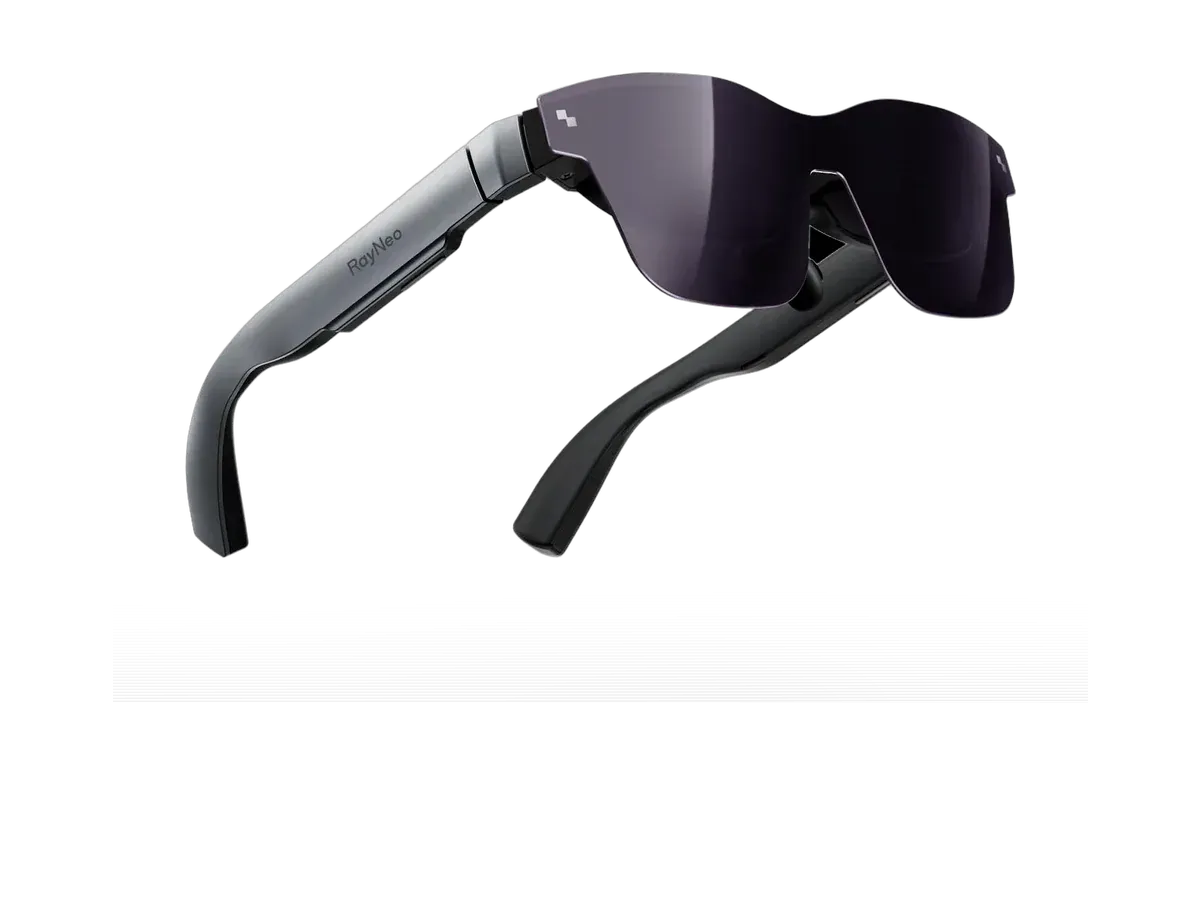
At a glance
- Display type
- Sony Micro-OLED
- Resolution
- 1920x1080
- Field of view
- 46°
- Refresh rate
- 120 Hz
- Brightness
- 600 nits
- Weight
- 76 g
- Sony Micro-OLED panels deliver excellent color accuracy
- Comfortable 76g with 9-point adjustable fit system
- 600 nits brightness low compared to newer models (1200+ nits)
- No HDR support of any kind
RayNeo Air 2
RayNeo
6.8/10 “According to the aggregated consensus of reviewers, the RayNeo Air 2 is a 2023 pair of display glasses whose Sony Micro-OLED picture still earns praise while everything around it shows its age. XDA Developers, SlashGear, and GBAtemp all scored it 7/10, crediting a sharp, bright virtual screen and lightweight comfort but faulting weak speakers, a fussy one-bracket fit, and AR software that never materialized, and iMore concluded it 'comes painfully close to being great.' Three newer RayNeo generations have since superseded it, the official store lists it out of stock at $149, and the record supports buying one today only at that kind of steep discount -- as a movies-and-gaming screen, not an AR device. Scores below are an editorial aggregate of that cited coverage, not AR Compare hands-on measurements.” Read the full review$149
Check price at RayNeo Store- Field of view
- 46°
- Weight
- 76 g
- Brightness
- 600 nits
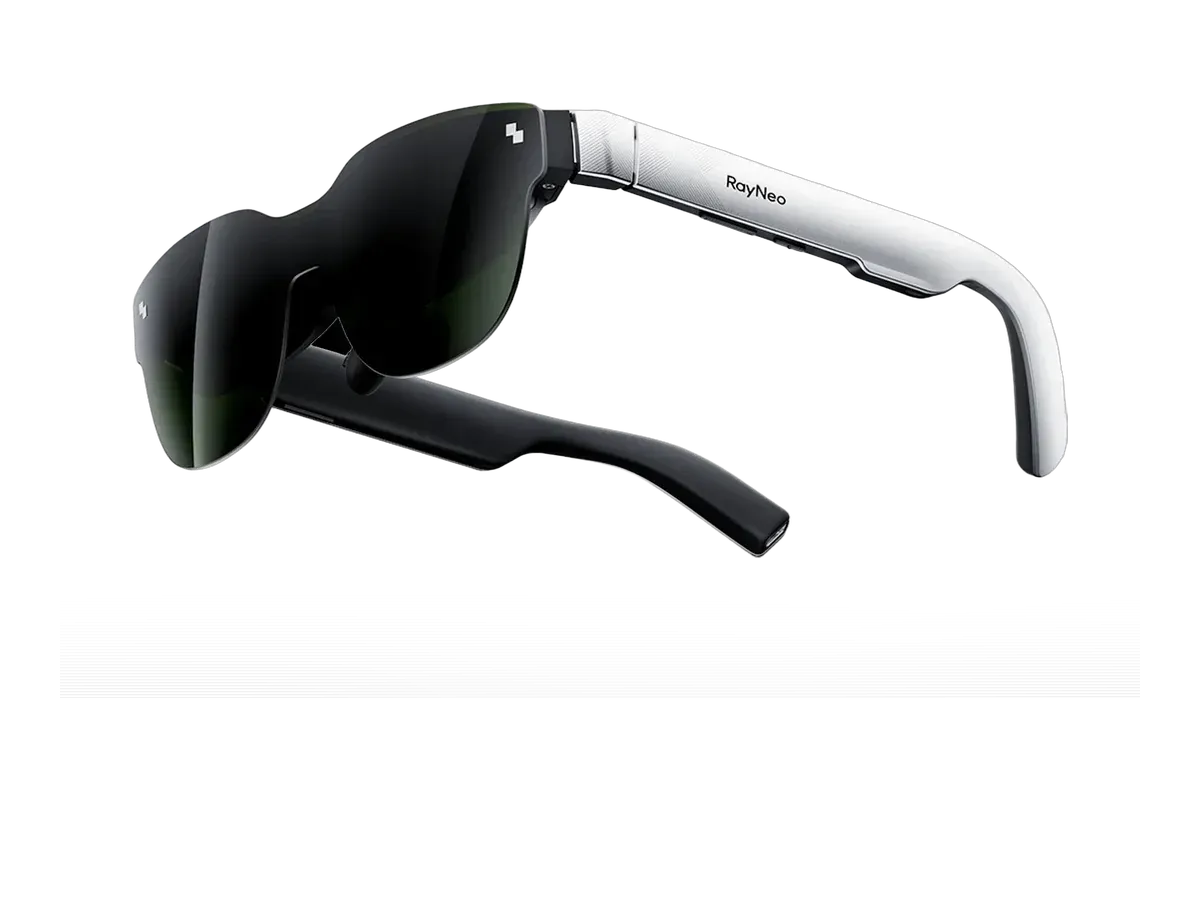
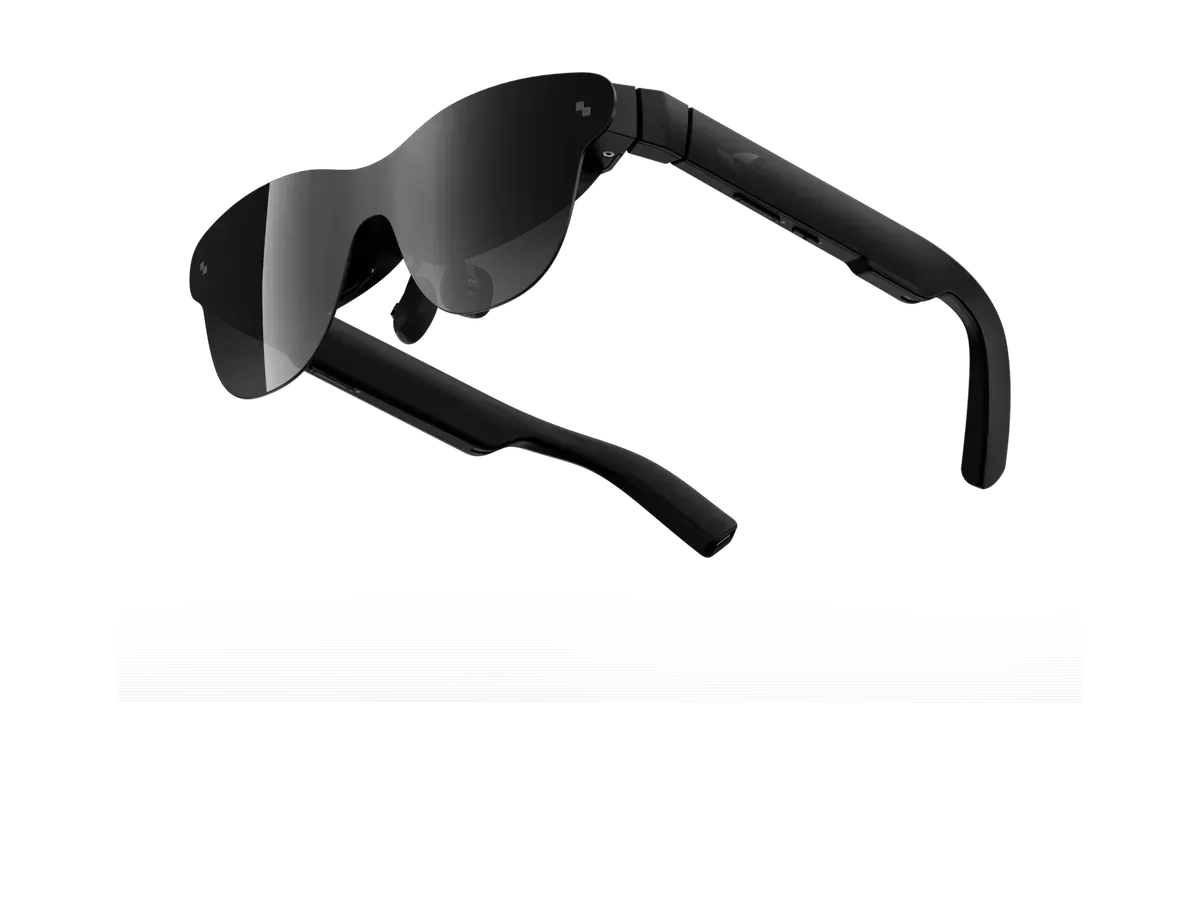
The RayNeo Air 2 is TCL's second-generation display glasses featuring dual Sony Micro-OLED panels delivering 1080p per eye at 120Hz. It was the first in the RayNeo Air series to offer a 201-inch virtual screen experience with 600 nits brightness. The lightweight 76g design with 9-point adjustability made it one of the most comfortable display glasses at launch in late 2023.
Our review
By AR Compare Team ·
According to the aggregated consensus of reviewers, the RayNeo Air 2 is a 2023 pair of display glasses whose Sony Micro-OLED picture still earns praise while everything around it shows its age. XDA Developers, SlashGear, and GBAtemp all scored it 7/10, crediting a sharp, bright virtual screen and lightweight comfort but faulting weak speakers, a fussy one-bracket fit, and AR software that never materialized, and iMore concluded it 'comes painfully close to being great.' Three newer RayNeo generations have since superseded it, the official store lists it out of stock at $149, and the record supports buying one today only at that kind of steep discount -- as a movies-and-gaming screen, not an AR device. Scores below are an editorial aggregate of that cited coverage, not AR Compare hands-on measurements.
- Display quality
- 7.5/10
- Comfort
- 7/10
- Battery life
- 5/10
- Value for money
- 7/10
- Build quality
- 6.5/10
- Software
- 4.5/10
The RayNeo Air 2 is a pair of tethered display glasses from TCL’s RayNeo brand — a wearable external monitor for whatever you plug it into, not a true augmented-reality device. It launched in November 2023 at $379 and now sits at the end of its life: RayNeo’s own store lists it at $149 and out of stock, and the catalog’s Amazon listing carries used units only. This RayNeo Air 2 review aggregates the hands-on record: Tom’s Hardware’s review, XDA Developers’ scored review, SlashGear’s scored review, iMore’s review, and GBAtemp’s review of the glasses with their Nintendo Switch dock bundle, alongside RayNeo’s official specifications. AR Compare has not performed hands-on testing of this device; every observation below is attributed to the cited sources, and the category scores are an editorial aggregate of cited reviewer sentiment. Product facts were cross-checked against AR Compare’s spec record for the Air 2 (a recorded 600 nits, a recorded 46-degree field of view, roughly 76 grams, a claimed 201-inch virtual screen, $149).
How This Review Was Compiled
Tom’s Hardware published the fullest review, connecting the glasses to a MacBook Pro, a Windows desktop, an iPhone 15 Pro Max, and an iPad, and it is the record’s harshest voice on audio. XDA Developers and SlashGear both scored the glasses 7/10 in the launch window, iMore reviewed them the same week with the most measured verdict, and GBAtemp scored the Air 2 with its JoyDock Switch bundle 7/10 in mid-2024, the latest read in the record. Where the sources disagree — edge sharpness and speaker quality, mainly — both readings are reported below rather than smoothed over.
The Picture: The One Part That Holds Up
Everything good in the record starts with the display. Two Sony Micro-OLED panels deliver a recorded 1920x1080 per eye at a recorded 120Hz through birdbath optics — the mirror-and-lens design most budget display glasses use — to simulate a claimed 201-inch screen at 6 meters. Tom’s Hardware calls the image quality outstanding and sharp from edge to edge, even in a brightly lit home office, and XDA Developers describes watching shows on it as ‘almost like having my own private theater.’ Brightness holds up better than the recorded 600 nits suggests: SlashGear found the virtual screen legible at peak brightness even under daylight, and Tom’s Hardware reports it stayed serviceable outdoors in midday sun whenever a solid object sat behind the picture rather than open sky.
Edge clarity is where the record genuinely disagrees. XDA Developers reports the periphery noticeably blurred, SlashGear notes ghosting along the vertical edges and corners, and iMore found the left and right sides always a little out of focus — three of the five reviews, against Tom’s Hardware’s sharp-to-the-borders experience. Fit likely explains the split: Tom’s Hardware itself notes that if the glasses shift even slightly, the image goes from crystal clear to blurry.
The Audio Problem
Sound is the sharpest divide in the record. Tom’s Hardware is blunt, calling the speakers ‘beyond horrible’ — muffled and distorted at about mid-volume, with a buzzing as if the arm plastics were vibrating against each other — and recommends Bluetooth earbuds outright. SlashGear lands softer, describing speakers that are fairly loud while noting they will not take calls. GBAtemp, reviewing months later, credits the integrated speakers with perfectly usable audio for gaming sessions. What the record does agree on is discretion: the recorded two-speaker system uses phase-cancellation Whisper Mode to cut leakage, and iMore confirms that sound leakage on the whole is minimal despite the open design. For quiet-room viewing the speakers pass; for anything more, the strongest advice in the record is earbuds.
Fit, Comfort, and Prescription Lenses
At roughly 76 grams the Air 2 weighs little more than sunglasses, and comfort in the record is good once the glasses are dialed in. GBAtemp reports wearing them without any noticeable discomfort, and Tom’s Hardware logged an hour each in macOS and Windows 11 with no eyestrain or fatigue. Getting dialed in is the catch. The recorded 9-point adjustment system covers the temples and nose bridge, but RayNeo ships a single nose pad bracket where the rival XREAL Air 2 ships four, and Tom’s Hardware had a hard time finding a comfortable fit as a result. SlashGear likewise found the nose clip a bit tight for lengthy sessions. Prescription wearers are handled the way most display glasses handle them: the record lists magnetic prescription inserts rather than any built-in focus adjustment, and a frame for prescription lenses ships in the box along with a cleaning cloth.
Gaming and What It Plugs Into
There is no battery and no processor onboard: the glasses draw power and video over a single USB-C cable, so the battery score of 5 follows this site’s category convention for tethered display glasses rather than any standalone runtime. Compatibility was a consensus strength at launch. XDA Developers plugged into an iPhone 15 Pro, a OnePlus Open, a Galaxy Z Flip 5, a Steam Deck, and a Lenovo Legion Go without problems, and Tom’s Hardware had the same result across Mac, Windows, iPhone, and iPad — the host just needs USB-C DisplayPort Alt Mode, with adapters filling the gaps for older devices. For games, GBAtemp reports the recorded 120Hz refresh rate enabling a lag-free experience and found the JoyDock accessory held a Switch securely, though the dock is bulky where fingers rest, and the reviewer ultimately pointed budget Switch players to a cheaper XREAL combination instead.
Where the Air 2 Stands in 2026
Honestly: this is a superseded product. RayNeo has shipped three newer generations since — the Air 2s, the Air 3s family, and the Air 4 Pro — and AR Compare’s record puts the gap in plain numbers: the Air 3s Pro and Air 4 Pro record 1,200 nits against the Air 2’s recorded 600, the newer models carry four speakers against its two, and the Air 4 Pro adds HDR support the Air 2 never had. The software story never improved either. Tom’s Hardware found factory AR software effectively non-existent at launch, XDA Developers’ verdict was impressive hardware let down by missing software, and GBAtemp still flagged the absent 3DoF head tracking in 2024. Retail tells the rest: the official store lists the Air 2 out of stock at $149, and the record’s Amazon listing is used-only. The practical successor is the Air 3s at $269 in AR Compare’s record; the spec-by-spec gap is itemized on the Air 2 vs Air 3s comparison.
Value
The value question flipped between 2023 and now. Launched at $379, the Air 2 drew hesitation even from reviewers who liked it: SlashGear found it tricky to recommend at its listing price, and Tom’s Hardware judged the XREAL Air 2 the better thought-out product at around $400. At $149, the calculus is different — that is aggressive picture-per-dollar pricing, $120 under the Air 3s — but only if new stock actually surfaces, and the missing extras have not gone anywhere: no HDR, no dimming, no light blocker, no hard case. The aggregate advice reads simply: at clearance money this is a fine movies-and-gaming screen; at anything approaching its old price, buy the newer generation. The broader field is ranked on the best budget AR glasses hub.
Who Should Buy the RayNeo Air 2
Per the aggregated consensus: bargain hunters who can actually find new stock near the $149 clearance listing and mainly want a big private screen for movies, flights, and couch sessions; Switch and Steam Deck players who want a light 120Hz display and will pair earbuds for sound; and prescription wearers comfortable buying magnetic inserts. Who should skip: anyone expecting real AR, since there is no head tracking, pinning, or spatial software; audio-sensitive viewers who will not use earbuds; outdoor viewers who need dimming or a light shade; and anyone offered one near its launch price, since the record points those buyers to the Air 3s generation instead.
Scores are aggregates of the cited reviews and hands-on reports, not AR Compare hands-on results.
Sources
- Tom’s Hardware — RayNeo Air 2 AR Glasses Review: Impressive Mini OLED Visuals Marred by Poor Audio and No-Frills Accessories
- XDA Developers — RayNeo Air 2 XR glasses review: Not true AR but entertaining nonetheless
- SlashGear — RayNeo Air 2 Review: XR Smart Glasses Have The Look, But At What Price?
- iMore — TCL RayNeo Air 2 smart glasses review
- GBAtemp — RayNeo Air 2 AR glasses and JoyDock Gaming Bundle review
- RayNeo — Air 2 official product page (specifications)
Pros & cons
Pros
- Sony Micro-OLED panels deliver excellent color accuracy
- Comfortable 76g with 9-point adjustable fit system
- 120Hz refresh rate for smooth gaming and video
- Whisper Mode with phase cancellation reduces audio leakage
- Wide device compatibility via USB-C DisplayPort Alt Mode
- A picture launch reviewers praised as outstanding, with one calling it sharp from edge to edge even in a bright room
- Legible outdoors at peak brightness, with the virtual screen holding up under daylight in reviewer testing
- Plug-and-play in reviewer tests across phones, laptops, and handhelds, from Steam Deck to iPhone 15
- A frame for prescription lens inserts and a cleaning cloth ship in the box
- At the current $149 clearance listing it undercuts every newer RayNeo model by at least $120
Cons
- 600 nits brightness low compared to newer models (1200+ nits)
- No HDR support of any kind
- Only 2 speakers vs 4 on newer Air 2s/3s/4 models
- No built-in myopia adjustment -- requires prescription inserts
- 46-degree FOV narrower than Air 3s (47 deg) and competitors
- Speaker quality split reviewers, with the harshest verdict calling the audio muffled and distorted at moderate volume
- One nose pad bracket in the box makes fit fussy, and a slight shift can blur the picture
- Soft or ghosted edges reported by three launch reviews, though one found the image sharp to the borders
- No AR software layer to speak of: no 3DoF head tracking, screen pinning, or spatial modes ever arrived
- Winding down at retail: out of stock at the official store, with the major marketplace listing used only
- Only a soft cloth pouch and no light blocker included, which reviewers called thin protection for a frameless lens
Full specifications
Specs last verified
| Display | |
|---|---|
| Display type | Sony Micro-OLED |
| Resolution | 1920x1080 |
| Field of view (°) | 46 |
| Refresh rate (Hz) | 120 |
| Brightness (nits) | 600 |
| Virtual screen size (in) | 201 |
| HDR support | ✕ No |
| Color support | Full color |
| Not published: Pixels per degree | |
| Optics | |
| Optics type | birdbath |
| Prescription support | ✓ Yes |
| Prescription options | Inserts / lens frame via Lensology, £79 GBP at partner (partner-sourced) |
| Not published: Dimming control, Transparency level | |
| Physical | |
| Weight (g) | 76 |
| Frame style | wraparound |
| Color options | Black |
| Foldable | ✓ Yes |
| Not published: IP rating | |
| Battery & power | |
| Charging method | USB-C (powered by connected device) |
| Not published: Battery life, Charging time | |
| Connectivity | |
| Connectivity | USB-C |
| Tethered | ✓ Yes |
| Compatible devices | Android, iOS, PC, Mac, Steam Deck, Nintendo Switch, PlayStation, Xbox |
| Computing | |
| Processing type | tethered |
| Not published: Operating system, Chipset | |
| Sensors & input | |
| Camera | ✕ No |
| Microphones | 2 |
| Speakers | directional |
| Not published: Tracking, Gesture control, Voice control | |
Prescription options
The documented prescription routes for the RayNeo Air 2, from the maker and named-partner documentation recorded in our database.
- Inserts / lens frame via Lensology, £79 GBP at partner (partner-sourced) — range not published by the maker Source: rayneo.com documentation
Maker documentation as recorded 2026-09-17. Ranges are the maker's published limits, not medical advice — confirm your exact prescription with your optician before ordering.
Read the RayNeo prescription guide for every documented option, model by model.
Where to buy
Price checked
RayNeo Air 2 specs: quick answers
- What is the RayNeo Air 2's field of view?
- The RayNeo Air 2 has a 46-degree field of view.
- What is the RayNeo Air 2's display resolution?
- The RayNeo Air 2's recorded per-eye display resolution is 1920x1080.
- How bright is the RayNeo Air 2's display?
- The RayNeo Air 2 has a rated peak brightness of 600 nits.
- How much does the RayNeo Air 2 weigh?
- The RayNeo Air 2's glasses weigh 76g according to the manufacturer specification.
- How much does the RayNeo Air 2 cost?
- The RayNeo Air 2 costs $149.
RayNeo Air 2: FAQs
How much does the RayNeo Air 2 cost?
The RayNeo Air 2 costs $149 (USD). It is available from 2 retailers listed on this page.
What field of view does the RayNeo Air 2 have?
The RayNeo Air 2 has a recorded field of view of 46 degrees.
How much does the RayNeo Air 2 weigh?
The RayNeo Air 2 weighs 76g according to the manufacturer specification.
Can I use the RayNeo Air 2 with prescription lenses?
Yes, the RayNeo Air 2 supports prescription lenses. The recorded diopter range is Prescription inserts via Lensology or optician-fitted (sample lenses in box).
What devices work with the RayNeo Air 2?
The RayNeo Air 2 lists compatibility with: Android, iOS, PC, Mac, Steam Deck, Nintendo Switch, PlayStation, Xbox.
What resolution does the RayNeo Air 2 have?
The RayNeo Air 2 has a recorded per-eye resolution of 1920x1080. It refreshes at 120Hz.
Are the RayNeo Air 2 good for gaming?
The RayNeo Air 2 runs at a recorded 120Hz refresh rate with a 46-degree field of view -- the display specs that matter most for gaming. It is tethered, drawing video from a connected phone, PC, or console rather than running games on its own.
Is the RayNeo Air 2 worth it?
The RayNeo Air 2 is priced at $149 (USD). For that you get a 46-degree field of view, 600 nits of brightness, and a 1920x1080 per-eye resolution. It weighs 76g. It is tethered, so it needs a connected phone, PC, or console to run rather than working on its own. The full spec breakdown on this page shows what the price includes.
Similar products
What shoppers cross-check with the RayNeo Air 2 — from our navigation records and closest spec matches.
Ranked in these buying guides
Where the RayNeo Air 2 lands in our recorded-spec rankings.
- Best AR Glasses for Gaming
- Best AR Glasses for Steam Deck
- Best AR Glasses for Movies & Travel
- Best AR Glasses for Productivity & Multi-Monitor Work
- Best AR Glasses for iPhone Users
- Best Budget AR Glasses & Smart Glasses
- Prescription Smart Glasses
- The Best Smart Glasses of 2026
- AR Glasses Under $300
- AR Glasses Under $200
- Smart Glasses With a Display
- Lightest Smart Glasses
- Monitor Glasses: AR Glasses That Replace a Screen
- Best AR Glasses for Mac & MacBook
- Best AR Glasses for PC & Windows
- Best AR Glasses for Android Phones & Samsung DeX
- Best AR Glasses for Nintendo Switch
- Best AR Glasses for PS5
- Best AR Glasses for Xbox Series X & S
- Widest FOV AR Glasses
- Brightest Smart Glasses
Related Comparisons
RayNeo Air 2 vs Rokid Max
RayNeo vs Rokid
RayNeo Air 2 vs XREAL Air 2 Pro
RayNeo vs XREAL
RayNeo Air 2 vs RayNeo Air 3s
RayNeo
RayNeo Air 2 vs TCL NxtWear S
RayNeo vs TCL
RayNeo Air 2 vs VITURE One Lite
RayNeo vs VITURE
RayNeo Air 2 vs XREAL 1S
RayNeo vs XREAL
RayNeo Air 2 vs XREAL Air 2
RayNeo vs XREAL
RayNeo Air 2 vs ASUS AirVision M1
RayNeo vs ASUS
RayNeo Air 2 vs ASUS ROG XREAL R1
RayNeo vs ASUS
RayNeo Air 2 vs Dream Glass Flow
RayNeo vs Dreamworld
RayNeo Air 2 vs GOOVIS G3 Max 3D Head Mounted Display
RayNeo vs Goovis
RayNeo Air 2 vs INAIR 2 Pro
RayNeo vs INAIR
RayNeo Air 2 vs Lenovo Legion Glasses 2
RayNeo vs Lenovo
RayNeo Air 2 vs RayNeo Air 3s Pro AR/XR Glasses
RayNeo
RayNeo Air 2 vs RayNeo Air 4 Pro
RayNeo
RayNeo Air 2 vs RayNeo GT
RayNeo
RayNeo Air 2 vs RayNeo GT Max
RayNeo
RayNeo Air 2 vs Rokid Max 2
RayNeo vs Rokid
RayNeo Air 2 vs Rokid Station 2 Spatial Computing Host
RayNeo vs Rokid
RayNeo Air 2 vs Shadow Creator Honghu MR
RayNeo vs Shadow Creator
RayNeo Air 2 vs TCL NXTWEAR S+ AR Glasses
RayNeo vs TCL
RayNeo Air 2 vs VITURE Beast XR Glasses
RayNeo vs VITURE
RayNeo Air 2 vs VITURE Luma Pro
RayNeo vs VITURE
RayNeo Air 2 vs VITURE Luma Ultra XR/AR Glasses
RayNeo vs VITURE
RayNeo Air 2 vs VITURE Luma XR
RayNeo vs VITURE
RayNeo Air 2 vs VITURE One XR Glasses
RayNeo vs VITURE
RayNeo Air 2 vs VITURE Pro 2 XR Glasses
RayNeo vs VITURE
RayNeo Air 2 vs VITURE Pro XR
RayNeo vs VITURE
RayNeo Air 2 vs XREAL Air 2 Ultra
RayNeo vs XREAL
RayNeo Air 2 vs XREAL Beam
RayNeo vs XREAL
RayNeo Air 2 vs XREAL One
RayNeo vs XREAL
RayNeo Air 2 vs XREAL One Pro
RayNeo vs XREAL
RayNeo Air 2 vs XREAL xbx a01+
RayNeo vs XREAL