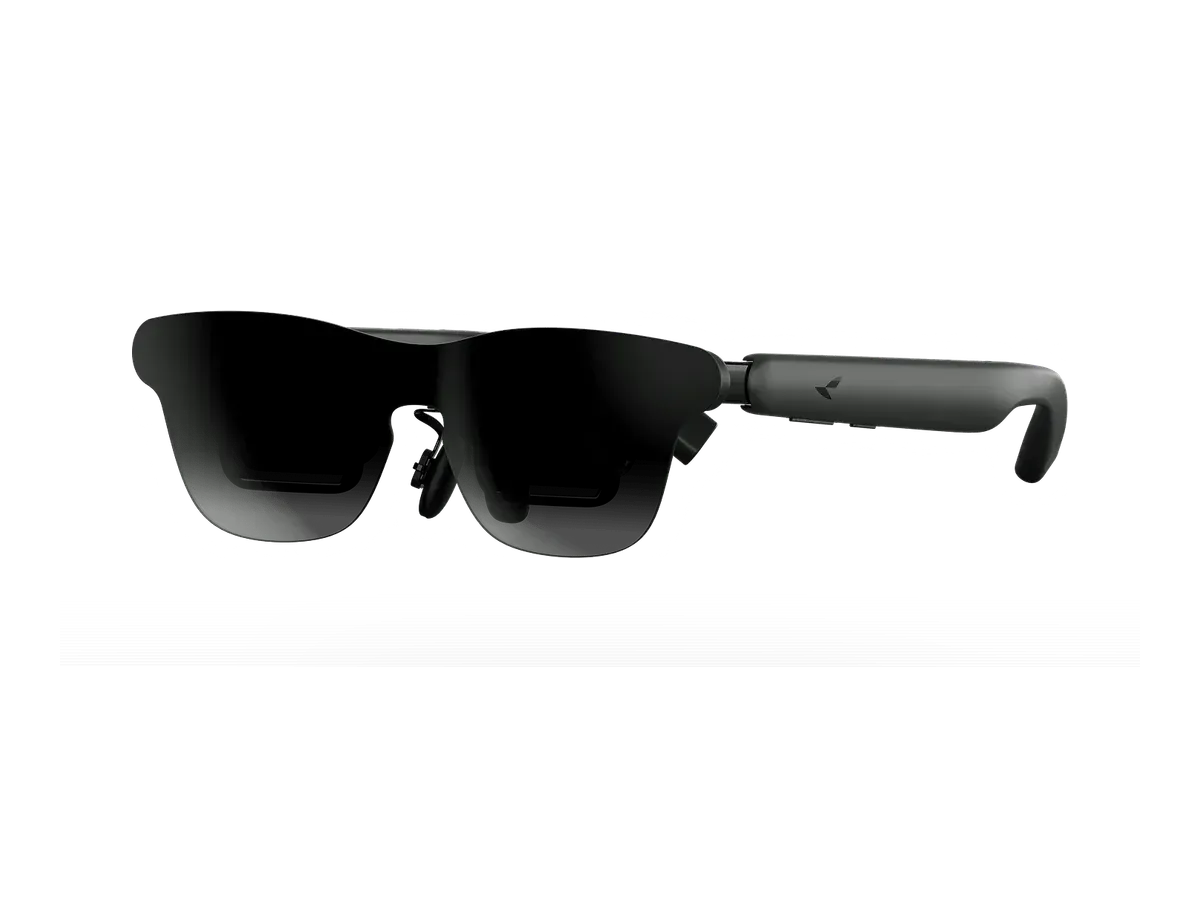
At a glance
- Display type
- 5.5th-gen Tandem Micro-OLED (Peacock Optical Engine 3.0 Max)
- Resolution
- 1920x1080
- Field of view
- 59°
- Refresh rate
- 120 Hz
- Brightness
- 1200 nits
- Weight
- 78 g
- First Dolby Vision-certified AR glasses (native playback with the RayNeo Pocket TV Pro, plus AI SDR-to-HDR conversion)
- 59-degree field of view from the Peacock Optical Engine 3.0 Max
- Heavier than the GT at 78 g
- Brightness drops to 336 nits in Pinned Mode
RayNeo GT Max
RayNeo
Read the full overview$399
Check price at Amazon- Field of view
- 59°
- Weight
- 78 g
- Brightness
- 1200 nits
The RayNeo GT Max are display glasses for media, gaming, and productivity from RayNeo, at US retail since 2026-09-04 at $399. They feature a 1920x1080 per-eye 5.5th-gen Tandem Micro-OLED (Peacock Optical Engine 3.0 Max), 59° field of view, 1200 nits perceived brightness, 120Hz refresh rate (60Hz in 3D), and a default virtual screen RayNeo states as 267 inches (scales 227/267/307). Weight is 78g per the spec table, connecting over USB-C with DisplayPort Alt Mode, and the frame comes in three physical IPD sizes at the same price. Best for: Movie-first buyers who want the widest field of view and native Dolby Vision in birdbath glasses.
Editorial overview
By AR Compare Team ·
Compiled from AR Compare's verified catalog record and cited coverage — AR Compare has not tested this device.
The RayNeo GT Max is the movie-first flagship of RayNeo’s September 2026 launch wave: announced at IFA on August 21 and at US retail since September 4, 2026 at $399 (a sale price against the $429 regular anchor the record confirms three ways from the maker’s store data). The headline figure is the 59-degree field of view from the Peacock Optical Engine 3.0 Max — the widest birdbath view in the catalog — rendering a default 267-inch virtual screen (scalable 227/267/307) from 5.5th-generation Tandem Micro-OLED panels at 1080p per eye, 120Hz, and 1,200 nits perceived brightness.
The record positions it as the first Dolby Vision-certified AR glasses, with native playback through the RayNeo Pocket TV Pro and AI SDR-to-HDR conversion — the same asterisk as the rest of the line, since that accessory costs $199 and HDMI consoles need an adapter. Audio is head-tracked spatial sound on Bang & Olufsen quad speakers, and a Zone 360 3DoF chip provides Pinned, Steady, and Follow anchoring, with brightness dropping to 336 nits in Pinned Mode. Fit is the Max’s quiet advantage: three physical IPD frame sizes (S/M/L) at one price — the maker’s answer to the fixed 64mm RayNeo GT — with prescription inserts through Lensology and a weight of 78 grams per the official spec table.
Early hands-on coverage is thin but notable: Tom’s Guide’s IFA 2026 write-up called the GT Max ‘easily the most comfortable AR glasses I’ve worn yet.’ What the record does not yet hold is full review consensus — scores, long-term comfort, and real-world brightness reads will have to accumulate before this page can carry a scored verdict.
Sources
What other reviewers say
1 review from an outside outlet.
Scores from other outlets, as published — not our rating.
| Source | Score |
|---|---|
| Tom's Guide | easily the most comfortable AR glasses I've worn yet |
Pros & cons
Pros
- First Dolby Vision-certified AR glasses (native playback with the RayNeo Pocket TV Pro, plus AI SDR-to-HDR conversion)
- 59-degree field of view from the Peacock Optical Engine 3.0 Max
- Head-tracked spatial audio on B&O quad speakers
- Three physical IPD frame sizes at one price, with Lensology prescription lens support
Cons
- Heavier than the GT at 78 g
- Brightness drops to 336 nits in Pinned Mode
- Dolby Vision needs the $199 Pocket TV Pro accessory
- HDMI devices (PlayStation, Xbox, Switch) need an adapter
Full specifications
| Display | |
|---|---|
| Display type | 5.5th-gen Tandem Micro-OLED (Peacock Optical Engine 3.0 Max) |
| Resolution | 1920x1080 |
| Field of view (°) | 59 |
| Refresh rate (Hz) | 120 |
| Brightness (nits) | 1200 |
| Virtual screen size (in) | 267 |
| HDR support | ✓ Yes |
| Color support | Full color |
| Not published: Pixels per degree | |
| Optics | |
| Optics type | birdbath |
| Dimming control | ✕ No |
| Prescription support | ✓ Yes |
| Prescription options | Inserts / lens frame via Lensology, £95 GBP (partner-sourced) |
| Not published: Transparency level | |
| Physical | |
| Weight (g) | 78 |
| Foldable | ✕ No |
| Not published: Frame style, Color options, IP rating | |
| Connectivity | |
| Connectivity | USB-C (DP Alt Mode) |
| Tethered | ✓ Yes |
| Compatible devices | iOS, Android, Mac, PC, Steam Deck |
| Sensors & input | |
| Camera | ✕ No |
| Speakers | open-ear · spatial audio |
| Tracking | 3DoF, Zone 360 3DoF chip (Pinned/Steady/Follow viewing modes) |
| Not published: Microphones, Gesture control, Voice control | |
Prescription options
The documented prescription routes for the RayNeo GT Max, from the maker and named-partner documentation recorded in our database.
- Inserts / lens frame via Lensology, £95 GBP (partner-sourced) — range not published by the maker Source: rayneo.com documentation
Maker documentation as recorded 2026-09-17. Ranges are the maker's published limits, not medical advice — confirm your exact prescription with your optician before ordering.
Read the RayNeo prescription guide for every documented option, model by model.
Where to buy
Price verified
RayNeo GT Max specs: quick answers
- What is the RayNeo GT Max's field of view?
- The RayNeo GT Max has a 59-degree field of view.
- What is the RayNeo GT Max's display resolution?
- The RayNeo GT Max's recorded per-eye display resolution is 1920x1080.
- How bright is the RayNeo GT Max's display?
- The RayNeo GT Max has a rated peak brightness of 1200 nits.
- How much does the RayNeo GT Max weigh?
- The RayNeo GT Max's glasses weigh 78g according to the manufacturer specification.
- How much does the RayNeo GT Max cost?
- The RayNeo GT Max costs $399.
RayNeo GT Max: FAQs
How much does the RayNeo GT Max cost?
The RayNeo GT Max costs $399 (USD). It is available from 2 retailers listed on this page.
What field of view does the RayNeo GT Max have?
The RayNeo GT Max has a recorded field of view of 59 degrees.
How much does the RayNeo GT Max weigh?
The RayNeo GT Max weighs 78g according to the manufacturer specification.
Can I use the RayNeo GT Max with prescription lenses?
Yes, the RayNeo GT Max supports prescription lenses. The recorded diopter range is Custom prescription lens inserts via Lensology; three IPD frame sizes (S/M/L).
What devices work with the RayNeo GT Max?
The RayNeo GT Max lists compatibility with: iOS, Android, Mac, PC, Steam Deck.
What resolution does the RayNeo GT Max have?
The RayNeo GT Max has a recorded per-eye resolution of 1920x1080. It refreshes at 120Hz.
Are the RayNeo GT Max good for gaming?
The RayNeo GT Max runs at a recorded 120Hz refresh rate with a 59-degree field of view -- the display specs that matter most for gaming.
Is the RayNeo GT Max worth it?
The RayNeo GT Max is priced at $399 (USD). For that you get a 59-degree field of view, 1200 nits of brightness, and a 1920x1080 per-eye resolution. It weighs 78g. The full spec breakdown on this page shows what the price includes.
Similar products
What shoppers cross-check with the RayNeo GT Max — from our navigation records and closest spec matches.
Ranked in these buying guides
Where the RayNeo GT Max lands in our recorded-spec rankings.
- Best AR Glasses for Gaming
- Best AR Glasses for Steam Deck
- Best AR Glasses for Movies & Travel
- Best AR Glasses for Productivity & Multi-Monitor Work
- Best AR Glasses for iPhone Users
- Prescription Smart Glasses
- The Best Smart Glasses of 2026
- Smart Glasses With a Display
- Lightest Smart Glasses
- Monitor Glasses: AR Glasses That Replace a Screen
- Best AR Glasses for Mac & MacBook
- Best AR Glasses for PC & Windows
- Best AR Glasses for Android Phones & Samsung DeX
- Widest FOV AR Glasses
- Brightest Smart Glasses
Related Comparisons
RayNeo GT Max vs XREAL One Pro
RayNeo vs XREAL
RayNeo GT Max vs RayNeo GT
RayNeo
RayNeo GT Max vs VITURE Beast XR Glasses
RayNeo vs VITURE
RayNeo GT Max vs XREAL 1S
RayNeo vs XREAL
RayNeo GT Max vs ASUS AirVision M1
RayNeo vs ASUS
RayNeo GT Max vs ASUS ROG XREAL R1
RayNeo vs ASUS
RayNeo GT Max vs Dream Glass Flow
RayNeo vs Dreamworld
RayNeo GT Max vs GOOVIS G3 Max 3D Head Mounted Display
RayNeo vs Goovis
RayNeo GT Max vs INAIR 2 Pro
RayNeo vs INAIR
RayNeo GT Max vs Lenovo Legion Glasses 2
RayNeo vs Lenovo
RayNeo GT Max vs RayNeo Air 2
RayNeo
RayNeo GT Max vs RayNeo Air 3s Pro AR/XR Glasses
RayNeo
RayNeo GT Max vs RayNeo Air 3s
RayNeo
RayNeo GT Max vs RayNeo Air 4 Pro
RayNeo
RayNeo GT Max vs Rokid Max
RayNeo vs Rokid
RayNeo GT Max vs Rokid Max 2
RayNeo vs Rokid
RayNeo GT Max vs Rokid Station 2 Spatial Computing Host
RayNeo vs Rokid
RayNeo GT Max vs Shadow Creator Honghu MR
RayNeo vs Shadow Creator
RayNeo GT Max vs TCL NxtWear S
RayNeo vs TCL
RayNeo GT Max vs TCL NXTWEAR S+ AR Glasses
RayNeo vs TCL
RayNeo GT Max vs VITURE Luma Pro
RayNeo vs VITURE
RayNeo GT Max vs VITURE Luma Ultra XR/AR Glasses
RayNeo vs VITURE
RayNeo GT Max vs VITURE Luma XR
RayNeo vs VITURE
RayNeo GT Max vs VITURE One XR Glasses
RayNeo vs VITURE
RayNeo GT Max vs VITURE One Lite
RayNeo vs VITURE
RayNeo GT Max vs VITURE Pro 2 XR Glasses
RayNeo vs VITURE
RayNeo GT Max vs VITURE Pro XR
RayNeo vs VITURE
RayNeo GT Max vs XREAL Air 2
RayNeo vs XREAL
RayNeo GT Max vs XREAL Air 2 Pro
RayNeo vs XREAL
RayNeo GT Max vs XREAL Air 2 Ultra
RayNeo vs XREAL
RayNeo GT Max vs XREAL Beam
RayNeo vs XREAL
RayNeo GT Max vs XREAL One
RayNeo vs XREAL
RayNeo GT Max vs XREAL xbx a01+
RayNeo vs XREAL