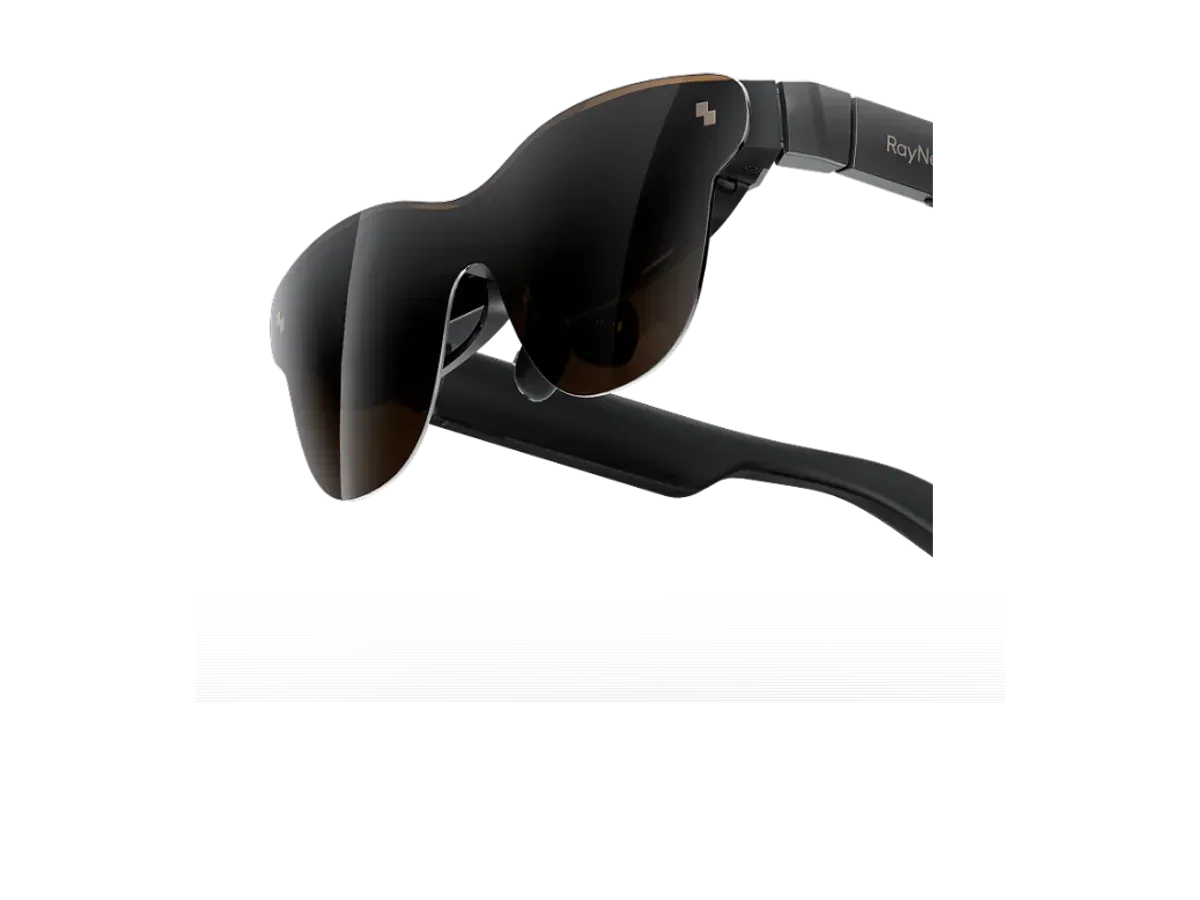
At a glance
- Display type
- Sony 0.6" tandem Micro-OLED (5.5th-gen, HueView 2.0)
- Resolution
- 1920x1080
- Field of view
- 46°
- Refresh rate
- 120 Hz
- Brightness
- 1200 nits
- Weight
- 76 g
- 1,200-nit tandem OLED — roughly 2x the brightness of Air 3s, usable in bright rooms
- Ties the Air 4 Pro at $299 for the brightest panel under $300
- No 3DoF — no screen pinning or smooth-follow modes
- Doesn't fully block ambient light and ships without a shade
RayNeo Air 3s Pro AR/XR Glasses
RayNeo
7.5/10 “According to the aggregated consensus of reviewers, the RayNeo Air 3s Pro is the no-frills picture bargain among budget display glasses: the sharpest, brightest image at its price and almost nothing else. Tom's Hardware calls the viewing experience an absolute champ and the price a compelling alternative to costlier rivals, Gizmochina describes an OLED personal theater with solid audio and broad compatibility for the money, and a 9/10 enthusiast review made it the writer's primary display for handheld gaming. What you give up is just as consistent: no 3DoF, no electrochromic dimming, no included light shade, cheap-feeling plastic, and a hard requirement for USB-C DisplayPort Alt Mode on the host device. Scores below are an editorial aggregate of that cited coverage, not AR Compare hands-on measurements.” Read the full review$299
Check price at Amazon- Field of view
- 46°
- Weight
- 76 g
- Brightness
- 1200 nits
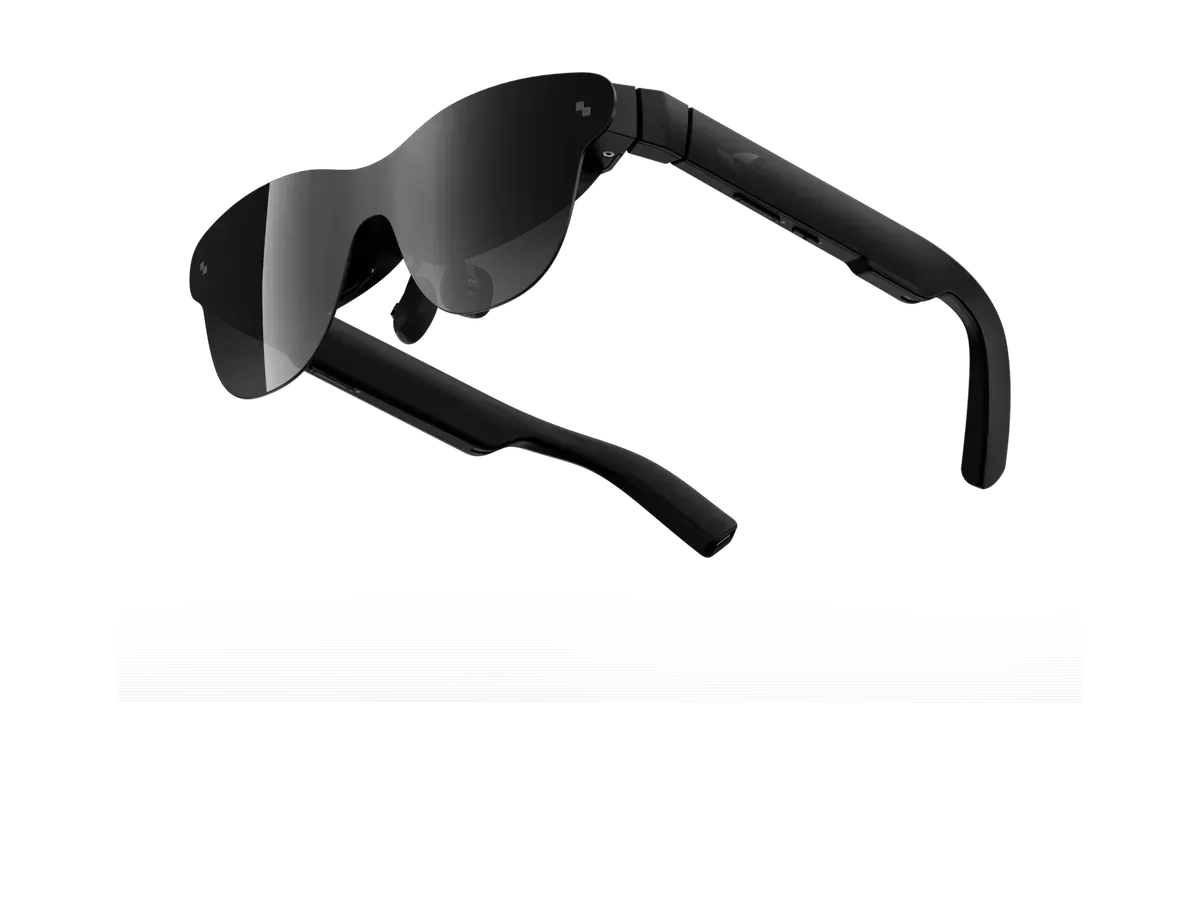
The RayNeo Air 3s Pro AR/XR Glasses are display glasses for media, gaming, and productivity from RayNeo, released 2025-08. They feature a 1920x1080 per-eye Sony 0.6" tandem Micro-OLED (5.5th-gen, HueView 2.0), 46° field of view, 1200 nits perceived brightness, 120Hz refresh rate. Weight is 76g. Best for: Value hunters who want the brightest sub-$300 display glasses for movies and Steam Deck/console gaming.
Our review
By AR Compare Team ·
According to the aggregated consensus of reviewers, the RayNeo Air 3s Pro is the no-frills picture bargain among budget display glasses: the sharpest, brightest image at its price and almost nothing else. Tom's Hardware calls the viewing experience an absolute champ and the price a compelling alternative to costlier rivals, Gizmochina describes an OLED personal theater with solid audio and broad compatibility for the money, and a 9/10 enthusiast review made it the writer's primary display for handheld gaming. What you give up is just as consistent: no 3DoF, no electrochromic dimming, no included light shade, cheap-feeling plastic, and a hard requirement for USB-C DisplayPort Alt Mode on the host device. Scores below are an editorial aggregate of that cited coverage, not AR Compare hands-on measurements.
- Display quality
- 8.5/10
- Comfort
- 7.5/10
- Battery life
- 5/10
- Value for money
- 8.5/10
- Build quality
- 6.5/10
- Software
- 5.5/10
The RayNeo Air 3s Pro is a pair of tethered display glasses — a wearable external monitor, not an AR headset — released in August 2025 at $299. It projects a recorded 1920x1080 per-eye picture from tandem micro-OLED panels at a recorded 1,200 nits and 120Hz through birdbath optics, the mirror-and-lens design most budget display glasses use. This review aggregates the hands-on record: Tom’s Hardware’s review, Gizmochina’s full review, Gaming Nexus’ review, and Pixel-Swish’s scored long-term review, alongside RayNeo’s official specifications. AR Compare has not performed hands-on testing of this device; every observation below is attributed to the cited sources, and the category scores are an editorial aggregate of cited reviewer sentiment. Product facts were cross-checked against AR Compare’s spec record for the Air 3s Pro (a recorded 1,200 nits, a recorded 46-degree field of view, roughly 76 grams, a claimed 201-inch virtual screen, $299).
How This Review Was Compiled
Tom’s Hardware’s Brandon Hill published the fullest review, testing across handhelds, Macs, and tablets with direct comparison against the older Air 3s. Gizmochina’s review is the most detailed on the display internals and compatibility, Gaming Nexus’ John Yan reviewed it against a long run of rival XR glasses, and Pixel-Swish’s Shaz Mohsin scored it 9/10 after adopting it as a daily driver for handheld gaming. Where the record disagrees — mostly on how much the missing extras matter — both readings are reported below rather than smoothed over.
The Picture: Why the Air 3s Pro Exists
Everything reviewers like about this product is the image. Tom’s Hardware calls it an absolute champ on image quality — bright, colorful, crisp across the entire field of view, with none of the edge blur that plagued earlier RayNeo generations — and reports a genuinely watchable picture even facing a window with the blinds open. Gaming Nexus rates the visuals superb for the price with vivid color and outstanding brightness, and Gizmochina found even 60 percent brightness sufficient for movies. The recorded 1,200 nits comes from a tandem OLED panel with 20 adjustment steps, and the recorded 120Hz mode defaults correctly on handhelds like the Steam Deck, where Gaming Nexus reports flicker-free, ghost-free play. One honest framing note from the record: RayNeo claims a 201-inch virtual screen at a simulated 6 meters, and Pixel-Swish calls that a bit of cheeky marketing, since the recorded 46-degree field of view means perceived size depends entirely on what your eyes focus on — closer to a large monitor at a desk, a wall-filling screen lying in bed.
RayNeo Air 3s vs Air 3s Pro: What’s the Difference?
Brightness, mostly. Tom’s Hardware puts it plainly: the Pro’s headline upgrade is maximum brightness of 1,200 nits versus 650 on the standard Air 3s, plus the newer HueView 2.0 screen generation, with the design, four-speaker audio, and weight unchanged. Gizmochina adds the smaller refinements — a matte dark finish instead of silver and about 15 percent less clamping force on the temples. AR Compare’s record prices the standard Air 3s at $269, so the practical question is whether roughly doubled brightness is worth about $30: Tom’s Hardware treats the Pro as the meaningful usability upgrade precisely because the extra headroom makes bright rooms workable without a shade. Both share the same recorded 46-degree field of view and 1080p panels. The full side-by-side sits on the Air 3s vs Air 3s Pro comparison.
Air 3s Pro vs Air 4 Pro: Same Price, Different Bets
The cited reviews do not test the two head to head, so this answer leans on AR Compare’s spec record: both list at $299 with 1,200-nit panels, 1080p per eye, and 120Hz, but the Air 4 Pro adds HDR10 support and Bang & Olufsen-tuned audio, while the Air 3s Pro counters with the newer tandem-OLED HueView 2.0 panel and the same four-speaker system reviewers already rate highly here. Neither offers 3DoF tracking or electrochromic dimming. For picture-first buyers the record supports either; the differences are itemized on the Air 3s Pro vs Air 4 Pro comparison.
What Does It Plug Into, and Is There a Battery?
There is no battery: the glasses draw power and video over a single USB-C cable, so the battery score of 5 follows this site’s category convention for tethered display glasses rather than any standalone runtime. The cable requirement is the consensus gotcha — the host device must support DisplayPort Alt Mode over USB-C. Steam Deck, recent iPad and MacBook models, Samsung DeX phones, and most handheld gaming PCs work plug-and-play, but reviewers kept hitting phone-shaped walls: Tom’s Hardware’s iPhone Air had no video output at all, and Gizmochina’s iPhone 14 Pro needed adapters. RayNeo’s own page confirms iPhone 15 and later connect directly while older iPhones and consoles route through adapters or the JoyDock, none included. Gaming Nexus notes there is no onboard chip for screen-size or distance adjustments, so any resizing depends on what the host device offers.
What’s Missing: 3DoF, Dimming, and a Shade
The Pro’s price is honest because the omissions are real. There is no 3DoF head tracking, so the image stays rigidly locked to your gaze — no pinning a screen in space, no smooth-follow — which Gaming Nexus warns may bother motion-sensitive viewers. There is no electrochromic dimming, the lens-tinting trick pricier glasses use to black out the world, and no light shade in the box: Tom’s Hardware wishes for 25 cents’ worth of plastic to cover the lens outdoors, and Gaming Nexus mentions taping up the front or 3D-printing a cover for full immersion. Build quality draws the same measured criticism everywhere — functional but cheap-feeling plastic, per Tom’s Hardware, and a felt carrying case both that outlet and Gaming Nexus call a step down from the previous zippered design. Comfort otherwise holds up at a recorded 76 grams with spring-loaded hinges and multi-position adjustments, though Gaming Nexus could never quite fit the whole image inside the eye box, and Pixel-Swish needed third-party prescription inserts before the glasses clicked.
Value
At $299 the aggregate is unambiguous: this is the picture-per-dollar pick of the budget tier. Tom’s Hardware frames it as a compelling alternative to the Xreal One, which it lists at an additional $150 for onboard tracking and dimming the RayNeo buyer forgoes, and Pixel-Swish’s 9/10 rests on it solving handheld-gaming neck strain outright — a plug-in big screen for a Steam Deck or MSI Claw with no battery of its own to manage. The conditional is equally clear across sources: pay for the picture, expect nothing else, and check your devices for USB-C DisplayPort Alt Mode before buying.
Who Should Buy the RayNeo Air 3s Pro
Per the aggregated consensus: handheld gamers on Steam Deck, ROG Ally, and similar devices who want a bright 120Hz big-screen picture for the least money, travelers and couch viewers who mostly watch in dim rooms where the missing shade is irrelevant, and 3D movie fans, who get an unusually good implementation at this price. Who should skip: anyone whose phone lacks USB-C DisplayPort Alt Mode, buyers who want screen pinning or any 3DoF anchoring, motion-sensitive viewers bothered by a gaze-locked image, outdoor users who need dimming or a bundled shade, and prescription wearers unwilling to buy lens inserts separately.
Scores are aggregates of the cited reviews and hands-on reports, not AR Compare hands-on results.
Sources
- Tom’s Hardware — RayNeo Air 3s Pro AR glasses review: A meaningful usability upgrade for already stellar glasses
- Gizmochina — RayNeo Air 3s Pro full review
- Gaming Nexus — RayNeo Air 3S Pro review
- Pixel-Swish — RayNeo Air 3s Pro review: A handheld gamer’s dream (9/10)
- RayNeo — Air 3s Pro official product page (specifications)
What other reviewers say
1 review from an outside outlet.
Scores from other outlets, as published — not our rating.
| Source | Score |
|---|---|
| Pixel-Swish | 9/10 |
Pros & cons
Pros
- 1,200-nit tandem OLED — roughly 2x the brightness of Air 3s, usable in bright rooms
- Ties the Air 4 Pro at $299 for the brightest panel under $300
- 120Hz with strong contrast and DCI-P3 color
- Comfortable 76 g with 9-point fit adjustment
- Image quality reviewers call superb edge to edge, with one enthusiast review scoring it 9/10 as a primary display
- Four-speaker audio with a whisper mode that kept a podcast inaudible to someone sitting nearby, per one review
- Separate brightness and volume rockers plus three-position temple and nose adjustments reviewers found easy to dial in
- Bright enough indoors that reviewers watched clearly beside a sunlit window with no shade attached
- 3D movie playback reviewers describe as crisp and deep, toggled straight from the rocker buttons
Cons
- No 3DoF — no screen pinning or smooth-follow modes
- Doesn't fully block ambient light and ships without a shade
- 1080p per eye, not 1200p like same-price rivals
- No IPD or diopter adjustment built in
- Plastic construction reviewers call cheap-feeling for the class, with a felt carry case that steps back from the prior zipped one
- Sunlight overwhelms the picture outdoors, and reviewers resort to tape or homemade covers since nothing ships in the box
- The host device does the work: no onboard screen-size or distance settings, so edges can sit outside the eye box for some faces
- Needs USB-C DisplayPort Alt Mode, which excludes many phones -- reviewers hit walls with several iPhones
- A stiff rubber USB-C cable and a right temple that warms after about an hour drew minor but repeated gripes
Full specifications
Specs last verified
| Display | |
|---|---|
| Display type | Sony 0.6" tandem Micro-OLED (5.5th-gen, HueView 2.0) |
| Resolution | 1920x1080 |
| Pixels per degree | 42 |
| Field of view (°) | 46 |
| Refresh rate (Hz) | 120 |
| Brightness (nits) | 1200 |
| Virtual screen size (in) | 201 |
| Color support | Full color |
| Not published: HDR support | |
| Optics | |
| Optics type | birdbath |
| Dimming control | ✓ Yes |
| Prescription support | ✓ Yes |
| Prescription options | Inserts / lens frame via Lensology, from £95 GBP (per RayNeo's guide; partner-sourced) |
| Not published: Transparency level | |
| Physical | |
| Weight (g) | 76 |
| Foldable | ✕ No |
| Not published: Frame style, Color options, IP rating | |
| Connectivity | |
| Connectivity | USB-C (DP Alt Mode) |
| Compatible devices | Android, iOS, PC, Mac, Steam Deck, Nintendo Switch 2, PlayStation, Xbox, ROG Ally |
| Not published: Tethered | |
| Computing | |
| Operating system | None (plug-and-play external display); optional RayNeo Pocket TV host |
| Chipset | None (tethered display glasses) |
| Not published: Processing type | |
| Sensors & input | |
| Camera | ✕ No |
| Speakers | open-ear · spatial audio |
| Tracking | 0DoF |
| Not published: Microphones, Gesture control, Voice control | |
Prescription options
The documented prescription routes for the RayNeo Air 3s Pro AR/XR Glasses, from the maker and named-partner documentation recorded in our database.
- Inserts / lens frame via Lensology, from £95 GBP (per RayNeo's guide; partner-sourced) — range not published by the maker Source: rayneo.com documentation
Maker documentation as recorded 2026-09-17. Ranges are the maker's published limits, not medical advice — confirm your exact prescription with your optician before ordering.
Read the RayNeo prescription guide for every documented option, model by model.
Where to buy
Price verified
RayNeo Air 3s Pro AR/XR Glasses specs: quick answers
- What is the RayNeo Air 3s Pro AR/XR Glasses's field of view?
- The RayNeo Air 3s Pro AR/XR Glasses has a 46-degree field of view.
- What is the RayNeo Air 3s Pro AR/XR Glasses's display resolution?
- The RayNeo Air 3s Pro AR/XR Glasses's recorded per-eye display resolution is 1920x1080.
- How bright is the RayNeo Air 3s Pro AR/XR Glasses's display?
- The RayNeo Air 3s Pro AR/XR Glasses has a rated peak brightness of 1200 nits.
- How much does the RayNeo Air 3s Pro AR/XR Glasses weigh?
- The RayNeo Air 3s Pro AR/XR Glasses's glasses weigh 76g according to the manufacturer specification.
- How much does the RayNeo Air 3s Pro AR/XR Glasses cost?
- The RayNeo Air 3s Pro AR/XR Glasses costs $299.
RayNeo Air 3s Pro AR/XR Glasses: FAQs
How much does the RayNeo Air 3s Pro AR/XR Glasses cost?
The RayNeo Air 3s Pro AR/XR Glasses costs $299 (USD). It is available from 2 retailers listed on this page.
What field of view does the RayNeo Air 3s Pro AR/XR Glasses have?
The RayNeo Air 3s Pro AR/XR Glasses has a recorded field of view of 46 degrees.
How much does the RayNeo Air 3s Pro AR/XR Glasses weigh?
The RayNeo Air 3s Pro AR/XR Glasses weighs 76g according to the manufacturer specification.
Can I use the RayNeo Air 3s Pro AR/XR Glasses with prescription lenses?
Yes, the RayNeo Air 3s Pro AR/XR Glasses supports prescription lenses. The recorded diopter range is Prescription lens frame support (lenses separate).
What devices work with the RayNeo Air 3s Pro AR/XR Glasses?
The RayNeo Air 3s Pro AR/XR Glasses lists compatibility with: Android, iOS, PC, Mac, Steam Deck, Nintendo Switch 2, PlayStation, Xbox.
What resolution does the RayNeo Air 3s Pro AR/XR Glasses have?
The RayNeo Air 3s Pro AR/XR Glasses has a recorded per-eye resolution of 1920x1080. It refreshes at 120Hz.
Are the RayNeo Air 3s Pro AR/XR Glasses good for gaming?
The RayNeo Air 3s Pro AR/XR Glasses runs at a recorded 120Hz refresh rate with a 46-degree field of view -- the display specs that matter most for gaming.
Is the RayNeo Air 3s Pro AR/XR Glasses worth it?
The RayNeo Air 3s Pro AR/XR Glasses is priced at $299 (USD). For that you get a 46-degree field of view, 1200 nits of brightness, and a 1920x1080 per-eye resolution. It weighs 76g. The full spec breakdown on this page shows what the price includes.
Similar products
What shoppers cross-check with the RayNeo Air 3s Pro AR/XR Glasses — from our navigation records and closest spec matches.
Ranked in these buying guides
Where the RayNeo Air 3s Pro AR/XR Glasses lands in our recorded-spec rankings.
- Best AR Glasses for Gaming
- Best AR Glasses for Steam Deck
- Best AR Glasses for Movies & Travel
- Best AR Glasses for Productivity & Multi-Monitor Work
- Best AR Glasses for iPhone Users
- Best Budget AR Glasses & Smart Glasses
- Prescription Smart Glasses
- The Best Smart Glasses of 2026
- AR Glasses Under $300
- Smart Glasses With a Display
- Lightest Smart Glasses
- Best AR Glasses for Nintendo Switch 2
- Monitor Glasses: AR Glasses That Replace a Screen
- Best AR Glasses for Mac & MacBook
- Best AR Glasses for PC & Windows
- Best AR Glasses for Android Phones & Samsung DeX
- Best AR Glasses for PS5
- Best AR Glasses for Xbox Series X & S
- Best AR Glasses for ROG Ally & Ally X
- Widest FOV AR Glasses
- Brightest Smart Glasses
Related Comparisons
RayNeo Air 3s Pro AR/XR Glasses vs RayNeo Air 4 Pro
RayNeo
RayNeo Air 3s Pro AR/XR Glasses vs RayNeo Air 3s
RayNeo
RayNeo Air 3s Pro AR/XR Glasses vs XREAL One Pro
RayNeo vs XREAL
RayNeo Air 3s Pro AR/XR Glasses vs XREAL Air 2 Pro
RayNeo vs XREAL
RayNeo Air 3s Pro AR/XR Glasses vs ASUS AirVision M1
RayNeo vs ASUS
RayNeo Air 3s Pro AR/XR Glasses vs ASUS ROG XREAL R1
RayNeo vs ASUS
RayNeo Air 3s Pro AR/XR Glasses vs Dream Glass Flow
RayNeo vs Dreamworld
RayNeo Air 3s Pro AR/XR Glasses vs GOOVIS G3 Max 3D Head Mounted Display
RayNeo vs Goovis
RayNeo Air 3s Pro AR/XR Glasses vs INAIR 2 Pro
RayNeo vs INAIR
RayNeo Air 3s Pro AR/XR Glasses vs Lenovo Legion Glasses 2
RayNeo vs Lenovo
RayNeo Air 3s Pro AR/XR Glasses vs RayNeo Air 2
RayNeo
RayNeo Air 3s Pro AR/XR Glasses vs RayNeo GT
RayNeo
RayNeo Air 3s Pro AR/XR Glasses vs RayNeo GT Max
RayNeo
RayNeo Air 3s Pro AR/XR Glasses vs Rokid Max
RayNeo vs Rokid
RayNeo Air 3s Pro AR/XR Glasses vs Rokid Max 2
RayNeo vs Rokid
RayNeo Air 3s Pro AR/XR Glasses vs Rokid Station 2 Spatial Computing Host
RayNeo vs Rokid
RayNeo Air 3s Pro AR/XR Glasses vs Shadow Creator Honghu MR
RayNeo vs Shadow Creator
RayNeo Air 3s Pro AR/XR Glasses vs TCL NxtWear S
RayNeo vs TCL
RayNeo Air 3s Pro AR/XR Glasses vs TCL NXTWEAR S+ AR Glasses
RayNeo vs TCL
RayNeo Air 3s Pro AR/XR Glasses vs VITURE Beast XR Glasses
RayNeo vs VITURE
RayNeo Air 3s Pro AR/XR Glasses vs VITURE Luma Pro
RayNeo vs VITURE
RayNeo Air 3s Pro AR/XR Glasses vs VITURE Luma Ultra XR/AR Glasses
RayNeo vs VITURE
RayNeo Air 3s Pro AR/XR Glasses vs VITURE Luma XR
RayNeo vs VITURE
RayNeo Air 3s Pro AR/XR Glasses vs VITURE One XR Glasses
RayNeo vs VITURE
RayNeo Air 3s Pro AR/XR Glasses vs VITURE One Lite
RayNeo vs VITURE
RayNeo Air 3s Pro AR/XR Glasses vs VITURE Pro 2 XR Glasses
RayNeo vs VITURE
RayNeo Air 3s Pro AR/XR Glasses vs VITURE Pro XR
RayNeo vs VITURE
RayNeo Air 3s Pro AR/XR Glasses vs XREAL 1S
RayNeo vs XREAL
RayNeo Air 3s Pro AR/XR Glasses vs XREAL Air 2
RayNeo vs XREAL
RayNeo Air 3s Pro AR/XR Glasses vs XREAL Air 2 Ultra
RayNeo vs XREAL
RayNeo Air 3s Pro AR/XR Glasses vs XREAL Beam
RayNeo vs XREAL
RayNeo Air 3s Pro AR/XR Glasses vs XREAL One
RayNeo vs XREAL
RayNeo Air 3s Pro AR/XR Glasses vs XREAL xbx a01+
RayNeo vs XREAL