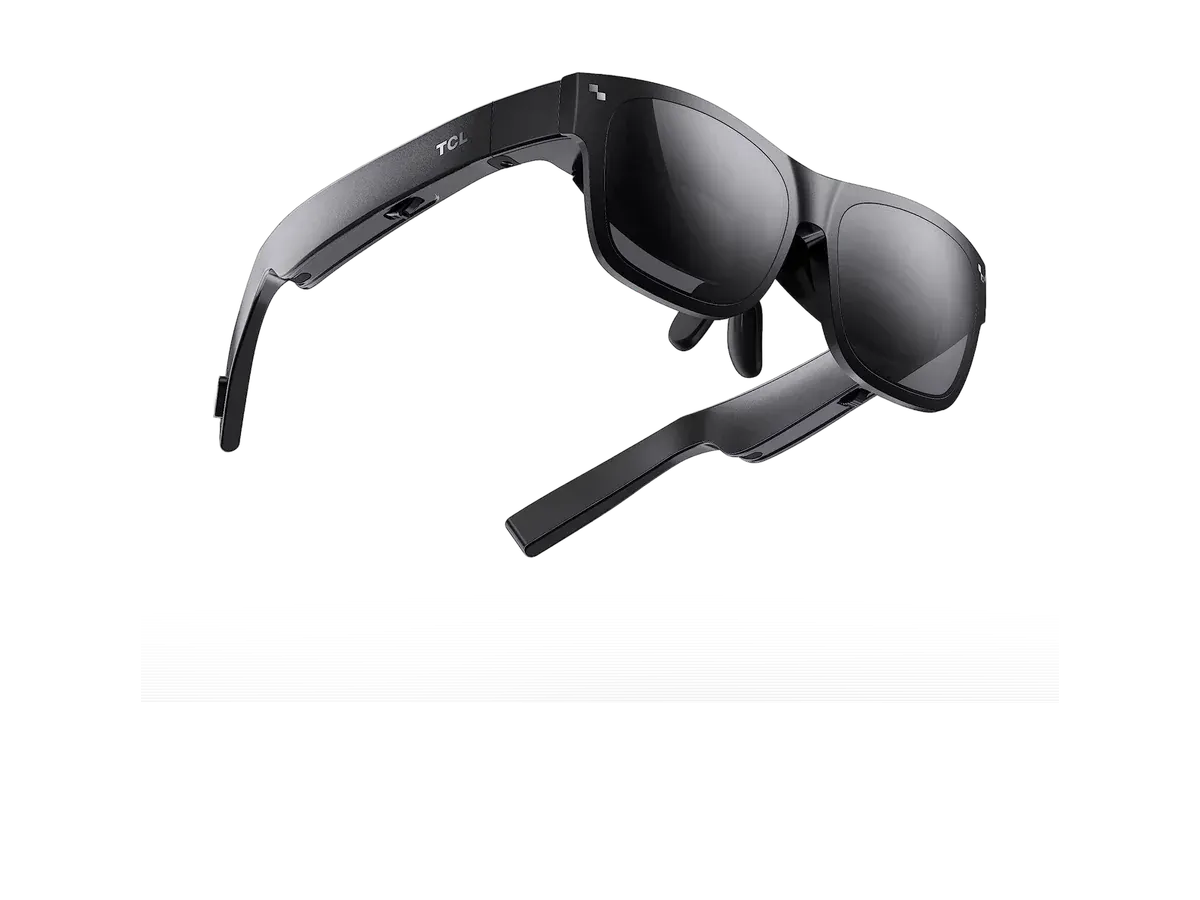
At a glance
- Display type
- Sony Micro-OLED
- Resolution
- 1920x1080
- Field of view
- 45°
- Refresh rate
- 60 Hz
- Brightness
- 400 nits
- Weight
- 89 g
- 49 PPD sharpness matches top-tier display glasses for text clarity
- Electrochromic dimming for adjustable ambient light control
- 60Hz refresh rate -- significantly behind 120Hz competitors for gaming
- 400 nits brightness trails most modern display glasses
TCL NxtWear S
TCL
6.3/10 “According to the aggregated consensus of reviewers, the TCL NxtWear S is a stylish 2023 experiment in personal-cinema glasses whose sharp Micro-OLED picture outlived the rest of the package. Popular Science praised the 1080p projection as particularly impressive yet still filed the device as an expensive novelty, MakeUseOf scored it 7.5/10 and hinged its appeal on which devices a buyer already owns, and How-To Geek's 6/10 put it plainly: 'they do video projection well, but most people shouldn't buy them.' Sore noses, thin audio, adapter hassles, and a 60Hz ceiling recur across the record, and TCL replaced it with the brighter 120Hz NXTWEAR S+ inside a year. In 2026 it makes sense only at a deep discount, never at the $399 list price. Scores below are an editorial aggregate of that cited coverage, not AR Compare hands-on measurements.” Read the full review$399
Check price at Amazon- Field of view
- 45°
- Weight
- 89 g
- Brightness
- 400 nits
The TCL NxtWear S is TCL's consumer display glasses released in mid-2023, featuring dual Sony Micro-OLED panels at 1080p per eye with a 45-degree field of view projecting a 130-inch virtual screen. With electrochromic dimming for adjustable tint levels, a compact foldable design, and 49 PPD for sharp text rendering, it targets entertainment and productivity users seeking a portable personal display. Note: TCL's RayNeo brand produces the newer Air-series display glasses.
Our review
By AR Compare Team ·
According to the aggregated consensus of reviewers, the TCL NxtWear S is a stylish 2023 experiment in personal-cinema glasses whose sharp Micro-OLED picture outlived the rest of the package. Popular Science praised the 1080p projection as particularly impressive yet still filed the device as an expensive novelty, MakeUseOf scored it 7.5/10 and hinged its appeal on which devices a buyer already owns, and How-To Geek's 6/10 put it plainly: 'they do video projection well, but most people shouldn't buy them.' Sore noses, thin audio, adapter hassles, and a 60Hz ceiling recur across the record, and TCL replaced it with the brighter 120Hz NXTWEAR S+ inside a year. In 2026 it makes sense only at a deep discount, never at the $399 list price. Scores below are an editorial aggregate of that cited coverage, not AR Compare hands-on measurements.
- Display quality
- 7.5/10
- Comfort
- 6/10
- Battery life
- 5/10
- Value for money
- 4.5/10
- Build quality
- 7/10
- Software
- 4.5/10
The TCL NxtWear S is a pair of tethered display glasses — a wearable external monitor, not a true AR headset — that TCL released in June 2023 at $399. Dual Sony Micro-OLED panels push a 1920x1080 per-eye picture through birdbath optics, the mirror-and-lens design most display glasses of that generation used, onto what reads as a 130-inch virtual screen. Nearly every TCL NxtWear S review in the 2023-24 record lands the same way: a genuinely good picture wrapped in dated everything else. This review aggregates that record: How-To Geek’s scored review, MakeUseOf’s scored review, Popular Science’s review, iMore’s long-term review, and Handheld Space’s handheld-gaming writeup. AR Compare has not performed hands-on testing of this device; every observation below is attributed to the cited sources, and the category scores are an editorial aggregate of cited reviewer sentiment. Product facts were cross-checked against AR Compare’s spec record for the NxtWear S (a recorded 45-degree field of view, a recorded 400 nits, a recorded 60Hz refresh rate, roughly 89 grams, $399).
How This Review Was Compiled
How-To Geek’s Tyler Hayes published the fullest US review, scoring it 6/10 after running it against multiple phones, a MacBook Air, and an iPad. MakeUseOf’s James Hirtz scored it 7.5/10 and dug deepest into the specs and the compatibility fine print. Popular Science’s Eric Alt judged it as a travel gadget, iMore’s Stephen Warwick reviewed it across weeks of travel with iPhones and iPads, and Handheld Space ran it against handheld gaming PCs like the Steam Deck. Where the sources disagree — mostly on comfort and on how much the picture’s limits matter — both readings are reported below rather than smoothed over.
The Picture: Why the NxtWear S Existed
The display is what every reviewer liked. Popular Science calls image and sound quality excellent, with the 1080p projection particularly impressive, and iMore’s reviewer describes being properly blown away by how good regular 2D shows and movies look. Handheld Space is the most vivid: “The colours pop, the blacks are deep, and it really does look like a big screen hovering a few metres away.” The sharpness comes from a recorded 49 pixels per degree — a density that keeps text and fine detail crisp — and AR Compare’s record also lists electrochromic dimming, lenses that tint electronically to darken the world behind the picture.
The limits drew just as much agreement. The recorded 400 nits is modest by later standards and suits indoor viewing, and the recorded 60Hz refresh rate reads as a real ceiling for gaming next to the 120Hz panels that arrived soon after. Popular Science found the see-through quality of the image a little distracting during movies, How-To Geek noted slight blurring around the top corners, and Handheld Space could never get the image perfectly aligned to the reviewer’s eyes. None of these complaints overturns the consensus that the picture is the product’s best argument; they explain why the argument only goes so far.
Comfort: The Record Splits at the Hour Mark
On paper the recorded 89 grams sits mid-pack, and MakeUseOf judged the weight light enough that fatigue never really registers. Worn for a while, the record turns. iMore’s reviewer reported a sore nose before a single 47-minute TV episode had finished, How-To Geek describes discomfort around the ears and nose creeping in near the hour mark, and Handheld Space mentions a slight pinch, creaking temples, and warmth after about half an hour — MakeUseOf logged heat in long sessions too. So comfort is a genuine split: fine in short sittings, wearing over a movie’s full length. The frame folds flat for travel, the magnetic USB-C cable snaps on cleverly, and that cable adds about 30 grams to the carry weight per AR Compare’s record. Prescription support is a quiet strength: inserts are supported in the spec record, and Handheld Space’s reviewer had custom corrective lenses made and used them successfully.
Audio: Quiet to Neighbors, Thin to You
The speaker story has one clever trick and one flat consensus. MakeUseOf credits the dual speakers’ phase-cancellation design with significantly reducing sound leakage, so seatmates hear little of what you play. What reaches your own ears is the weakness: iMore calls the sound very shallow and thin, bearable for dialogue-heavy shows but a poor match for anything cinematic, and recommends pairing noise-canceling earbuds instead. Handheld Space additionally hit occasional static and popping that broke immersion. Reviewers converge on the same advice — treat the built-in speakers as a fallback, not the plan.
Compatibility: What the NxtWear S Actually Plugs Into
This is where the record gets conditional. MakeUseOf puts it directly: compatibility centers on owning a USB-C device with DisplayPort Alt Mode. Laptops are the happy path — How-To Geek’s MacBook Air picked the glasses up instantly as a second display, and Popular Science reports the same immediate handshake. Handheld Space found they work fine with laptops, some Android phones, and handhelds like the Steam Deck and ROG Ally, which matches the compatibility list in AR Compare’s record. Everything else took dongles in 2023: an adapter for iPhones of that era, another for the Nintendo Switch, and an extra purchase for phones without DisplayPort output such as Google’s Pixels. Software was the sorest point. How-To Geek’s reviewer churned through three phones before the TCL AR companion app worked on a fourth, and iMore notes the 3D extras were Android-first, leaving iPhone owners with plain mirroring. There is no onboard battery — the glasses draw power from the host device over the cable, and iMore points out they occupy and drain the phone’s only port — so the battery score of 5 follows this site’s category convention for tethered display glasses rather than a standalone runtime.
Where the NxtWear S Stands in 2026
Honestly: superseded, twice over, mostly by TCL itself. In early 2024 TCL shipped the NXTWEAR S+, which per AR Compare’s record moved to 120Hz, raised brightness to 600 nits, trimmed the weight slightly, and now lists at $250 — the side-by-side comparison itemizes the gap. Since then TCL’s consumer display-glasses effort has carried the RayNeo badge, and a current pick like the RayNeo Air 3s Pro delivers 1,200 nits and 120Hz for $299 in AR Compare’s record. Against that field, the original NxtWear S survives only as clearance stock, and Handheld Space’s summary — not awful, just not quite ready for prime time — was written before either successor existed. The consensus follows the hardware: nothing here is broken, but every reason to buy it now depends on a steep discount.
Value
At $399 the aggregate was already unenthusiastic in 2023, and time has not helped. How-To Geek called the glasses largely a novelty at that price and argued the conversation would change only if it fell closer to $150; Popular Science reached the same shelf, filing the device as an expensive novelty that early adopters would enjoy and most people should wait out. MakeUseOf’s friendlier 7.5/10 came with the caveat that value hinges entirely on already owning the right USB-C hardware. With TCL’s own NXTWEAR S+ listing $149 less in AR Compare’s record, the value case at full price has effectively closed.
Who Should Buy the TCL NxtWear S
Per the aggregated consensus: bargain hunters who find it well below list price and want a sharp, private movie screen for a laptop, Mac, or Steam Deck; travelers who mostly watch dialogue-light content in short sittings and already own good earbuds; and prescription wearers drawn by workable corrective-lens inserts. Who should skip: gamers, for whom the recorded 60Hz trails every 120Hz successor; anyone shopping at or near the $399 list price, since TCL’s own NXTWEAR S+ is newer and cheaper; phone-first buyers whose devices lack USB-C DisplayPort output; viewers sensitive to nose or ear pressure over feature-length sessions; and anyone counting on the built-in speakers for more than dialogue.
Scores are aggregates of the cited reviews and hands-on reports, not AR Compare hands-on results.
Sources
- How-To Geek — TCL NXTWEAR S Review: Smart Glasses With Simple Vision
- MakeUseOf — TCL NXTWEAR S Review: Affordable, Compact Portable XR Display
- Popular Science — TCL NXTWEAR S XR glasses review: A smart wearable with an emphasis on wearability
- iMore — TCL NXTWEAR S review: Fun and futuristic, but not without drawbacks
- Handheld Space — TCL Nextwear S review
Pros & cons
Pros
- 49 PPD sharpness matches top-tier display glasses for text clarity
- Electrochromic dimming for adjustable ambient light control
- Compact foldable design with magnetic USB-C cable attachment
- Phase cancellation speakers reduce sound leakage to others
- 100,000:1 contrast ratio for deep blacks
- A 1080p Micro-OLED picture reviewers call excellent, with colors that pop and deep blacks on the 130-inch virtual screen
- Plug-and-play second-display duty on Macs and laptops, working instantly over one USB-C cable per multiple reviewers
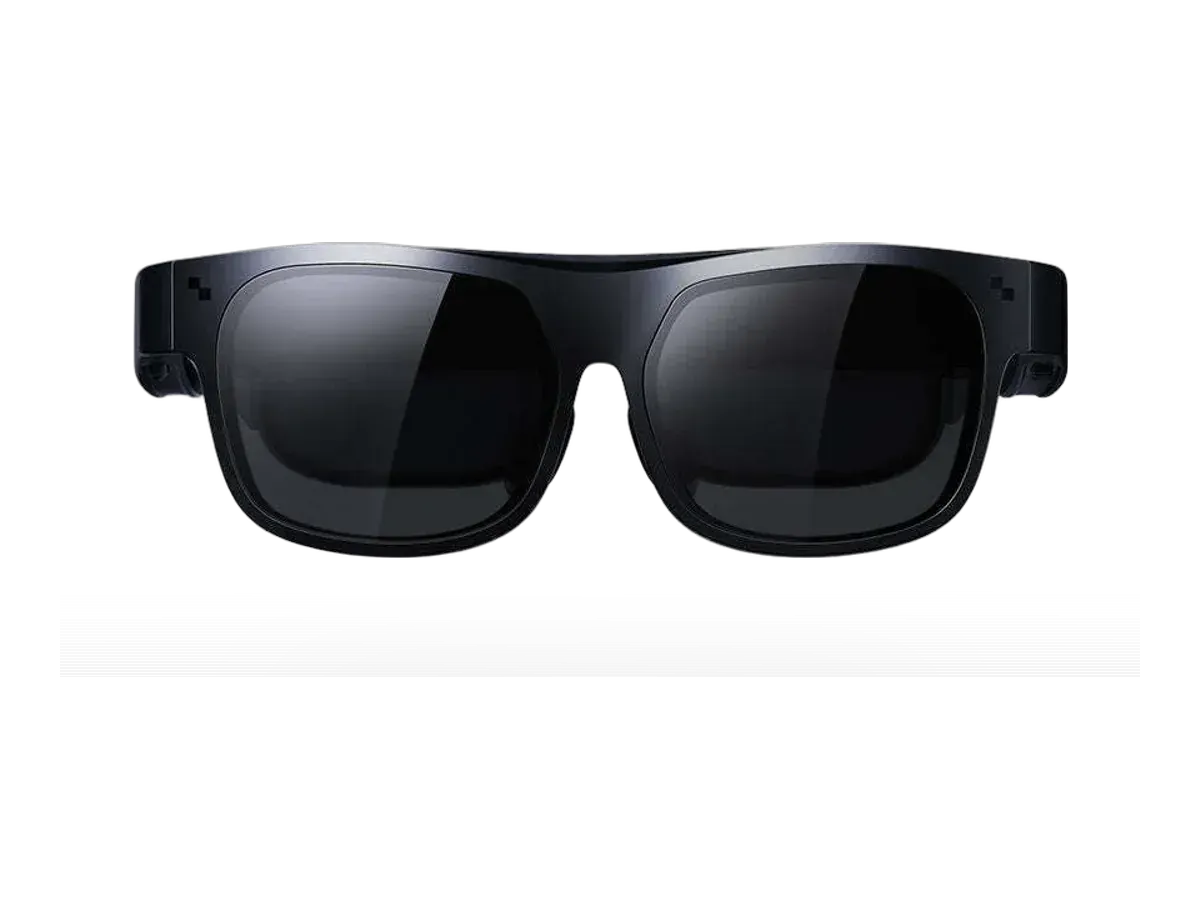
- A design reviewers say passes for ordinary sunglasses, hiding the tech well enough to wear in public
- Prescription inserts are supported, and one reviewer wore the glasses with custom-made corrective lenses
Cons
- 60Hz refresh rate -- significantly behind 120Hz competitors for gaming
- 400 nits brightness trails most modern display glasses
- 89g weight is heavier than newer competitors
- Magnetic cable adds 30g to total carry weight
- Open-ear speaker audio quality is thin and shallow per reviewer consensus
- Comfort complaints recur, with sore noses and ear pressure reported inside the first hour of viewing
- Phones need USB-C DisplayPort Alt Mode, and iPhones and consoles of its era needed separate adapters
- The companion app frustrated testers, failing on multiple phones, and 3D extras were Android-first
- Superseded in TCL's own lineup within a year by the brighter, faster NXTWEAR S+
Full specifications
Specs last verified
| Display | |
|---|---|
| Display type | Sony Micro-OLED |
| Resolution | 1920x1080 |
| Pixels per degree | 49 |
| Field of view (°) | 45 |
| Refresh rate (Hz) | 60 |
| Brightness (nits) | 400 |
| Virtual screen size (in) | 130 |
| HDR support | ✕ No |
| Color support | Full color |
| Optics | |
| Optics type | birdbath |
| Dimming control | ✓ Yes |
| Transparency level | electrochromic (adjustable tint) |
| Prescription support | ✓ Yes |
| Prescription options | Inserts / lens frame via Lensology, £79 GBP at partner |
| Physical | |
| Weight (g) | 89 |
| Frame style | wraparound |
| Color options | Dark Gray |
| Foldable | ✓ Yes |
| Not published: IP rating | |
| Battery & power | |
| Charging method | USB-C (powered by connected device) |
| Not published: Battery life, Charging time | |
| Connectivity | |
| Connectivity | USB-C |
| Tethered | ✓ Yes |
| Compatible devices | Android, iOS, PC, Mac, Steam Deck, ROG Ally, PlayStation, Xbox, Nintendo Switch |
| Computing | |
| Processing type | tethered |
| Not published: Operating system, Chipset | |
| Sensors & input | |
| Camera | ✕ No |
| Microphones | 2 |
| Speakers | open-ear |
| Not published: Tracking, Gesture control, Voice control | |
Prescription options
The documented prescription routes for the TCL NxtWear S, from the maker and named-partner documentation recorded in our database.
- Inserts / lens frame via Lensology, £79 GBP at partner — range not published by the maker Source: rayneo.com documentation
Maker documentation as recorded 2026-09-17. Ranges are the maker's published limits, not medical advice — confirm your exact prescription with your optician before ordering.
Where to buy
TCL NxtWear S specs: quick answers
- What is the TCL NxtWear S's field of view?
- The TCL NxtWear S has a 45-degree field of view.
- What is the TCL NxtWear S's display resolution?
- The TCL NxtWear S's recorded per-eye display resolution is 1920x1080.
- How bright is the TCL NxtWear S's display?
- The TCL NxtWear S has a rated peak brightness of 400 nits.
- How much does the TCL NxtWear S weigh?
- The TCL NxtWear S's glasses weigh 89g according to the manufacturer specification.
- How much does the TCL NxtWear S cost?
- The TCL NxtWear S costs $399.
TCL NxtWear S: FAQs
How much does the TCL NxtWear S cost?
The TCL NxtWear S costs $399 (USD). It is available from 1 retailer listed on this page.
What field of view does the TCL NxtWear S have?
The TCL NxtWear S has a recorded field of view of 45 degrees.
How much does the TCL NxtWear S weigh?
The TCL NxtWear S weighs 89g according to the manufacturer specification.
Can I use the TCL NxtWear S with prescription lenses?
Yes, the TCL NxtWear S supports prescription lenses. The recorded diopter range is Prescription inserts available.
What devices work with the TCL NxtWear S?
The TCL NxtWear S lists compatibility with: Android, iOS, PC, Mac, Steam Deck, ROG Ally, PlayStation, Xbox.
What resolution does the TCL NxtWear S have?
The TCL NxtWear S has a recorded per-eye resolution of 1920x1080. It refreshes at 60Hz.
Are the TCL NxtWear S good for gaming?
The TCL NxtWear S runs at a recorded 60Hz refresh rate with a 45-degree field of view -- the display specs that matter most for gaming. It is tethered, drawing video from a connected phone, PC, or console rather than running games on its own.
Is the TCL NxtWear S worth it?
The TCL NxtWear S is priced at $399 (USD). For that you get a 45-degree field of view, 400 nits of brightness, and a 1920x1080 per-eye resolution. It weighs 89g. It is tethered, so it needs a connected phone, PC, or console to run rather than working on its own. The full spec breakdown on this page shows what the price includes.
Similar products
What shoppers cross-check with the TCL NxtWear S — from our navigation records and closest spec matches.
Ranked in these buying guides
Where the TCL NxtWear S lands in our recorded-spec rankings.
- Best AR Glasses for Gaming
- Best AR Glasses for Steam Deck
- Best AR Glasses for Movies & Travel
- Best AR Glasses for Productivity & Multi-Monitor Work
- Best AR Glasses for iPhone Users
- Prescription Smart Glasses
- The Best Smart Glasses of 2026
- Smart Glasses With a Display
- Lightest Smart Glasses
- Monitor Glasses: AR Glasses That Replace a Screen
- Best AR Glasses for Mac & MacBook
- Best AR Glasses for PC & Windows
- Best AR Glasses for Android Phones & Samsung DeX
- Best AR Glasses for Nintendo Switch
- Best AR Glasses for PS5
- Best AR Glasses for Xbox Series X & S
- Best AR Glasses for ROG Ally & Ally X
- Widest FOV AR Glasses
- Brightest Smart Glasses
Related Comparisons
TCL NxtWear S vs XREAL Air 2 Pro
TCL vs XREAL
TCL NxtWear S vs RayNeo Air 2
TCL vs RayNeo
TCL NxtWear S vs Rokid Max
TCL vs Rokid
TCL NxtWear S vs VITURE One Lite
TCL vs VITURE
TCL NxtWear S vs INAIR 2 Pro
TCL vs INAIR
TCL NxtWear S vs ASUS AirVision M1
TCL vs ASUS
TCL NxtWear S vs ASUS ROG XREAL R1
TCL vs ASUS
TCL NxtWear S vs Dream Glass Flow
TCL vs Dreamworld
TCL NxtWear S vs GOOVIS G3 Max 3D Head Mounted Display
TCL vs Goovis
TCL NxtWear S vs Lenovo Legion Glasses 2
TCL vs Lenovo
TCL NxtWear S vs RayNeo Air 3s Pro AR/XR Glasses
TCL vs RayNeo
TCL NxtWear S vs RayNeo Air 3s
TCL vs RayNeo
TCL NxtWear S vs RayNeo Air 4 Pro
TCL vs RayNeo
TCL NxtWear S vs RayNeo GT Max
TCL vs RayNeo
TCL NxtWear S vs RayNeo GT
TCL vs RayNeo
TCL NxtWear S vs Rokid Max 2
TCL vs Rokid
TCL NxtWear S vs Rokid Station 2 Spatial Computing Host
TCL vs Rokid
TCL NxtWear S vs Shadow Creator Honghu MR
TCL vs Shadow Creator
TCL NxtWear S vs TCL NXTWEAR S+ AR Glasses
TCL
TCL NxtWear S vs VITURE Beast XR Glasses
TCL vs VITURE
TCL NxtWear S vs VITURE Luma Pro
TCL vs VITURE
TCL NxtWear S vs VITURE Luma Ultra XR/AR Glasses
TCL vs VITURE
TCL NxtWear S vs VITURE Luma XR
TCL vs VITURE
TCL NxtWear S vs VITURE One XR Glasses
TCL vs VITURE
TCL NxtWear S vs VITURE Pro 2 XR Glasses
TCL vs VITURE
TCL NxtWear S vs VITURE Pro XR
TCL vs VITURE
TCL NxtWear S vs XREAL 1S
TCL vs XREAL
TCL NxtWear S vs XREAL Air 2
TCL vs XREAL
TCL NxtWear S vs XREAL Air 2 Ultra
TCL vs XREAL
TCL NxtWear S vs XREAL Beam
TCL vs XREAL
TCL NxtWear S vs XREAL One
TCL vs XREAL
TCL NxtWear S vs XREAL One Pro
TCL vs XREAL
TCL NxtWear S vs XREAL xbx a01+
TCL vs XREAL