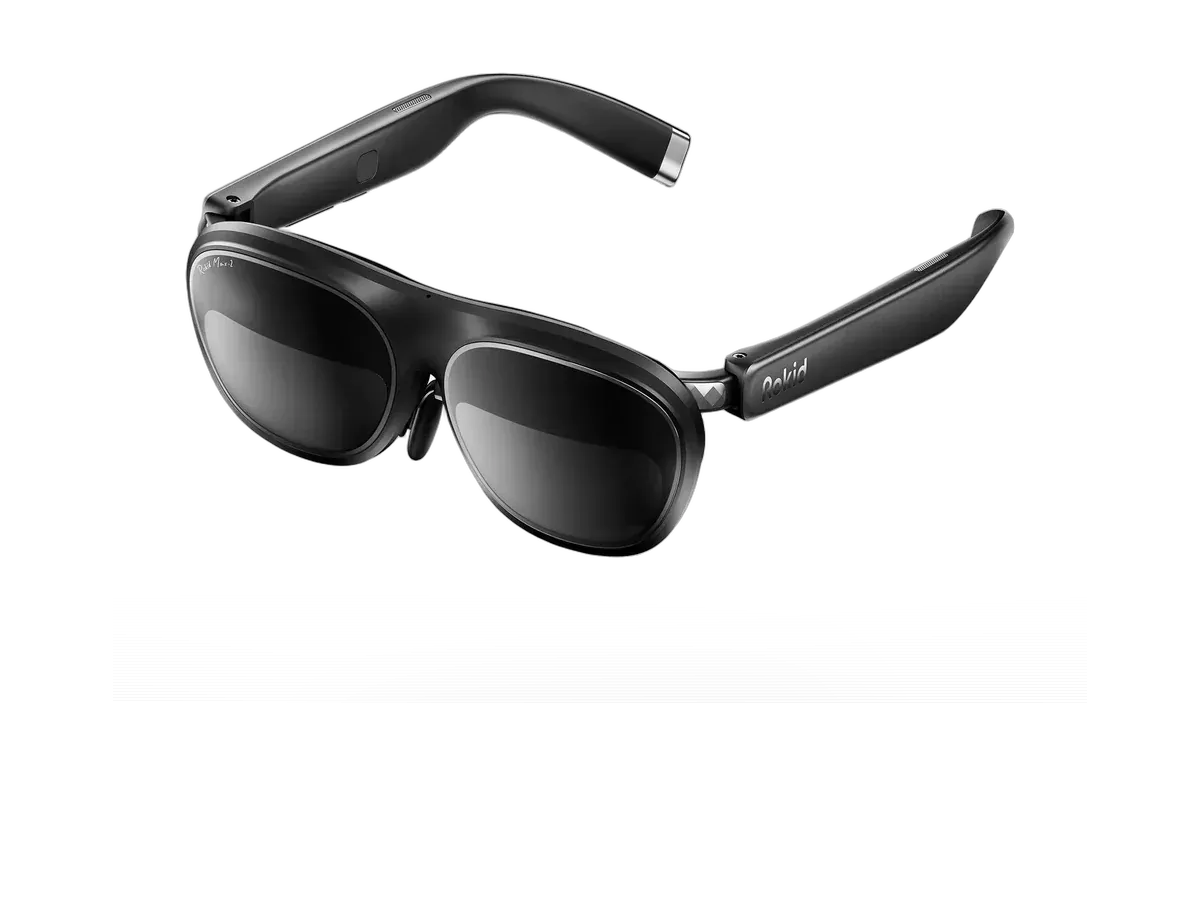
At a glance
- Display type
- Sony 0.68" Micro-OLED
- Resolution
- 1920x1200
- Field of view
- 50°
- Refresh rate
- 120 Hz
- Brightness
- 600 nits
- Weight
- 75 g
- Largest virtual screen in category at 215 inches
- 50-degree FOV wider than most display glasses competitors
- 600 nits brightness trails newer models (RayNeo 1200 nits, VITURE 4000 nits)
- No HDR10 or HDR support of any kind
Rokid Max 2
Rokid
7.6/10 “The aggregated consensus positions the Rokid Max 2 as the comfort-and-eyesight pick of the wired display glasses field. Its per-eye 0 to -6.00D diopter dials are the feature reviewers keep calling a genuine category advantage, the 215-inch virtual screen earns consistent praise for movies, and at 75 grams testers repeatedly report full-film sessions without fatigue. The equally consistent criticisms: IPD alignment is gated behind the paid Station 2 accessory, edge blur limits productivity use, brightness tops out at 600 nits, and Rokid's software execution trails its hardware. Owners' advice is to buy it on discount as a travel cinema for nearsighted eyes -- and to look elsewhere for desktop-replacement ambitions.” Read the full review$429
Check price at Amazon- Field of view
- 50°
- Weight
- 75 g
- Brightness
- 600 nits
The Rokid Max 2 is Rokid's flagship display glasses featuring dual Sony 0.68-inch Micro-OLED displays delivering a massive 215-inch virtual screen -- the largest in the consumer display glasses category. With a 50-degree field of view, 1080p per eye at 120Hz, and built-in diopter adjustment from 0 to -6.0D, it combines impressive screen size with practical accessibility. Unveiled at IFA Berlin 2024.
Our review
By AR Compare Team ·
The aggregated consensus positions the Rokid Max 2 as the comfort-and-eyesight pick of the wired display glasses field. Its per-eye 0 to -6.00D diopter dials are the feature reviewers keep calling a genuine category advantage, the 215-inch virtual screen earns consistent praise for movies, and at 75 grams testers repeatedly report full-film sessions without fatigue. The equally consistent criticisms: IPD alignment is gated behind the paid Station 2 accessory, edge blur limits productivity use, brightness tops out at 600 nits, and Rokid's software execution trails its hardware. Owners' advice is to buy it on discount as a travel cinema for nearsighted eyes -- and to look elsewhere for desktop-replacement ambitions.
- Display quality
- 8/10
- Comfort
- 8.5/10
- Battery life
- 5.5/10
- Value for money
- 7.5/10
- Build quality
- 7.5/10
- Software
- 6/10
The Rokid Max 2 is Rokid’s flagship tethered display glasses, and the crowdsourced record around it — professional reviews from Serious Insights, AndroidGuys, MMORPG.com, and Basic Tutorials, plus Kickstarter-backer and forum owner reports — paints one of the most internally consistent pictures in the category. This review aggregates that record. AR Compare has not performed hands-on testing of this unit; all observations below are attributed to the cited sources, and the category scores are an editorial aggregate of cited reviewer and owner sentiment.
How This Review Was Compiled
Sources include launch and long-term reviews, an AppleInsider forum ownership discussion, and backer feedback from Rokid’s Kickstarter campaign surfaced in review coverage. The consensus and the complaints below recur across nearly all of them.
The Diopter Dials: The Reason This Product Gets Recommended
The Max 2’s defining feature is real-time sharpness adjustment from 0.00 to -6.00 diopters via small rotary controls above each lens, set independently per eye. Reviewers call the integrated diopter compensation “a real game changer in this product category”: anyone nearsighted up to -6D can use the glasses fully with no insert lenses to order, swap, or lose. Basic Tutorials found the adjustment worked smoothly with no visible distortion. The caveats: farsighted users and astigmatism still need insert solutions, and the dials make the Max 2 especially attractive for shared or multi-user households — a point several reviewers raise as a differentiator even against VITURE, whose dials stop at -4.0D or -6.0D depending on model.
Display and Comfort
The dual Sony 0.68-inch Micro-OLED panels (1920x1080 per eye, up to 120Hz, roughly 50-degree FOV) project one of the largest virtual screens in the category at a claimed 215 inches. The center-of-screen experience draws real enthusiasm: deep blacks, vibrant colors, fluid motion — “movies look fantastic,” in the aggregate phrasing, especially with the included blackout cover. AndroidGuys titled its review “A Stunning Visual Experience.”
Comfort is the other consensus strength. At 75 grams with revised nose pads and balanced weight, testers report watching a full feature film without significant eye fatigue or pressure, and one reviewer wore them through a 3-hour flight without issues. Serious Insights’ framing — better as a media-consumption companion than a work display — has become the standard shorthand for this product.
Pain Points Owners Report
The IPD paywall. The most pointed complaint in the record: software IPD adjustment requires the separately sold Station 2. Without it, owners whose interpupillary distance departs from the default have no way to align the displays. Reviewers uniformly argue this should be built in, not sold as an accessory.
Edge blur. The birdbath optics are excellent only where they align perfectly with your eyes. Blurry corners impact fast-paced games and make spreadsheets, reading, and multitasking hit-or-miss. Owners looking for a laptop-monitor replacement consistently come away disappointed.
Brightness and audio. The 600-nit ceiling with manual dimming limits bright-light use, occasional birdbath reflections persist, and the built-in speakers sound thin and leak at louder volumes.
Software. A Rokid Air owner who backed the Max 2 concluded that as a standalone experience the Max 2 falls short “not due to hardware, but subpar software execution,” with little value beyond tethered video and Switch/Steam Deck gaming unless you add the Station 2 — and early backers hit DRM problems that kept Netflix off the Station 2 at launch. An AppleInsider forum reviewer’s takeaway matches: hardware shines, software needs polish, and weak ecosystem integration hurts daily-carry appeal. There is also a design quirk: the solid lower frame blocks your downward glance at a keyboard or desk.
No battery. Like all wired display glasses, the Max 2 draws power from the host device; phone users should plan for faster drain or a power bank.
Value
At its $359-$529 range (list prices have varied by region and bundle), the consensus is conditional: at frequently seen discount prices it is an easy recommendation as a portable cinema, particularly for nearsighted buyers; at full list with a Station 2 added, it competes against the XREAL 1S and VITURE Luma line, where its software gap shows.
Who Should Buy the Rokid Max 2
Per the aggregated record: nearsighted media watchers (0 to -6D) who want zero-insert convenience, travelers who prize comfort for long viewing sessions, and households sharing one pair among multiple users. Who should skip: productivity buyers who need edge-to-edge text clarity, anyone unwilling to pay extra for the Station 2 to unlock IPD alignment, and buyers wanting a polished standalone software ecosystem — XREAL’s X1-chip models remain the crowd’s pick there.
Scores are aggregates of the cited reviews and owner reports, not AR Compare hands-on measurements.
Sources
- Serious Insights — Rokid Max 2 AR Glasses Review: Better as Media Consumption Companion Than a Work Display
- AndroidGuys — Rokid Max 2 AR Glasses Review: A Stunning Visual Experience
- Basic Tutorials — Rokid Max 2 Review: AR glasses with micro OLED displays tried out
- MMORPG.com — Rokid Max 2 AR Glasses Review: Is it Worth the Purchase Without the Station 2?
- AppleInsider Forums — Rokid Max 2 AR Glasses review: Hardware shines, software needs polish (owner discussion)
- WhatGear — Rokid Max 2 & Rokid Station: 5 things you need to know
Pros & cons
Pros
- Largest virtual screen in category at 215 inches
- 50-degree FOV wider than most display glasses competitors
- Built-in 0 to -6.0D diopter adjustment -- no inserts needed
- Lightest in class at just 75g with comfortable ergonomics
- Two color options: Night Black and Dawn Silver
- Comfortable pick for flights and travel per multiple long-session reports
Cons
- 600 nits brightness trails newer models (RayNeo 1200 nits, VITURE 4000 nits)
- No HDR10 or HDR support of any kind
- Single pinhole microphone -- limited call quality
- Basic HiFi speakers without premium audio tuning
- No electrochromic dimming -- no light blocking control
- Software IPD adjustment is locked behind the separately sold Station 2 accessory
- Birdbath optics blur at the edges, hurting spreadsheets and UI-heavy work
- Thin-sounding speakers that leak audio at volume
- Owners report software polish and ecosystem integration lag the hardware, including early Netflix DRM issues on Station 2
Full specifications
Specs last verified
| Display | |
|---|---|
| Display type | Sony 0.68" Micro-OLED |
| Resolution | 1920x1200 |
| Pixels per degree | 38 |
| Field of view (°) | 50 |
| Refresh rate (Hz) | 120 |
| Brightness (nits) | 600 |
| Virtual screen size (in) | 215 |
| HDR support | ✕ No |
| Color support | Full color |
| Optics | |
| Optics type | birdbath |
| Dimming control | ✓ Yes |
| Prescription support | ✓ Yes |
| Prescription options | Built-in dials, -6.00 to 0.00 · Inserts / lens frame |
| Not published: Transparency level | |
| Physical | |
| Weight (g) | 75 |
| Frame style | wraparound |
| Color options | Night Black, Dawn Silver |
| Foldable | ✓ Yes |
| Not published: IP rating | |
| Battery & power | |
| Charging method | USB-C (powered by connected device) |
| Not published: Battery life, Charging time | |
| Connectivity | |
| Connectivity | USB-C |
| Tethered | ✓ Yes |
| Compatible devices | Android, iOS, PC, Mac, Steam Deck, ROG Ally, Nintendo Switch, PlayStation, Xbox |
| Computing | |
| Processing type | tethered |
| Operating system | None standalone; YodaOS-Master via Rokid Station 2 |
| Chipset | None (tethered display glasses) |
| Sensors & input | |
| Camera | ✕ No |
| Microphones | 1 |
| Speakers | directional |
| Not published: Tracking, Gesture control, Voice control | |
Prescription options
The documented prescription routes for the Rokid Max 2, from the maker and named-partner documentation recorded in our database.
- Built-in dials, -6.00 to 0.00 Source: global.rokid.com documentation
- Inserts / lens frame — range not published by the maker Source: global.rokid.com documentation
Maker documentation as recorded 2026-09-17. Ranges are the maker's published limits, not medical advice — confirm your exact prescription with your optician before ordering.
Read the Rokid prescription guide for every documented option, model by model.
Where to buy
Price verified
Rokid Max 2 specs: quick answers
- What is the Rokid Max 2's field of view?
- The Rokid Max 2 has a 50-degree field of view.
- What is the Rokid Max 2's display resolution?
- The Rokid Max 2's recorded per-eye display resolution is 1920x1200.
- How bright is the Rokid Max 2's display?
- The Rokid Max 2 has a rated peak brightness of 600 nits.
- How much does the Rokid Max 2 weigh?
- The Rokid Max 2's glasses weigh 75g according to the manufacturer specification.
- How much does the Rokid Max 2 cost?
- The Rokid Max 2 costs $429.
Rokid Max 2: FAQs
How much does the Rokid Max 2 cost?
The Rokid Max 2 costs $429 (USD). It is available from 2 retailers listed on this page.
What field of view does the Rokid Max 2 have?
The Rokid Max 2 has a recorded field of view of 50 degrees.
How much does the Rokid Max 2 weigh?
The Rokid Max 2 weighs 75g according to the manufacturer specification.
Can I use the Rokid Max 2 with prescription lenses?
Yes, the Rokid Max 2 supports prescription lenses. The recorded diopter range is 0.00 to -6.00.
What devices work with the Rokid Max 2?
The Rokid Max 2 lists compatibility with: Android, iOS, PC, Mac, Steam Deck, ROG Ally, Nintendo Switch, PlayStation.
What resolution does the Rokid Max 2 have?
The Rokid Max 2 has a recorded per-eye resolution of 1920x1200. It refreshes at 120Hz.
Are the Rokid Max 2 good for gaming?
The Rokid Max 2 runs at a recorded 120Hz refresh rate with a 50-degree field of view -- the display specs that matter most for gaming. It is tethered, drawing video from a connected phone, PC, or console rather than running games on its own.
Is the Rokid Max 2 worth it?
The Rokid Max 2 is priced at $429 (USD). For that you get a 50-degree field of view, 600 nits of brightness, and a 1920x1200 per-eye resolution. It weighs 75g. It is tethered, so it needs a connected phone, PC, or console to run rather than working on its own. The full spec breakdown on this page shows what the price includes.
Similar products
What shoppers cross-check with the Rokid Max 2 — from our navigation records and closest spec matches.
Ranked in these buying guides
Where the Rokid Max 2 lands in our recorded-spec rankings.
- Best AR Glasses for Gaming
- Best AR Glasses for Steam Deck
- Best AR Glasses for Movies & Travel
- Best AR Glasses for Productivity & Multi-Monitor Work
- Best AR Glasses for iPhone Users
- Prescription Smart Glasses
- The Best Smart Glasses of 2026
- Smart Glasses With a Display
- Lightest Smart Glasses
- Monitor Glasses: AR Glasses That Replace a Screen
- Best AR Glasses for Mac & MacBook
- Best AR Glasses for PC & Windows
- Best AR Glasses for Android Phones & Samsung DeX
- Best AR Glasses for Nintendo Switch
- Best AR Glasses for PS5
- Best AR Glasses for Xbox Series X & S
- Best AR Glasses for ROG Ally & Ally X
- Widest FOV AR Glasses
- Brightest Smart Glasses
Related Comparisons
Rokid Max 2 vs RayNeo Air 4 Pro
Rokid vs RayNeo
Rokid Max 2 vs XREAL One Pro
Rokid vs XREAL
Rokid Max 2 vs VITURE Luma XR
Rokid vs VITURE
Rokid Max 2 vs XREAL One
Rokid vs XREAL
Rokid Max 2 vs Rokid Max
Rokid
Rokid Max 2 vs VITURE Pro XR
Rokid vs VITURE
Rokid Max 2 vs XREAL 1S
Rokid vs XREAL
Rokid Max 2 vs RayNeo Air 3s
Rokid vs RayNeo
Rokid Max 2 vs Lenovo Legion Glasses 2
Rokid vs Lenovo
Rokid Max 2 vs INAIR 2 Pro
Rokid vs INAIR
Rokid Max 2 vs XREAL Air 2 Pro
Rokid vs XREAL
Rokid Max 2 vs VITURE One Lite
Rokid vs VITURE
Rokid Max 2 vs VITURE Luma Pro
Rokid vs VITURE
Rokid Max 2 vs ASUS AirVision M1
Rokid vs ASUS
Rokid Max 2 vs ASUS ROG XREAL R1
Rokid vs ASUS
Rokid Max 2 vs Dream Glass Flow
Rokid vs Dreamworld
Rokid Max 2 vs GOOVIS G3 Max 3D Head Mounted Display
Rokid vs Goovis
Rokid Max 2 vs RayNeo Air 2
Rokid vs RayNeo
Rokid Max 2 vs RayNeo Air 3s Pro AR/XR Glasses
Rokid vs RayNeo
Rokid Max 2 vs RayNeo GT Max
Rokid vs RayNeo
Rokid Max 2 vs RayNeo GT
Rokid vs RayNeo
Rokid Max 2 vs Rokid Station 2 Spatial Computing Host
Rokid
Rokid Max 2 vs Shadow Creator Honghu MR
Rokid vs Shadow Creator
Rokid Max 2 vs TCL NxtWear S
Rokid vs TCL
Rokid Max 2 vs TCL NXTWEAR S+ AR Glasses
Rokid vs TCL
Rokid Max 2 vs VITURE Beast XR Glasses
Rokid vs VITURE
Rokid Max 2 vs VITURE Luma Ultra XR/AR Glasses
Rokid vs VITURE
Rokid Max 2 vs VITURE One XR Glasses
Rokid vs VITURE
Rokid Max 2 vs VITURE Pro 2 XR Glasses
Rokid vs VITURE
Rokid Max 2 vs XREAL Air 2
Rokid vs XREAL
Rokid Max 2 vs XREAL Air 2 Ultra
Rokid vs XREAL
Rokid Max 2 vs XREAL Beam
Rokid vs XREAL
Rokid Max 2 vs XREAL xbx a01+
Rokid vs XREAL