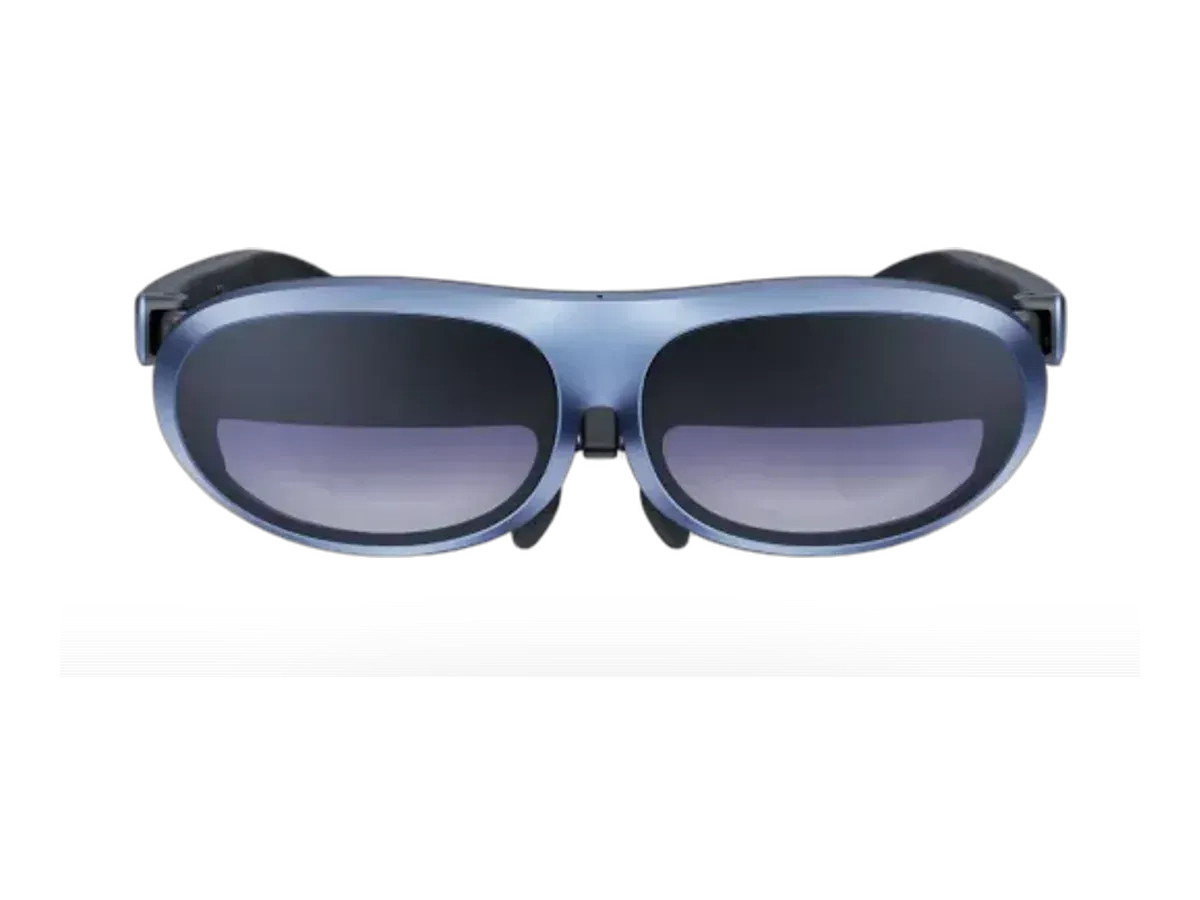
At a glance
- Display type
- Sony Micro-OLED
- Resolution
- 1920x1080
- Field of view
- 50°
- Refresh rate
- 120 Hz
- Brightness
- 600 nits
- Weight
- 75 g
- Excellent value at its ~$159 closeout price while stock lasted
- Same 50-degree FOV and 215-inch virtual screen as the newer Max 2
- Only one color option (Space Blue) vs Max 2's two options
- 600 nits brightness trails newer models from RayNeo and VITURE
Rokid Max
Rokid
7.4/10 “According to owners and reviewers who have lived with it since 2023, the Rokid Max is an excellent wearable display and a poor AR device -- and that distinction defines the buying decision. XDA's framing stuck: not quite AR, but a wearable 215-inch screen is still awesome. Movies, flights, Switch and Steam Deck sessions, and cloud gaming are where it earns its keep, helped by built-in diopter dials that no rival offered at its price. Blurry edges, modest brightness, and a software ecosystem that never matured are the recurring gripes. With the Max 2 now shipping, the aggregate advice is simple: the original Max is only worth buying heavily discounted -- and at those prices, it is one of the best value plays in the category.” Read the full review$159
See current alternatives- Field of view
- 50°
- Weight
- 75 g
- Brightness
- 600 nits
The Rokid Max is Rokid's first-generation consumer display glasses, launched in March 2023 with dual Sony Micro-OLED panels delivering a 215-inch virtual screen at 50 degrees field of view. Featuring 1080p per eye resolution at 120Hz, built-in diopter adjustment from 0 to -6.0D, and a lightweight 75g design, it established the template that the Max 2 later refined. Originally priced at $439, it has since been discounted to around $159.
Succeeded by Rokid Max 2 — a newer model is available.
Our review
By AR Compare Team ·
According to owners and reviewers who have lived with it since 2023, the Rokid Max is an excellent wearable display and a poor AR device -- and that distinction defines the buying decision. XDA's framing stuck: not quite AR, but a wearable 215-inch screen is still awesome. Movies, flights, Switch and Steam Deck sessions, and cloud gaming are where it earns its keep, helped by built-in diopter dials that no rival offered at its price. Blurry edges, modest brightness, and a software ecosystem that never matured are the recurring gripes. With the Max 2 now shipping, the aggregate advice is simple: the original Max is only worth buying heavily discounted -- and at those prices, it is one of the best value plays in the category.
- Display quality
- 8/10
- Comfort
- 8/10
- Battery life
- 5.5/10
- Value for money
- 8/10
- Build quality
- 7.5/10
- Software
- 6/10
Launched in March 2023, the Rokid Max is one of the longest-lived products in the display glasses category, which means the crowdsourced record on it is unusually mature: launch reviews from XDA, PhoneArena, and Dexerto, plus years of long-term owner commentary. This review aggregates that record. AR Compare has not performed hands-on testing of this unit; all observations are attributed to the cited sources, and the category scores are an editorial aggregate of cited reviewer and owner sentiment.
How This Review Was Compiled
Sources span 2023 launch reviews through 2025 retrospectives that evaluate the Max against its successor, the Max 2, and the broader 2025-2026 field. That long baseline is the most valuable thing about this product’s record: we know how it ages.
What Owners Still Praise After Years of Use
The core proposition held up. The dual Sony Micro-OLED panels (1920x1080 per eye, 120Hz, roughly 50-degree FOV, 600 nits) project a claimed 215-inch virtual screen, and XDA’s verdict — “not quite AR, but a wearable 215-inch screen is still awesome” — remains the canonical summary. PhoneArena praised an impressive screen and sound in a sunglasses form factor, and Dexerto rated the Max with the Rokid Station as “a perfect AR entertainment suite” for tethered media.
Long-term owners repeatedly describe the Max as a travel essential. One reviewer noted the glasses became a must-carry on flights because the display beats any seatback screen, and that in coffee shops the virtual screen sits at eye level — better for neck posture than hunching over a laptop. A 2025 retrospective concluded that for media consumption, cloud gaming, or second-screen work, the Max is an easy recommendation that delivers “a massive screen in your pocket” for 90% of users.
The built-in diopter adjustment deserves its own mention: at a $159 street price, per-eye myopia dials were and remain rare, and nearsighted owners cite them as the reason they picked Rokid over the XREAL Air line.
Pain Points Owners Report
It is a display, not AR. On their own, the glasses mirror a screen; there is no onboard tracking, no anchoring, and no apps. The Rokid Station (sold separately) adds an Android TV brain, but 2025 commentary is consistent that without richer tracking and software these are wearable displays, not immersive AR — commentators describe the experience as 65-85% of a Vision Pro-style media experience at a fraction of the cost, and no more than that.
Software never matured. Across the Max and Max 2 generations, owners identify software as Rokid’s persistent weakness — subpar execution, ecosystem gaps, and delays (early Max 2 backers, for example, hit Netflix DRM problems on Station 2). Buyers of the original Max should assume the software situation is what it is today, permanently.
Optical limits. The standard birdbath trade-offs apply and are well documented by owners: edge and corner blur that punishes spreadsheets and small text, occasional internal reflections, and a 600-nit ceiling with manual dimming that struggles in bright rooms and outdoors.
Sunset status. The Max 2 hit the market in January 2025 with better nose pads and refined dials. The original Max now sells on clearance, and the aggregate owner advice treats it accordingly: a discount buy, not a full-price one.
Value
This is where the Max’s age becomes its advantage. Heavily discounted original Max units are repeatedly described as the better value play for pure media consumption versus paying list for the Max 2 — the display hardware is nearly identical for movies. Against 2026’s budget leader, the RayNeo Air 3s at $269, the Max’s diopter dials remain its trump card for nearsighted buyers.
Who Should Buy the Rokid Max in 2026
Per the aggregated consensus: nearsighted deal-hunters who want a no-inserts travel cinema for flights, Switch, Steam Deck, and cloud gaming — bought at clearance pricing. Who should skip: anyone wanting real AR features, desktop-monitor text sharpness, bright-environment use, or a product with a future software roadmap. Those buyers should look at the Max 2, XREAL 1S, or VITURE Luma line instead.
Scores are aggregates of the cited reviews and long-term owner reports, not AR Compare hands-on measurements.
Sources
- XDA — Rokid Max review: Not quite AR, but a wearable 215-inch screen is still awesome
- PhoneArena — Rokid Max review: Impressive screen and sound in the form factor of sunglasses
- Dexerto — Rokid Max & Station review: A perfect AR entertainment suite
- TS2 — Rokid AR Smart Glasses in 2025: Rokid Max, New Releases, and the AR Competition
- Metanexus XR — Rokid Max AR Glasses Review 2025: Compact Powerhouse for Big-Screen Fun
Pros & cons
Pros
- Excellent value at its ~$159 closeout price while stock lasted
- Same 50-degree FOV and 215-inch virtual screen as the newer Max 2
- Built-in 0 to -6.0D diopter adjustment eliminates prescription inserts
- Lightweight 75g design comfortable for extended viewing sessions
- 120Hz refresh rate for smooth gaming and video playback
- 215-inch virtual screen from Sony Micro-OLED panels still rated excellent for movies and cloud gaming
- Deep discounts since the Max 2 launched make it one of the cheapest capable wearable displays
Cons
- Only one color option (Space Blue) vs Max 2's two options
- 600 nits brightness trails newer models from RayNeo and VITURE
- No HDR support of any kind
- No electrochromic dimming for ambient light control
- Basic directional speakers without premium audio tuning
- Not real AR: no onboard tracking or apps without the separate Rokid Station
- Software ecosystem remains the weak point per long-term owners
- Superseded by the Max 2, so future accessory and software attention is unlikely
Full specifications
Specs last verified
| Display | |
|---|---|
| Display type | Sony Micro-OLED |
| Resolution | 1920x1080 |
| Field of view (°) | 50 |
| Refresh rate (Hz) | 120 |
| Brightness (nits) | 600 |
| Virtual screen size (in) | 215 |
| HDR support | ✕ No |
| Color support | Full color |
| Not published: Pixels per degree | |
| Optics | |
| Optics type | birdbath |
| Prescription support | ✓ Yes |
| Prescription options | Built-in dials, -6.00 to 0.00 · Inserts / lens frame |
| Not published: Dimming control, Transparency level | |
| Physical | |
| Weight (g) | 75 |
| Frame style | wraparound |
| Color options | Space Blue |
| Foldable | ✓ Yes |
| Not published: IP rating | |
| Battery & power | |
| Charging method | USB-C (powered by connected device) |
| Not published: Battery life, Charging time | |
| Connectivity | |
| Connectivity | USB-C |
| Tethered | ✓ Yes |
| Compatible devices | Android, iOS, PC, Mac, Steam Deck, ROG Ally, Nintendo Switch, PlayStation, Xbox |
| Computing | |
| Processing type | tethered |
| Not published: Operating system, Chipset | |
| Sensors & input | |
| Camera | ✕ No |
| Microphones | 1 |
| Speakers | directional |
| Tracking | 3DoF |
| Not published: Gesture control, Voice control | |
Prescription options
The documented prescription routes for the Rokid Max, from the maker and named-partner documentation recorded in our database.
- Built-in dials, -6.00 to 0.00 Source: global.rokid.com documentation
- Inserts / lens frame — range not published by the maker Source: global.rokid.com documentation
Maker documentation as recorded 2026-09-17. Ranges are the maker's published limits, not medical advice — confirm your exact prescription with your optician before ordering.
Read the Rokid prescription guide for every documented option, model by model.
Where to buy
Rokid Max specs: quick answers
- What is the Rokid Max's field of view?
- The Rokid Max has a 50-degree field of view.
- What is the Rokid Max's display resolution?
- The Rokid Max's recorded per-eye display resolution is 1920x1080.
- How bright is the Rokid Max's display?
- The Rokid Max has a rated peak brightness of 600 nits.
- How much does the Rokid Max weigh?
- The Rokid Max's glasses weigh 75g according to the manufacturer specification.
- How much does the Rokid Max cost?
- The Rokid Max costs $159.
Rokid Max: FAQs
How much does the Rokid Max cost?
The Rokid Max costs $159 (USD). It is available from 1 retailer listed on this page.
What field of view does the Rokid Max have?
The Rokid Max has a recorded field of view of 50 degrees.
How much does the Rokid Max weigh?
The Rokid Max weighs 75g according to the manufacturer specification.
Can I use the Rokid Max with prescription lenses?
Yes, the Rokid Max supports prescription lenses. The recorded diopter range is 0.00 to -6.00.
What devices work with the Rokid Max?
The Rokid Max lists compatibility with: Android, iOS, PC, Mac, Steam Deck, ROG Ally, Nintendo Switch, PlayStation.
What resolution does the Rokid Max have?
The Rokid Max has a recorded per-eye resolution of 1920x1080. It refreshes at 120Hz.
Are the Rokid Max good for gaming?
The Rokid Max runs at a recorded 120Hz refresh rate with a 50-degree field of view -- the display specs that matter most for gaming. It is tethered, drawing video from a connected phone, PC, or console rather than running games on its own.
Is the Rokid Max worth it?
The Rokid Max is priced at $159 (USD). For that you get a 50-degree field of view, 600 nits of brightness, and a 1920x1080 per-eye resolution. It weighs 75g. It is tethered, so it needs a connected phone, PC, or console to run rather than working on its own. The full spec breakdown on this page shows what the price includes.
Similar products
What shoppers cross-check with the Rokid Max — from our navigation records and closest spec matches.
Related Comparisons
RayNeo Air 4 Pro vs Rokid Max 2
RayNeo vs Rokid
Rokid Max vs Rokid Max 2
Rokid
Rokid Max vs RayNeo Air 3s
Rokid vs RayNeo
Rokid Max vs RayNeo Air 4 Pro
Rokid vs RayNeo
Rokid Max vs XREAL Air 2 Pro
Rokid vs XREAL
Rokid Max vs RayNeo Air 2
Rokid vs RayNeo
Rokid Max vs VITURE Pro XR
Rokid vs VITURE
Rokid Max vs TCL NxtWear S
Rokid vs TCL
Rokid Max vs VITURE One Lite
Rokid vs VITURE
Rokid Max vs XREAL One
Rokid vs XREAL
Rokid Max vs ASUS AirVision M1
Rokid vs ASUS
Rokid Max vs ASUS ROG XREAL R1
Rokid vs ASUS
Rokid Max vs Dream Glass Flow
Rokid vs Dreamworld
Rokid Max vs GOOVIS G3 Max 3D Head Mounted Display
Rokid vs Goovis
Rokid Max vs INAIR 2 Pro
Rokid vs INAIR
Rokid Max vs Lenovo Legion Glasses 2
Rokid vs Lenovo
Rokid Max vs RayNeo Air 3s Pro AR/XR Glasses
Rokid vs RayNeo
Rokid Max vs RayNeo GT Max
Rokid vs RayNeo
Rokid Max vs RayNeo GT
Rokid vs RayNeo
Rokid Max vs Rokid Station 2 Spatial Computing Host
Rokid
Rokid Max vs Shadow Creator Honghu MR
Rokid vs Shadow Creator
Rokid Max vs TCL NXTWEAR S+ AR Glasses
Rokid vs TCL
Rokid Max vs VITURE Beast XR Glasses
Rokid vs VITURE
Rokid Max vs VITURE Luma Pro
Rokid vs VITURE
Rokid Max vs VITURE Luma Ultra XR/AR Glasses
Rokid vs VITURE
Rokid Max vs VITURE Luma XR
Rokid vs VITURE
Rokid Max vs VITURE One XR Glasses
Rokid vs VITURE
Rokid Max vs VITURE Pro 2 XR Glasses
Rokid vs VITURE
Rokid Max vs XREAL 1S
Rokid vs XREAL
Rokid Max vs XREAL Air 2
Rokid vs XREAL
Rokid Max vs XREAL Air 2 Ultra
Rokid vs XREAL
Rokid Max vs XREAL Beam
Rokid vs XREAL
Rokid Max vs XREAL One Pro
Rokid vs XREAL
Rokid Max vs XREAL xbx a01+
Rokid vs XREAL