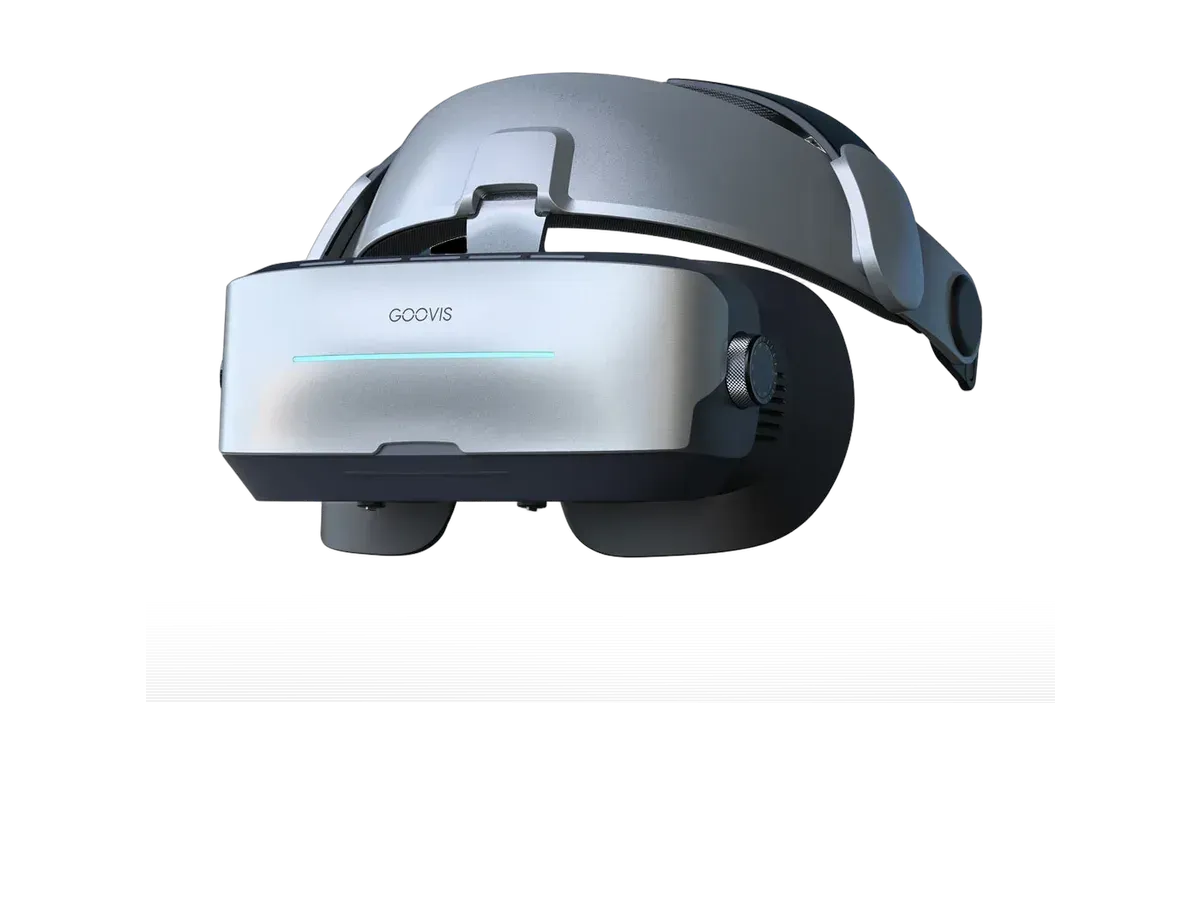
At a glance
- Display type
- Dual 0.83" Micro-OLED, 3528 ppi
- Resolution
- 2560x1440
- Field of view
- 65°
- Refresh rate
- 120 Hz
- Weight
- 300 g
- Battery
- 3 hr
- Sharpest in this set: 2560x1440 per eye at 45 PPD, an image reviewers liken to an OLED TV up close
- Best-in-class per-eye diopter range (+2.0 to -7.0D) — most glasses wearers need no inserts
- Expensive vs birdbath glasses ($911 base set)
- 300 g closed headset — not a wear-anywhere device, no AR passthrough
GOOVIS G3 Max 3D Head Mounted Display
Goovis
8.1/10 “According to the aggregated consensus of reviewers, the GOOVIS G3 Max is the picture-quality benchmark among wearable cinema displays: a sealed head-mounted OLED theater whose image testers consistently rank above anything glasses-shaped. TweakTown scored it 93 percent and called the visual fidelity unrivalled, HomeTheaterHifi's reviewer -- a trained display calibrator -- judged it 'like watching a premium OLED TV from less than four feet away', and MakeUseOf rated an early unit 9/10. The caveats are just as consistent: built-in speakers reviewers refuse to recommend, no HDR support, a fiddly multi-part setup, and a $1,199 price for what is strictly a virtual screen with no tracking or AR features. Scores below are an editorial aggregate of that cited coverage, not AR Compare hands-on measurements.” Read the full review$1,199
Check price at Amazon- Field of view
- 65°
- Weight
- 300 g
- Battery
- 3 hr
The GOOVIS G3 Max 3D Head Mounted Display are display glasses for media, gaming, and productivity from Goovis, released 2023-12. They feature a 2560x1440 per-eye Dual 0.83" Micro-OLED, 3528 ppi, 65° field of view, 120Hz refresh rate. Weight is 300g. Best for: Home-cinema enthusiasts and frequent flyers who prioritize maximum image quality and 3D Blu-ray playback over portability.
Our review
By AR Compare Team ·
According to the aggregated consensus of reviewers, the GOOVIS G3 Max is the picture-quality benchmark among wearable cinema displays: a sealed head-mounted OLED theater whose image testers consistently rank above anything glasses-shaped. TweakTown scored it 93 percent and called the visual fidelity unrivalled, HomeTheaterHifi's reviewer -- a trained display calibrator -- judged it 'like watching a premium OLED TV from less than four feet away', and MakeUseOf rated an early unit 9/10. The caveats are just as consistent: built-in speakers reviewers refuse to recommend, no HDR support, a fiddly multi-part setup, and a $1,199 price for what is strictly a virtual screen with no tracking or AR features. Scores below are an editorial aggregate of that cited coverage, not AR Compare hands-on measurements.
- Display quality
- 9/10
- Comfort
- 7/10
- Battery life
- 5.5/10
- Value for money
- 7/10
- Build quality
- 8/10
- Software
- 6/10
The GOOVIS G3 Max is a head-mounted cinema display — a sealed visor that hangs a private movie screen in front of your eyes — and not a pair of AR glasses. Released in December 2023 at $1,199 for the flagship package with its Android TV dongle, it pairs two 0.83-inch Micro-OLED panels, each a recorded 2560x1440, with aspheric optics and a claimed 1,000-inch virtual screen. The GOOVIS G3 Max review record is small but unusually united. This review aggregates the hands-on coverage: HomeTheaterHifi’s full review, TweakTown’s scored review, MakeUseOf’s launch review, and TechNewsWorld’s ownership column, alongside GOOVIS’ official specifications. AR Compare has not performed hands-on testing of this device; every observation below is attributed to the cited sources, and the category scores are an editorial aggregate of cited reviewer sentiment. Product facts were cross-checked against AR Compare’s spec record for the G3 Max (a recorded 65-degree field of view, a recorded 120Hz refresh rate, roughly 300 grams, $1,199).
How This Review Was Compiled
HomeTheaterHifi published the fullest evaluation in July 2025: reviewer Chris Eberle is a trained display calibrator who ran test patterns through the headset before watching films. TweakTown’s Jak Connor scored it 93 percent in a September 2025 review covering movies, 3D playback, and PC use. MakeUseOf’s James Bruce scored a production-ready early unit 9/10 at the mid-2023 crowdfunding launch, and TechNewsWorld’s Rob Enderle, a multi-week owner, wrote the record’s most direct Vision Pro comparison. Where the sources disagree — mainly on setup and the head straps — both readings are reported below rather than smoothed over.
The Picture: Why the G3 Max Exists
Everything in the record starts with the image. Each eye gets its own Micro-OLED panel at a recorded 2560x1440 — a recorded 3,528 pixels per inch, about 45 pixels per degree, dense enough that individual pixels stop being visible. Spread across the recorded 65-degree field of view, HomeTheaterHifi calculates that is like sitting 3.7 feet from a 65-inch TV: IMAX territory rather than living-room territory. The judgments match the numbers. TweakTown’s reviewer was “absolutely blown away”, describing every film as sharp, vibrant, and crisp, and concluding the visual fidelity is unrivalled among headsets. HomeTheaterHifi reports rich, lifelike color, deep OLED blacks, and smooth motion with no visible artifacts at 24, 50, or 60fps, and calls the whole device “one of the coolest things I’ve seen”. The honest fine print from the same sources: there is no HDR10 or Dolby Vision support, and MakeUseOf found HDR content played back washed out on the early unit.
3D Blu-ray Playback: The Closest Thing to a Rival-Free Feature
With 3D TVs long discontinued, Blu-ray 3D support is the part of the record with no competitor. HomeTheaterHifi saw no crosstalk — the ghosting where one eye’s image leaks into the other — and no distortion, said the experience recalled seeing Avatar in an IMAX theater, and judged that for 3D fans “there is no better way to enjoy it than the G3 Max”. TweakTown independently called its 3D “cinema-grade” and on par with the cinema, noting support for frame-packed Blu-ray 3D and side-by-side files, with a button to swap the eyes if a file arrives flipped. One limit reviewers flag: it plays 3D content but will not convert flat video into 3D.
Comfort, Fit, and the Two Head Straps
At a recorded 300 grams for the visor, reviewers compare wearing it to a pair of heavier ski goggles rather than a VR headset. TechNewsWorld’s Enderle wore it for hours-long sessions without marks on his face, crediting the top-support design that Apple’s Vision Pro lacks. The strap situation draws the record’s most consistent grumbling: TweakTown found the fabric band more comfortable but front-heavy and the rigid strap better balanced but harder on the forehead, while HomeTheaterHifi recommends the optional click-adjust rigid headband outright. Optical fit is a genuine strength — per-eye focus dials covering a recorded +2.0D to -7.0D in 0.5D steps with digital feedback, plus sliding tabs to match pupil distance — and HomeTheaterHifi, whose eyes carry different prescriptions, had a perfectly sharp picture within a minute, no inserts needed. But fit is not universal: some light bleeds in around the nose for certain faces, which Enderle noticed and shrugged off, and MakeUseOf’s early unit could not be focused at all by the reviewer’s wife. Because there is no tracking of any kind, the image is fixed to your head and follows every movement, which HomeTheaterHifi found briefly unnerving before using the option to shrink the picture.
Audio, Power, and Setup: The Consensus Weak Spots
The built-in speakers are the one thing every source pans. HomeTheaterHifi does not pull punches — “the sound is poor at best”, tinny and barely audible at maximum volume — TweakTown lists terrible built-in audio as its leading con, and TechNewsWorld’s advice is simply not to use them. The rescue is the headphone jack and Bluetooth: HomeTheaterHifi reports surround soundtracks pass through as effective two-channel with spatial cues intact. Power comes from the included battery pack, good for a recorded 3 hours, or any USB-C wall charger, so the battery score reflects a modest external runtime rather than onboard endurance. On setup the record splits along one clean line: feed it a USB-C source that outputs video and TweakTown’s experience — plug-and-play, running in under five minutes — holds; route through the HDMI converter, dongle, and battery boxes and you get HomeTheaterHifi’s version, a fiddly assembly with instructions that did not help much.
Not VR: Where It Stands in 2026
TweakTown opens with the necessary correction: this is not a VR headset, and buyers comparing it to a Quest 3 are comparing across categories. The G3 Max has no cameras, no apps of its own, and a recorded 0DoF — no tracking — so it is strictly a wearable monitor. The cited reviews do not benchmark it against a Quest 3, but they do against the Vision Pro: HomeTheaterHifi calls the G3 Max a good value beside Apple’s $3,499 headset and notes Apple offers nothing like GOOVIS’ built-in optical adjustability, while Enderle wrote that movie nights felt “like having my own IMAX screen that I could use anywhere”. As of 2026 it is still GOOVIS’ flagship, not superseded; the trade against display glasses is unchanged. Its recorded 65-degree field of view is wider than any display glasses AR Compare tracks, including the VITURE Beast’s recorded 58 degrees, but glasses weigh a quarter as much, cost half or less, and let you see the room. The side-by-sides sit on the G3 Max vs VITURE Beast and G3 Max vs XREAL One Pro comparisons.
Value
At $1,199 for the flagship package, the aggregate view is that the G3 Max is expensive against birdbath display glasses and cheap against everything that matches its picture. TweakTown, which reviewed the base kit at a $1,099 list price, scored value 90 percent and framed it as less than half the cost of the only headset with a comparable cinema experience. MakeUseOf reviewed it when it launched at $799 in early-bird preorders and admitted the full price would prompt second thoughts. HomeTheaterHifi lands in the middle, judging it decent value provided the buyer is the movie-first person this was built for and budgets for real headphones.
Who Should Buy the GOOVIS G3 Max
Per the aggregated consensus: home-cinema enthusiasts who want reference-grade contrast and sharpness without a projector room, 3D Blu-ray collectors with nowhere left to play their discs, frequent flyers and late-night viewers who want a private screen with its own battery (how a sealed visor trades against glasses-style pairs in an actual carry-on is covered in our smart glasses for travel guide), and glasses wearers whose prescriptions fit the recorded diopter range. Who should skip: anyone who wants AR, passthrough, apps, or spatial tracking, gamers who mean VR when they say headset, viewers who will not add headphones, HDR devotees, and anyone who wants a wear-anywhere device rather than a sealed visor for the couch, bed, or seat 14C.
Scores are aggregates of the cited reviews and hands-on reports, not AR Compare hands-on results.
Sources
- HomeTheaterHifi — GOOVIS G3 Max 3D Head Mounted Display Review
- TweakTown — GOOVIS G3 MAX 3D HMD Review - Experience an IMAX-like Cinema in Your Living Room
- MakeUseOf — Goovis G3 Max Personal Cinema Display: The Best Private Big Screen Experience Yet
- TechNewsWorld — Apple Vision Pro and Why the Goovis G3 Max May Be Better
- GOOVIS — G3 Max official product page (specifications)
Pros & cons
Pros
- Sharpest in this set: 2560x1440 per eye at 45 PPD, an image reviewers liken to an OLED TV up close
- Best-in-class per-eye diopter range (+2.0 to -7.0D) — most glasses wearers need no inserts
- True 65-degree IMAX-like FOV with Blu-ray 3D support
- Far cheaper than Vision Pro for pure movie watching
- A recorded 120Hz refresh rate with motion handling reviewers found artifact-free across 24, 50, and 60fps content
- Behaves as a plain external display for consoles, Blu-ray players, and PCs -- no accounts, downloads, or software installs
- A flip-up hinge and removable light mask that let wearers check their surroundings mid-movie
- About 3 hours of viewing from the included battery pack, so sessions are not tied to a wall outlet
Cons
- Expensive vs birdbath glasses ($911 base set)
- 300 g closed headset — not a wear-anywhere device, no AR passthrough
- Built-in speakers weak; headphones recommended
- No tracking or spatial features — strictly a virtual screen
- No HDR10 or Dolby Vision support, which reviewers call disappointing in a device sold as a personal cinema
- Assembly spans several boxes and an HDMI-to-USB-C converter chain, with instructions reviewers found unhelpful
- Neither included head strap fully satisfies: the fabric band is comfortable but front-heavy, the rigid one steadier but harsher
- Fit is face-dependent, with light bleed around the nose for some wearers, and one person trying an early unit could not get a clear image at all
- It will not convert 2D video to 3D, and reviewers note native content that exploits the full panels is scarce
Full specifications
Specs last verified
| Display | |
|---|---|
| Display type | Dual 0.83" Micro-OLED, 3528 ppi |
| Resolution | 2560x1440 |
| Pixels per degree | 45 |
| Field of view (°) | 65 |
| Refresh rate (Hz) | 120 |
| Virtual screen size (in) | 1000 |
| Color support | Full color |
| Not published: Brightness, HDR support | |
| Optics | |
| Optics type | aspheric |
| Dimming control | ✓ Yes |
| Prescription support | ✓ Yes |
| Prescription options | Built-in dials, -7.00 to +2.00 |
| Not published: Transparency level | |
| Physical | |
| Weight (g) | 300 |
| Foldable | ✕ No |
| Not published: Frame style, Color options, IP rating | |
| Battery & power | |
| Battery life (hours) | 3 |
| Not published: Charging method, Charging time | |
| Connectivity | |
| Connectivity | USB-C (DP Alt Mode) |
| Compatible devices | Android, iPhone 15/16, PC, Mac, Steam Deck, ROG Ally, PlayStation 5, Xbox, Lenovo Legion Go, iPad |
| Not published: Tethered | |
| Computing | |
| Operating system | None (display); Android TV via optional D4H1 controller |
| Chipset | None in headset; optional D4H1 Android TV media player dongle |
| Not published: Processing type | |
| Sensors & input | |
| Camera | ✕ No |
| Speakers | open-ear |
| Tracking | 0DoF |
| Not published: Microphones, Gesture control, Voice control | |
Prescription options
The documented prescription routes for the GOOVIS G3 Max 3D Head Mounted Display, from the maker and named-partner documentation recorded in our database.
- Built-in dials, -7.00 to +2.00 Source: goovis.com documentation
Maker documentation as recorded 2026-09-17. Ranges are the maker's published limits, not medical advice — confirm your exact prescription with your optician before ordering.
Where to buy
Price verified
GOOVIS G3 Max 3D Head Mounted Display specs: quick answers
- What is the GOOVIS G3 Max 3D Head Mounted Display's field of view?
- The GOOVIS G3 Max 3D Head Mounted Display has a 65-degree field of view.
- What is the GOOVIS G3 Max 3D Head Mounted Display's display resolution?
- The GOOVIS G3 Max 3D Head Mounted Display's recorded per-eye display resolution is 2560x1440.
- How much does the GOOVIS G3 Max 3D Head Mounted Display weigh?
- The GOOVIS G3 Max 3D Head Mounted Display's glasses weigh 300g according to the manufacturer specification.
- How long does the GOOVIS G3 Max 3D Head Mounted Display's battery last?
- The GOOVIS G3 Max 3D Head Mounted Display is rated for about 3 hours of battery life.
- How much does the GOOVIS G3 Max 3D Head Mounted Display cost?
- The GOOVIS G3 Max 3D Head Mounted Display costs $1,199.
GOOVIS G3 Max 3D Head Mounted Display: FAQs
How much does the GOOVIS G3 Max 3D Head Mounted Display cost?
The GOOVIS G3 Max 3D Head Mounted Display costs $1,199 (USD). It is available from 2 retailers listed on this page.
What field of view does the GOOVIS G3 Max 3D Head Mounted Display have?
The GOOVIS G3 Max 3D Head Mounted Display has a recorded field of view of 65 degrees.
How much does the GOOVIS G3 Max 3D Head Mounted Display weigh?
The GOOVIS G3 Max 3D Head Mounted Display weighs 300g according to the manufacturer specification.
How long does the battery last on the GOOVIS G3 Max 3D Head Mounted Display?
The GOOVIS G3 Max 3D Head Mounted Display has a rated battery life of 3 hours.
Can I use the GOOVIS G3 Max 3D Head Mounted Display with prescription lenses?
Yes, the GOOVIS G3 Max 3D Head Mounted Display supports prescription lenses. The recorded diopter range is Per-eye diopter adjustment +2.0D to -7.0D in 0.5D steps with digital feedback.
What devices work with the GOOVIS G3 Max 3D Head Mounted Display?
The GOOVIS G3 Max 3D Head Mounted Display lists compatibility with: Android, iPhone 15/16, PC, Mac, Steam Deck, ROG Ally, PlayStation 5, Xbox.
What resolution does the GOOVIS G3 Max 3D Head Mounted Display have?
The GOOVIS G3 Max 3D Head Mounted Display has a recorded per-eye resolution of 2560x1440. It refreshes at 120Hz.
Are the GOOVIS G3 Max 3D Head Mounted Display good for gaming?
The GOOVIS G3 Max 3D Head Mounted Display runs at a recorded 120Hz refresh rate with a 65-degree field of view -- the display specs that matter most for gaming.
Is the GOOVIS G3 Max 3D Head Mounted Display worth it?
The GOOVIS G3 Max 3D Head Mounted Display is priced at $1,199 (USD). For that you get a 65-degree field of view, a 2560x1440 per-eye resolution, and 3 hours of rated battery life. It weighs 300g. The full spec breakdown on this page shows what the price includes.
Similar products
What shoppers cross-check with the GOOVIS G3 Max 3D Head Mounted Display — from our navigation records and closest spec matches.
Ranked in these buying guides
Where the GOOVIS G3 Max 3D Head Mounted Display lands in our recorded-spec rankings.
- Best AR Glasses for Gaming
- Best AR Glasses for Steam Deck
- Best AR Glasses for Movies & Travel
- Best AR Glasses for Productivity & Multi-Monitor Work
- Best AR Glasses for iPhone Users
- Prescription Smart Glasses
- The Best Smart Glasses of 2026
- Smart Glasses With a Display
- Lightest Smart Glasses
- Monitor Glasses: AR Glasses That Replace a Screen
- Best AR Glasses for Mac & MacBook
- Best AR Glasses for PC & Windows
- Best AR Glasses for Android Phones & Samsung DeX
- Best AR Glasses for PS5
- Best AR Glasses for Xbox Series X & S
- Best AR Glasses for ROG Ally & Ally X
- Best AR Glasses for Lenovo Legion Go
- Widest FOV AR Glasses
- Smart Glasses Battery Life, Ranked
Related Comparisons
GOOVIS G3 Max 3D Head Mounted Display vs ASUS AirVision M1
Goovis vs ASUS
GOOVIS G3 Max 3D Head Mounted Display vs ASUS ROG XREAL R1
Goovis vs ASUS
GOOVIS G3 Max 3D Head Mounted Display vs Dream Glass Flow
Goovis vs Dreamworld
GOOVIS G3 Max 3D Head Mounted Display vs INAIR 2 Pro
Goovis vs INAIR
GOOVIS G3 Max 3D Head Mounted Display vs Lenovo Legion Glasses 2
Goovis vs Lenovo
GOOVIS G3 Max 3D Head Mounted Display vs RayNeo Air 2
Goovis vs RayNeo
GOOVIS G3 Max 3D Head Mounted Display vs RayNeo Air 3s
Goovis vs RayNeo
GOOVIS G3 Max 3D Head Mounted Display vs RayNeo Air 3s Pro AR/XR Glasses
Goovis vs RayNeo
GOOVIS G3 Max 3D Head Mounted Display vs RayNeo Air 4 Pro
Goovis vs RayNeo
GOOVIS G3 Max 3D Head Mounted Display vs RayNeo GT
Goovis vs RayNeo
GOOVIS G3 Max 3D Head Mounted Display vs RayNeo GT Max
Goovis vs RayNeo
GOOVIS G3 Max 3D Head Mounted Display vs Rokid Max
Goovis vs Rokid
GOOVIS G3 Max 3D Head Mounted Display vs Rokid Max 2
Goovis vs Rokid
GOOVIS G3 Max 3D Head Mounted Display vs Rokid Station 2 Spatial Computing Host
Goovis vs Rokid
GOOVIS G3 Max 3D Head Mounted Display vs Shadow Creator Honghu MR
Goovis vs Shadow Creator
GOOVIS G3 Max 3D Head Mounted Display vs TCL NxtWear S
Goovis vs TCL
GOOVIS G3 Max 3D Head Mounted Display vs TCL NXTWEAR S+ AR Glasses
Goovis vs TCL
GOOVIS G3 Max 3D Head Mounted Display vs VITURE Beast XR Glasses
Goovis vs VITURE
GOOVIS G3 Max 3D Head Mounted Display vs VITURE Luma Pro
Goovis vs VITURE
GOOVIS G3 Max 3D Head Mounted Display vs VITURE Luma Ultra XR/AR Glasses
Goovis vs VITURE
GOOVIS G3 Max 3D Head Mounted Display vs VITURE Luma XR
Goovis vs VITURE
GOOVIS G3 Max 3D Head Mounted Display vs VITURE One XR Glasses
Goovis vs VITURE
GOOVIS G3 Max 3D Head Mounted Display vs VITURE One Lite
Goovis vs VITURE
GOOVIS G3 Max 3D Head Mounted Display vs VITURE Pro 2 XR Glasses
Goovis vs VITURE
GOOVIS G3 Max 3D Head Mounted Display vs VITURE Pro XR
Goovis vs VITURE
GOOVIS G3 Max 3D Head Mounted Display vs XREAL 1S
Goovis vs XREAL
GOOVIS G3 Max 3D Head Mounted Display vs XREAL Air 2
Goovis vs XREAL
GOOVIS G3 Max 3D Head Mounted Display vs XREAL Air 2 Pro
Goovis vs XREAL
GOOVIS G3 Max 3D Head Mounted Display vs XREAL Air 2 Ultra
Goovis vs XREAL
GOOVIS G3 Max 3D Head Mounted Display vs XREAL Beam
Goovis vs XREAL
GOOVIS G3 Max 3D Head Mounted Display vs XREAL One
Goovis vs XREAL
GOOVIS G3 Max 3D Head Mounted Display vs XREAL One Pro
Goovis vs XREAL
GOOVIS G3 Max 3D Head Mounted Display vs XREAL xbx a01+
Goovis vs XREAL