At a glance
- Display type
- Sony Micro-OLED
- Resolution
- 1920x1080
- Field of view
- 43°
- Refresh rate
- 60 Hz
- Weight
- 78 g
- Kickstarter phenomenon: $3.1M from 5,069 backers, out-raising the original Oculus Rift campaign
- TIME Best Inventions of 2022
- 60Hz only, 43° (marketing) / ~38-39° measured FOV
- Long superseded — two full generations behind Luma series
VITURE One XR Glasses
VITURE
6.5/10 “According to the aggregated consensus of reviewers, the VITURE One was one of the best display glasses of its generation and is the wrong buy in 2026: VITURE has discontinued it, and the Luma series that replaced it improves on the 60Hz refresh rate and narrow field of view reviewers criticized here. At launch the record was glowing -- Laptop Mag made it an Editor's Choice and called it 'the best of the best when it comes to snapping up a pair of XR glasses' -- while Dexerto scored it 4/5 and CGMagazine's 7/10 judged the price hard to justify and the 60Hz ceiling limiting. Those are exactly the caveats the newer Luma XR fixes at $399, well below the One's $549 list price. Scores below are an editorial aggregate of that cited coverage, not AR Compare hands-on measurements.” Read the full review$549
See current alternatives- Field of view
- 43°
- Weight
- 78 g
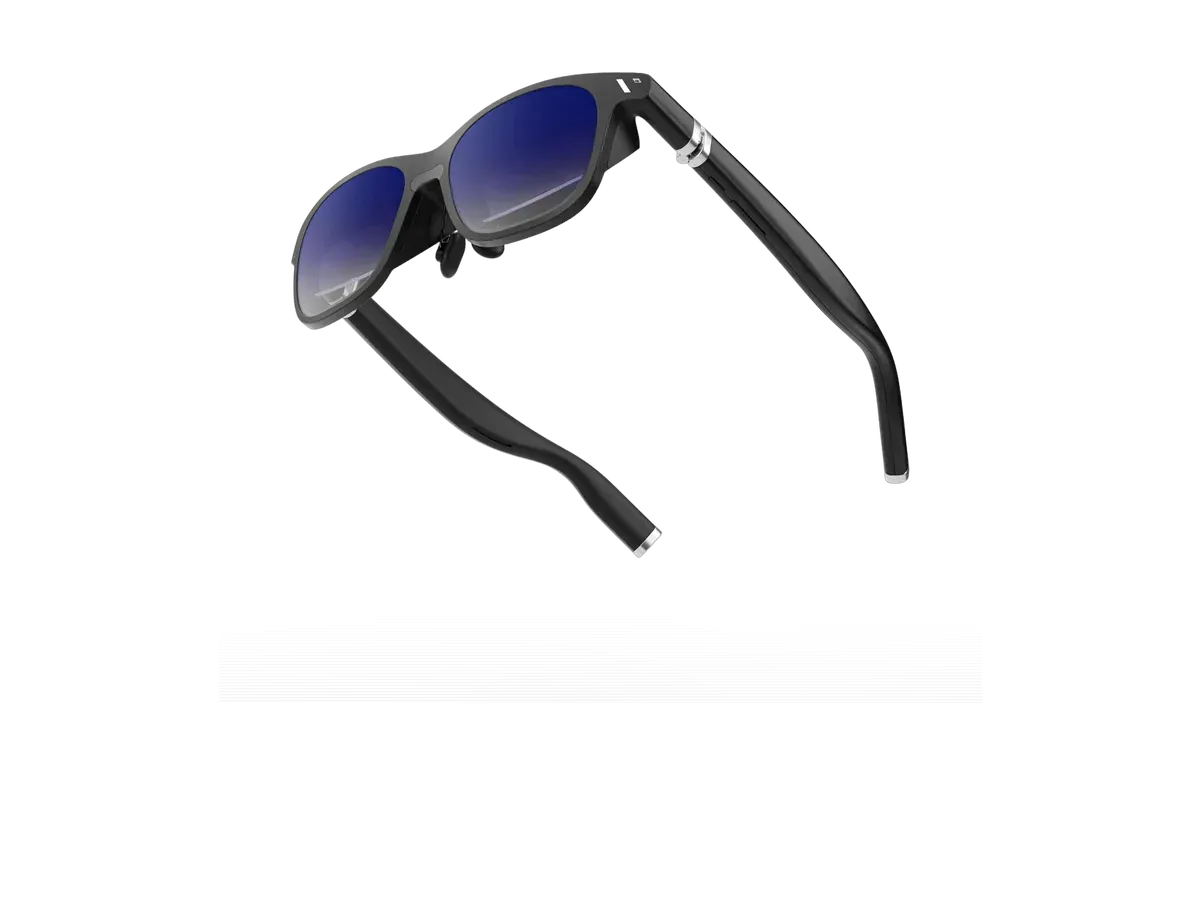
The VITURE One XR Glasses are display glasses for media, gaming, and productivity from VITURE, released 2022-11. They feature a 1920x1080 per-eye Sony Micro-OLED, 43° field of view, 60Hz refresh rate. Weight is 78g. Best for: Historical/reference entry — VITURE's first-generation glasses; buy Luma series instead.
Our review
By AR Compare Team ·
According to the aggregated consensus of reviewers, the VITURE One was one of the best display glasses of its generation and is the wrong buy in 2026: VITURE has discontinued it, and the Luma series that replaced it improves on the 60Hz refresh rate and narrow field of view reviewers criticized here. At launch the record was glowing -- Laptop Mag made it an Editor's Choice and called it 'the best of the best when it comes to snapping up a pair of XR glasses' -- while Dexerto scored it 4/5 and CGMagazine's 7/10 judged the price hard to justify and the 60Hz ceiling limiting. Those are exactly the caveats the newer Luma XR fixes at $399, well below the One's $549 list price. Scores below are an editorial aggregate of that cited coverage, not AR Compare hands-on measurements.
- Display quality
- 7.5/10
- Comfort
- 7.5/10
- Battery life
- 5/10
- Value for money
- 5.5/10
- Build quality
- 7.5/10
- Software
- 6/10
The VITURE One is where the modern display-glasses category more or less started: a November 2022 Kickstarter phenomenon that raised $3.1 million from 5,069 backers — out-raising the original Oculus Rift campaign — and made TIME’s Best Inventions list that year. It is a wearable external monitor rather than a full AR headset, projecting a recorded 1920x1080 per-eye picture from Sony Micro-OLED panels onto a 120-inch virtual screen through birdbath optics, the mirror-and-lens design most display glasses of its era used. VITURE has since discontinued it, so this VITURE One review is as much about where the product stands in 2026 as about how good it once was. This review aggregates the hands-on record: Laptop Mag’s launch review, Dexerto’s scored review, CGMagazine’s scored review, ZDNET reviewer Matthew Miller’s month-long report, and TheGamer’s review of the Neckband accessory, alongside VITURE’s current store lineup. AR Compare has not performed hands-on testing of this device; every observation below is attributed to the cited sources, and the category scores are an editorial aggregate of cited reviewer sentiment. Product facts were cross-checked against AR Compare’s spec record for the VITURE One (a recorded 43-degree field of view, 60Hz, roughly 78 grams, myopia adjustment dials to -5.0D, $549).
How This Review Was Compiled
Laptop Mag’s Jason England published the fullest launch review and made the One an Editor’s Choice. Dexerto’s Rosalie Newcombe scored a multi-week review 4/5, centered on a Steam Deck OLED. CGMagazine’s Zubi Khan was the most critical of the scored record at 7/10, reviewing across a Nintendo Switch, an iPad Pro, and a gaming PC. ZDNET’s Matthew Miller bought a pair with his own money and rated a month-long report 5/5 after taking the glasses on a 15-hour flight. TheGamer’s Eric Switzer reviewed the Android-powered Neckband accessory, so his judgment weighs on the ecosystem rather than the optics. Where the sources disagree — mostly on whether the price was ever justified — both readings are reported below rather than smoothed over.
Discontinued and Replaced: Where the One Stands in 2026
The headline fact of this review is catalog status: the VITURE One is discontinued and no longer appears anywhere in VITURE’s own store. The current lineup on VITURE’s site is the Luma series — Luma XR at $399, Luma Pro at $499, and Luma Ultra at $599 — plus the VITURE Pro 2 and The Beast, the company’s current flagship. AR Compare’s record puts the One two full generations behind that range: the VITURE Pro XR superseded it in April 2024 with a 120Hz panel and a wider 46-degree view at $459, and the 2025 Luma generation pushed to 50- and 52-degree views on larger virtual screens. The One’s two loudest recurring criticisms — the 60Hz cap and the modest field of view — are fixed everywhere in that successor line, mostly at lower prices; the one caveat that carries over is HDR, which AR Compare’s record shows no current VITURE model supports. The budget VITURE One Lite, the dimming-free variant still recorded at $349, keeps the same 60Hz and 43-degree limits and the same caveats. The spec-by-spec gap is itemized on the Luma XR vs One comparison, and the VITURE Luma XR page covers the closest current successor.
The Screen That Started It: What Reviewers Loved
Nothing in the record disputes that the One earned its reputation. Laptop Mag calls the simulated 120-inch display floating in front of your eyes a vivid joy to experience and rates setup an absolute cinch — the magnetic USB-C cable clicks in, and a phone, laptop, or Steam Deck screen simply appears. Dexerto agrees, describing the picture as incredibly crisp and vivid and reporting that a Steam Deck OLED’s screen was projected within seconds of connecting. The One also introduced two features that became VITURE signatures. The first is myopia adjustment: dials above each lens that correct near-sightedness up to a recorded -5.0D, which Matthew Miller, a glasses wearer himself, calls superb because it let him leave his prescription pair off entirely. The second is electrochromic dimming — lenses that darken electronically at a button press — which Laptop Mag found splendid for shutting out the world on a long flight. Miller’s month-long report delivers the era’s strongest one-line endorsement: “They are fantastic and I will not ever travel again without them.”
The 60Hz Ceiling and the Other Caveats
The criticisms are just as consistent, and they explain why the successor line exists. The recorded 60Hz refresh rate is the big one: CGMagazine reports that PC gaming is where things fell apart, primarily because of the missing higher refresh rate, even though the same review found the panel well matched to a Nintendo Switch. The recorded 43-degree field of view reads modest by 2026 standards, and AR Compare’s own record notes the usable view measured narrower in practice than the marketing figure. There is no HDR either; CGMagazine noticed the missing deep blacks an HDR-enabled image would provide. Fit is where the record genuinely splits. CGMagazine likened long sessions to wearing an ordinary pair of shades, and Miller kept his on through a 15-hour flight, but Dexerto reports the inward-leaning frames “do feel fairly tight on my head” and describes the beginnings of motion sickness during fast kart-racing segments — with the honest caveat that the reviewer is photosensitive. Audio drew the faintest praise: Dexerto rates the speakers fairly impressive for what they are but notes they can sound tinny.
The Neckband and the Cost of the Ecosystem
The One has no onboard battery and draws power and video over USB-C from whatever it plugs into, so the battery score of 5 follows this site’s category convention for tethered display glasses rather than any standalone runtime. How much that taxes the host device is genuinely disputed: Miller reports no significant phone battery drain across dozens of hours, while CGMagazine leaned on the battery-equipped mobile dock to keep a Switch running through several hours of play. The Neckband — $179 at the time — is the accessory that made the One more than a monitor: an Android-powered collar that streams Netflix, Game Pass, GeForce Now, and PlayStation Remote Play straight to the glasses with no phone attached. TheGamer calls it an essential accessory after streaming hours of Game Pass titles onto a giant 120-inch screen on the ceiling, and flags the trade-offs plainly: a cooling fan loud enough to turn game volume up over, and enough cases and chargers that half a travel bag fills with VITURE gear. Laptop Mag’s warning covers the whole ecosystem — investing in it gets real expensive, real fast, with the shade, adapters, and dock all sold separately.
Value
At $549 the One divided reviewers even when it was current. CGMagazine’s 7/10 calls it a steep price for what is essentially “a glorified floating screen” and finds it difficult to justify against similar devices at comparable prices, while Laptop Mag and Miller both judged the picture worth the money when the One had no clear better rival. In 2026 the math is simpler: the Luma XR delivers a wider view, a 120Hz panel, and a larger virtual screen for $399, $150 below the One’s list price. The launch-era enthusiasm in the record was real, but it described a market with no better option — and that market no longer exists.
Who Should Buy the VITURE One
Per the aggregated consensus: almost no one at anything near list price in 2026 — the honest recommendation from the record and the catalog alike is the Luma series instead. The narrow exceptions are buyers who find deeply discounted remaining stock and mainly want movie and Switch viewing with the myopia dials and dimming intact, and existing Neckband or dock owners replacing a broken pair to keep an ecosystem they already paid for. Who should skip: PC and high-refresh gamers, whom the recorded 60Hz panel frustrated even in 2024, anyone sensitive to tight frames or fast on-screen motion, buyers who want a product VITURE still sells, and anyone offered old stock near the original $549 — the Luma XR is better on refresh rate, field of view, and screen size for $150 less.
Scores are aggregates of the cited reviews and hands-on reports, not AR Compare hands-on results.
Sources
- Laptop Mag — Viture One XR Glasses: An expensive game changer
- Dexerto — Viture One XR glasses review: Reality redefined (4/5)
- CGMagazine — Viture One XR AR Glasses Review (7/10)
- ZDNET / Palm Solo — Viture One XR glasses: The best way to experience big screen media on the go (Matthew Miller)
- TheGamer — This High Tech Neckband Is The Ultimate Way To Play Starfield
- VITURE — Official store lineup (Luma series, VITURE Pro 2, and The Beast)
Pros & cons
Pros
- Kickstarter phenomenon: $3.1M from 5,069 backers, out-raising the original Oculus Rift campaign
- TIME Best Inventions of 2022
- Pioneered myopia dials and electrochromic dimming in consumer XR glasses
- Neckband accessory enabled untethered Android streaming/gaming
- A 120-inch virtual screen from Sony Micro-OLED panels that launch reviewers called crisp, vivid, and a joy to watch
- Built-in myopia adjustment dials one long-term owner calls superb, letting near-sighted wearers ditch their prescription pair
- At a recorded 78 grams reviewers wore them through hours-long sessions and a 15-hour flight without complaint
- Setup reviewers describe as near-instant: a host device's screen appears seconds after the magnetic USB-C cable clicks in
- Electrochromic dimming reviewers found splendid for shutting out cabin light at the press of a button
Cons
- 60Hz only, 43° (marketing) / ~38-39° measured FOV
- Long superseded — two full generations behind Luma series
- No longer sold in VITURE's store lineup
- Ecosystem costs reviewers flagged from day one, with the shade, adapters, dock, and Neckband all sold separately
- No HDR, and one reviewer noticed the missing deep blacks a modern HDR panel would provide
- Inward-leaning frames one reviewer found fairly tight, with fast in-game motion leaving the same tester queasy
- Speakers rated fairly impressive for their size but prone to sounding tinny
- The Android Neckband's cooling fan runs loud enough that its reviewer turned game volume up to cover it
Full specifications
Specs last verified
| Display | |
|---|---|
| Display type | Sony Micro-OLED |
| Resolution | 1920x1080 |
| Field of view (°) | 43 |
| Refresh rate (Hz) | 60 |
| Virtual screen size (in) | 120 |
| Color support | Full color |
| Not published: Pixels per degree, Brightness, HDR support | |
| Optics | |
| Optics type | birdbath |
| Dimming control | ✓ Yes |
| Prescription support | ✓ Yes |
| Prescription options | Built-in dials, -5.00 to 0.00 · Inserts / lens frame, -16.00 to +12.00, cyl up to 6.00 |
| Not published: Transparency level | |
| Physical | |
| Weight (g) | 78 |
| Foldable | ✕ No |
| Not published: Frame style, Color options, IP rating | |
| Connectivity | |
| Connectivity | USB-C (DP Alt Mode) |
| Not published: Tethered, Compatible devices | |
| Computing | |
| Operating system | Steam Deck, Android, laptops via USB-C; consoles via dock; Neckband standalone |
| Chipset | None on-device; optional Neckband accessory ran Android app ecosystem |
| Not published: Processing type | |
| Sensors & input | |
| Camera | ✕ No |
| Speakers | directional |
| Tracking | 3DoF |
| Not published: Microphones, Gesture control, Voice control | |
Prescription options
The documented prescription routes for the VITURE One XR Glasses, from the maker and named-partner documentation recorded in our database.
- Built-in dials, -5.00 to 0.00 Source: viture.com documentation
- Inserts / lens frame, -16.00 to +12.00, cyl up to 6.00 Source: viture.com documentation
Maker documentation as recorded 2026-09-17. Ranges are the maker's published limits, not medical advice — confirm your exact prescription with your optician before ordering.
Read the VITURE prescription guide for every documented option, model by model.
Where to buy
VITURE One XR Glasses specs: quick answers
- What is the VITURE One XR Glasses's field of view?
- The VITURE One XR Glasses has a 43-degree field of view.
- What is the VITURE One XR Glasses's display resolution?
- The VITURE One XR Glasses's recorded per-eye display resolution is 1920x1080.
- How much does the VITURE One XR Glasses weigh?
- The VITURE One XR Glasses's glasses weigh 78g according to the manufacturer specification.
- How much does the VITURE One XR Glasses cost?
- The VITURE One XR Glasses costs $549.
VITURE One XR Glasses: FAQs
How much does the VITURE One XR Glasses cost?
The VITURE One XR Glasses costs $549 (USD).
What field of view does the VITURE One XR Glasses have?
The VITURE One XR Glasses has a recorded field of view of 43 degrees.
How much does the VITURE One XR Glasses weigh?
The VITURE One XR Glasses weighs 78g according to the manufacturer specification.
Can I use the VITURE One XR Glasses with prescription lenses?
Yes, the VITURE One XR Glasses supports prescription lenses. The recorded diopter range is Built-in myopia adjustment dials up to -5.0D.
What resolution does the VITURE One XR Glasses have?
The VITURE One XR Glasses has a recorded per-eye resolution of 1920x1080. It refreshes at 60Hz.
Are the VITURE One XR Glasses good for gaming?
The VITURE One XR Glasses runs at a recorded 60Hz refresh rate with a 43-degree field of view -- the display specs that matter most for gaming.
Is the VITURE One XR Glasses worth it?
The VITURE One XR Glasses is priced at $549 (USD). For that you get a 43-degree field of view and a 1920x1080 per-eye resolution. It weighs 78g. The full spec breakdown on this page shows what the price includes.
Similar products
What shoppers cross-check with the VITURE One XR Glasses — from our navigation records and closest spec matches.
Related Comparisons
VITURE One XR Glasses vs VITURE Pro XR
VITURE
VITURE One XR Glasses vs ASUS AirVision M1
VITURE vs ASUS
VITURE One XR Glasses vs ASUS ROG XREAL R1
VITURE vs ASUS
VITURE One XR Glasses vs Dream Glass Flow
VITURE vs Dreamworld
VITURE One XR Glasses vs GOOVIS G3 Max 3D Head Mounted Display
VITURE vs Goovis
VITURE One XR Glasses vs INAIR 2 Pro
VITURE vs INAIR
VITURE One XR Glasses vs Lenovo Legion Glasses 2
VITURE vs Lenovo
VITURE One XR Glasses vs RayNeo Air 2
VITURE vs RayNeo
VITURE One XR Glasses vs RayNeo Air 3s Pro AR/XR Glasses
VITURE vs RayNeo
VITURE One XR Glasses vs RayNeo Air 3s
VITURE vs RayNeo
VITURE One XR Glasses vs RayNeo Air 4 Pro
VITURE vs RayNeo
VITURE One XR Glasses vs RayNeo GT Max
VITURE vs RayNeo
VITURE One XR Glasses vs RayNeo GT
VITURE vs RayNeo
VITURE One XR Glasses vs Rokid Max 2
VITURE vs Rokid
VITURE One XR Glasses vs Rokid Max
VITURE vs Rokid
VITURE One XR Glasses vs Rokid Station 2 Spatial Computing Host
VITURE vs Rokid
VITURE One XR Glasses vs Shadow Creator Honghu MR
VITURE vs Shadow Creator
VITURE One XR Glasses vs TCL NXTWEAR S+ AR Glasses
VITURE vs TCL
VITURE One XR Glasses vs TCL NxtWear S
VITURE vs TCL
VITURE One XR Glasses vs VITURE Beast XR Glasses
VITURE
VITURE One XR Glasses vs VITURE Luma Pro
VITURE
VITURE One XR Glasses vs VITURE Luma Ultra XR/AR Glasses
VITURE
VITURE One XR Glasses vs VITURE Luma XR
VITURE
VITURE One XR Glasses vs VITURE One Lite
VITURE
VITURE One XR Glasses vs VITURE Pro 2 XR Glasses
VITURE
VITURE One XR Glasses vs XREAL 1S
VITURE vs XREAL
VITURE One XR Glasses vs XREAL Air 2
VITURE vs XREAL
VITURE One XR Glasses vs XREAL Air 2 Pro
VITURE vs XREAL
VITURE One XR Glasses vs XREAL Air 2 Ultra
VITURE vs XREAL
VITURE One XR Glasses vs XREAL Beam
VITURE vs XREAL
VITURE One XR Glasses vs XREAL One
VITURE vs XREAL
VITURE One XR Glasses vs XREAL One Pro
VITURE vs XREAL
VITURE One XR Glasses vs XREAL xbx a01+
VITURE vs XREAL