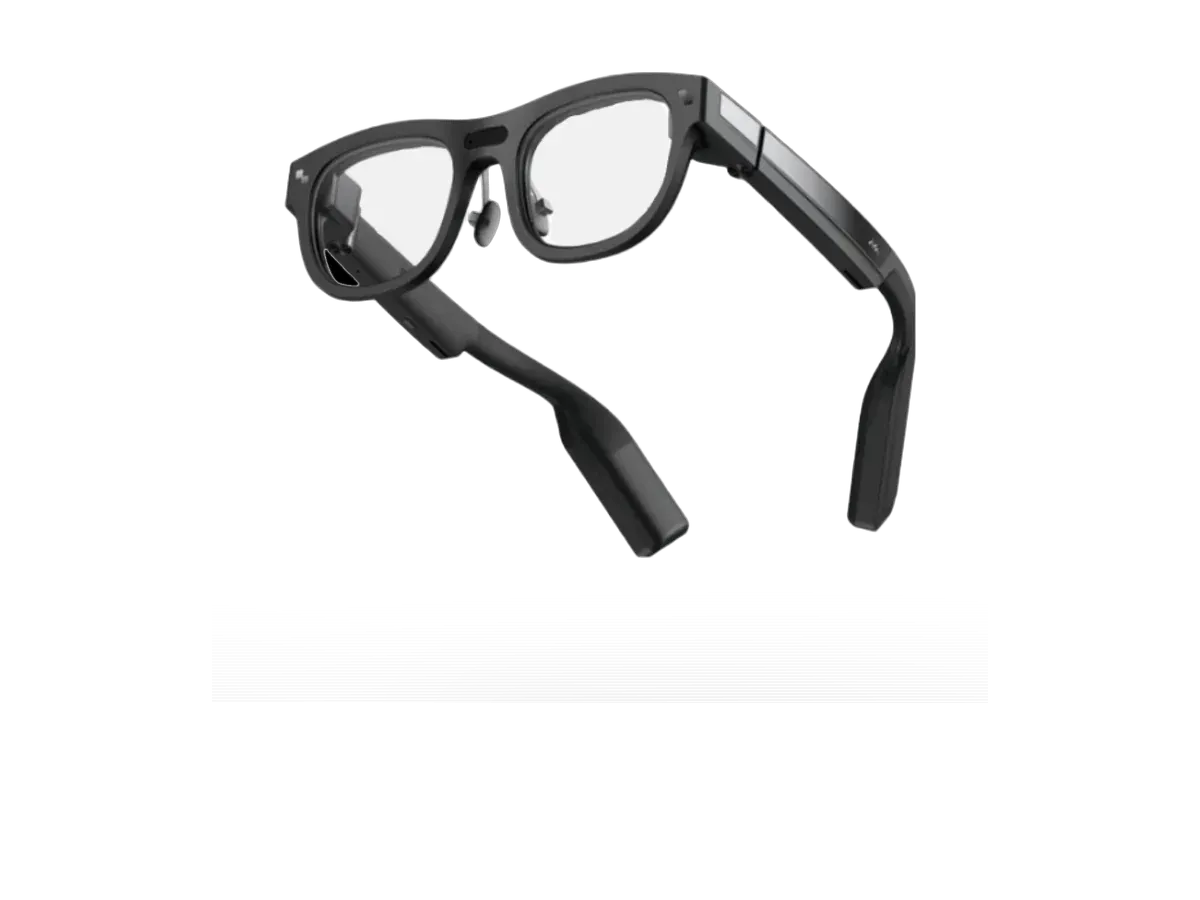
At a glance
- Display type
- Micro-LED waveguide
- Resolution
- 640x480
- Field of view
- 25°
- Brightness
- 1000 nits
- Weight
- 119 g
- Battery
- 2 hr
- First standalone AR glasses with binocular full-color Micro-LED waveguide
- Snapdragon XR2 provides strong on-device processing power
- 25-degree FOV is extremely narrow for AR content
- 119 grams is heavy for prolonged daily wear
TCL RayNeo X2
RayNeo
6/10 “According to the aggregated consensus of reviewers, the TCL RayNeo X2 is a genuine category first -- standalone AR glasses with binocular full-color Micro-LED waveguides and a Snapdragon XR2 onboard, no phone tether required -- that reviewers admire as an achievement and stop short of recommending as a purchase. XDA Developers scored it 6.5/10 across a month of wear and called it a big first step; UploadVR reviewed a retail unit and was blunter, judging the hardware close to the best achievable near this price in 2024 while calling its augmented reality laughably bad and advising everyone but curious early adopters to wait. The recorded 1,000-nit display reads in sunlight and the live translation genuinely works, if slowly; the recorded 25-degree field of view, short display-on battery, and 119-gram bulk mark the limits. Scores below are an editorial aggregate of that cited coverage, not AR Compare hands-on measurements.” Read the full review$499
Check price at RayNeo Store- Field of view
- 25°
- Weight
- 119 g
- Battery
- 2 hr
The TCL RayNeo X2 is the world's first standalone AR glasses with binocular full-color Micro-LED waveguide display. Powered by the Qualcomm Snapdragon XR2 with 6GB RAM and 128GB storage, it features 6DoF SLAM tracking, gesture recognition, a 16MP camera, and runs Android -- all in a 119-gram form factor.
Our review
By AR Compare Team ·
According to the aggregated consensus of reviewers, the TCL RayNeo X2 is a genuine category first -- standalone AR glasses with binocular full-color Micro-LED waveguides and a Snapdragon XR2 onboard, no phone tether required -- that reviewers admire as an achievement and stop short of recommending as a purchase. XDA Developers scored it 6.5/10 across a month of wear and called it a big first step; UploadVR reviewed a retail unit and was blunter, judging the hardware close to the best achievable near this price in 2024 while calling its augmented reality laughably bad and advising everyone but curious early adopters to wait. The recorded 1,000-nit display reads in sunlight and the live translation genuinely works, if slowly; the recorded 25-degree field of view, short display-on battery, and 119-gram bulk mark the limits. Scores below are an editorial aggregate of that cited coverage, not AR Compare hands-on measurements.
- Display quality
- 6.5/10
- Comfort
- 5.5/10
- Battery life
- 4/10
- Value for money
- 4.5/10
- Build quality
- 6/10
- Software
- 4/10
The TCL RayNeo X2 is the first pair of standalone AR glasses with binocular full-color Micro-LED waveguide displays — a computer, camera, and see-through screen in one frame, with no phone tether and no puck. TCL’s RayNeo arm crowdfunded it and then moved it to general sale in January 2024, and RayNeo’s own store now lists it at $499, currently out of stock. This review aggregates the hands-on record — UploadVR’s retail-unit review, XDA Developers’ month-long scored review, and Android Authority’s CES hands-on — plus Engadget’s launch report and RayNeo’s official specifications. AR Compare has not performed hands-on testing of this device; every observation below is attributed to the cited sources, and the category scores are an editorial aggregate of cited reviewer sentiment. Product facts were cross-checked against AR Compare’s spec record for the RayNeo X2 (binocular full-color Micro-LED waveguides at a recorded 1,000 nits, a recorded 25-degree field of view, a recorded 640x480 per eye, roughly 119 grams, a recorded 2-hour active-display battery, $499).
How This Review Was Compiled
Three reviewers actually wore the glasses, at three depths. XDA Developers’ Ben Sin wore a review unit for a month and published the only scored review in the record, a 6.5/10. UploadVR’s David Heaney reviewed a retail unit at the greatest technical depth and most critically. Android Authority’s C. Scott Brown tried an early unit at CES 2023, a year before general sale. Engadget’s Will Shanklin covered the CES announcement without wearing the glasses, so his report is treated as supporting evidence for specifications and positioning, never as a hands-on opinion. Where the record disagrees — mostly in tone, between XDA’s cautious optimism and UploadVR’s warning — both readings are reported below rather than smoothed over. Coverage of the cheaper RayNeo X2 Lite, a different product, is deliberately excluded.
The Category First: Standalone, for Better and Worse
The X2’s claim to history is that everything happens on the glasses. A Snapdragon XR2 — the same chip that powered the Meta Quest 2, as Engadget’s launch report notes — runs Android onboard with 6GB of RAM and 128GB of storage, alongside GPS, a 16MP camera, and SLAM-based spatial tracking. Nothing needs a phone screen except the companion app for setup and media transfer. The catch is what reviewers found when that standalone computer met real streets. UploadVR calls the positional tracking the worst reviewed in a decade and concludes the X2 ‘is an AR device technically only’ — its overlays behave like a heads-up display rather than objects pinned convincingly to the world, and the AR side of the experience is dismissed as laughably bad. XDA reaches a gentler version of the same conclusion, calling the glasses ‘a big first step’ and ‘an intriguing first attempt at doing real AR’ while declining to recommend them to a general buyer. Android Authority’s CES takeaway sat in between: individual demos impressed, but nothing produced the feeling of needing to own a pair.
The Display: Micro-LED That Reads in Sunlight
The display is the hardware’s genuine breakthrough. The recorded 1,000 nits of Micro-LED brightness through the waveguides makes the overlay legible outdoors: UploadVR found it usable on sunny days and estimates it several times brighter than the passthrough headsets of the era, and XDA read notifications in sunlight, noting text renders best against darker backgrounds. TCL also claims a 100,000:1 contrast ratio, per Engadget’s launch report. The limits are just as concrete. The recorded 25-degree field of view — an overlay XDA likens to a small 6-inch phone held at arm’s length — is, in UploadVR’s judgment, what cripples the X2’s viability as an AR device even while it serves a heads-up display perfectly well, and the recorded 640x480 per-eye resolution keeps things sharp only because the window is so small. The optics also cut both ways: UploadVR reports the waveguides scatter incoming light into fringed streaks around monitors, phones, and the sun, and smear dark-mode text badly.
Translation: The Standout Feature, With a Stopwatch Running
Every source lands on the same standout. Look at someone speaking another language and translated subtitles appear under their face — Android Authority watched English text scroll past while a colleague spoke Chinese at CES and called the experience genuinely futuristic, and UploadVR, the record’s harshest voice, still describes live translation as ‘a true glimpse of a very different future’. The practical record tempers the wonder. XDA timed a 10-to-20-second wait before translated text appears and roughly 10 to 15 seconds for the separate scene-recognition feature, and UploadVR found the implementation laggy and clunky enough to remain a novelty. Navigation gets the same split verdict: a mini map with turn-by-turn directions that XDA found functional for walking or cycling — anything faster outruns the lag — while UploadVR notes the arrows are not the true world-locked AR guidance the marketing implies.
Battery, Comfort, and Wearing Them in Public
Battery is the hardest limit in the record. The recorded 2-hour active-display figure matches what reviewers observed: UploadVR reports 1-2 hours with the display constantly on and around 5 hours of audio with occasional camera use, while XDA drained a full charge in 70 to 80 minutes of heavy AI and video work but stretched a light notifications-only day to a full workday. Standby drain is bad enough that UploadVR warns the glasses can be dead when picked up if left powered on, the magnetic charging cable is proprietary, and the included case cannot charge them. Comfort splits by expectation. At a recorded 119 grams the X2 more than doubles the roughly 50 grams UploadVR cites for its Ray-Ban Meta glasses, yet XDA walked around town for an hour straight without discomfort. Social acceptability is the harsher test: Android Authority found the frames chunky and far from fashionable, Engadget’s launch report likened them to comically oversized 1970s eyewear, and UploadVR places them at the very limits of what can be worn outdoors without stares.
Value: The Price That Kept Falling
The price history needs care, because the record spans three figures. XDA reviewed during the crowdfunding window, when the early-bird rate was $699, and judged even that high for a niche first-generation device. UploadVR’s later retail-unit review records the glasses selling at $850 at the time of writing and advises against buying at that level. RayNeo’s own store page today shows $499 and out of stock, which matches AR Compare’s recorded price. The falling trajectory tells its own story about demand, and the consensus advice does not flip at the lower figure: this is a purchase for people who want to live with the first of something, not a value proposition. Buyers wanting everyday smart glasses that disappear on the face are better served by the camera-and-audio category the Ray-Ban Meta Gen 2 leads, and AR Compare’s catalog also lists RayNeo’s newer RayNeo X3 Pro, which is where this product line went next.
Who Should Buy the TCL RayNeo X2
Per the aggregated consensus: early adopters who want standalone true-AR glasses before the platform giants ship theirs and who accept a first-generation experience; developers and tinkerers drawn to an Android device with Micro-LED waveguides, SLAM, and GPS onboard; and frequent travelers willing to tolerate 10-to-20-second waits for the genuinely useful live translation. Who should skip: anyone expecting a phone replacement or headset-class visuals, buyers who need all-day battery rather than a recorded 2 hours of active display, commuters who would rely on navigation at road speeds the lag cannot match, and mainstream buyers — the two deepest reviews agree the X2 is a fascinating proof of concept that general customers should wait out.
Scores are aggregates of the cited reviews and hands-on reports, not AR Compare hands-on results.
Sources
- UploadVR — RayNeo X2 Review: Are The First Standalone AR Glasses More Than A Tech Demo?
- XDA Developers — TCL RayNeo X2 review: A first step towards true AR glasses, but still work to do
- Android Authority — TCL RayNeo X2 hands-on: Maybe the world is ready for Google Glass now?
- Engadget — TCL’s huge glasses remind us good AR is difficult
- RayNeo — TCL RayNeo X2 official product page (specifications)
What other reviewers say
1 review from an outside outlet.
Scores from other outlets, as published — not our rating.
| Source | Score |
|---|---|
| XDA Developers | 6.5/10 |
Pros & cons
Pros
- First standalone AR glasses with binocular full-color Micro-LED waveguide
- Snapdragon XR2 provides strong on-device processing power
- 6DoF SLAM tracking with gesture recognition support
- 16MP camera for photos and 1080p video recording
- 128GB onboard storage -- most in any AR glasses
- A recorded 1,000 nits of waveguide brightness that reviewers read outdoors in direct sunlight, several times brighter than the passthrough headsets of its day
- Live conversation subtitles that float under the speaker, called a true glimpse of a very different future in the most critical review
- Worn daily for a month in the longest review without physical complaints, including hour-long continuous walks around town
- Turn-by-turn walking navigation drawn into the lens with a mini map, one of the few onboard apps reviewers found genuinely useful within the display's limits
Cons
- 25-degree FOV is extremely narrow for AR content
- 119 grams is heavy for prolonged daily wear
- 6DoF tracking quality inconsistent in reviewer testing
- Only 2 hours of battery with active display use
- Limited app ecosystem compared to established platforms
- Waveguide optics scatter incoming light into fringed streaks around monitors, phones, and the sun, and dark-mode text smears badly
- Live translation and scene recognition answer with waits reviewers timed between 10 and 20 seconds
- Standby drain that can leave the glasses dead in an unpowered case, charged only through a proprietary magnetic cable
- Touchpad and ring controls described as slow and frustrating, with a companion app that struggles to stay connected
Full specifications
Specs last verified
| Display | |
|---|---|
| Display type | Micro-LED waveguide |
| Resolution | 640x480 |
| Field of view (°) | 25 |
| Brightness (nits) | 1000 |
| HDR support | ✕ No |
| Color support | Full color |
| Not published: Pixels per degree, Refresh rate, Virtual screen size | |
| Optics | |
| Optics type | waveguide |
| Transparency level | see-through AR overlay |
| Prescription support | ✓ Yes |
| Prescription options | Inserts / lens frame via Lensology, from £79 GBP (partner-sourced) |
| Not published: Dimming control | |
| Physical | |
| Weight (g) | 119 |
| Frame style | round |
| Color options | Black |
| Foldable | ✕ No |
| Not published: IP rating | |
| Battery & power | |
| Battery life (hours) | 2 |
| Charging method | Magnetic charging |
| Not published: Charging time | |
| Connectivity | |
| Connectivity | Bluetooth 5.2, WiFi 5, USB-C |
| Tethered | ✕ No |
| Compatible devices | Standalone |
| Computing | |
| Processing type | on-device |
| Operating system | Android |
| Chipset | Qualcomm Snapdragon XR2 |
| Sensors & input | |
| Camera | 16MP |
| Microphones | 3 |
| Speakers | open-ear |
| Tracking | 6DoF, head, SLAM |
| Gesture control | ✓ Yes |
| Voice control | ✓ Yes |
Prescription options
The documented prescription routes for the TCL RayNeo X2, from the maker and named-partner documentation recorded in our database.
- Inserts / lens frame via Lensology, from £79 GBP (partner-sourced) — range not published by the maker Source: rayneo.com documentation
Maker documentation as recorded 2026-09-17. Ranges are the maker's published limits, not medical advice — confirm your exact prescription with your optician before ordering.
Read the RayNeo prescription guide for every documented option, model by model.
Where to buy
Price checked
TCL RayNeo X2 specs: quick answers
- What is the TCL RayNeo X2's field of view?
- The TCL RayNeo X2 has a 25-degree field of view.
- What is the TCL RayNeo X2's display resolution?
- The TCL RayNeo X2's recorded per-eye display resolution is 640x480.
- How bright is the TCL RayNeo X2's display?
- The TCL RayNeo X2 has a rated peak brightness of 1000 nits.
- How much does the TCL RayNeo X2 weigh?
- The TCL RayNeo X2's glasses weigh 119g according to the manufacturer specification.
- How long does the TCL RayNeo X2's battery last?
- The TCL RayNeo X2 is rated for about 2 hours of battery life.
- Does the TCL RayNeo X2 have a camera?
- Yes, the TCL RayNeo X2 has a built-in camera. The recorded camera resolution is 16MP.
- How much does the TCL RayNeo X2 cost?
- The TCL RayNeo X2 costs $499.
TCL RayNeo X2: FAQs
How much does the TCL RayNeo X2 cost?
The TCL RayNeo X2 costs $499 (USD). It is available from 1 retailer listed on this page.
What field of view does the TCL RayNeo X2 have?
The TCL RayNeo X2 has a recorded field of view of 25 degrees.
How much does the TCL RayNeo X2 weigh?
The TCL RayNeo X2 weighs 119g according to the manufacturer specification.
How long does the battery last on the TCL RayNeo X2?
The TCL RayNeo X2 has a rated battery life of 2 hours.
Can I use the TCL RayNeo X2 with prescription lenses?
Yes, the TCL RayNeo X2 supports prescription lenses. The recorded diopter range is Rx sample lenses in box for optician fitting; inserts via Lensology (sold out — support may change on restock).
Does the TCL RayNeo X2 have a camera?
Yes, the TCL RayNeo X2 has a built-in camera (16MP).
What devices work with the TCL RayNeo X2?
The TCL RayNeo X2 lists compatibility with: Standalone.
What resolution does the TCL RayNeo X2 have?
The TCL RayNeo X2 has a recorded per-eye resolution of 640x480.
Is the TCL RayNeo X2 worth it?
The TCL RayNeo X2 is priced at $499 (USD). For that you get a 25-degree field of view, 1000 nits of brightness, a 640x480 per-eye resolution, and 2 hours of rated battery life. It weighs 119g. The full spec breakdown on this page shows what the price includes.
Similar products
What shoppers cross-check with the TCL RayNeo X2 — from our navigation records and closest spec matches.
Ranked in these buying guides
Where the TCL RayNeo X2 lands in our recorded-spec rankings.
Related Comparisons
TCL RayNeo X2 vs RayNeo X3 Pro
RayNeo
TCL RayNeo X2 vs Snap Spectacles Gen 5
RayNeo vs Snap
TCL RayNeo X2 vs Vuzix Blade 2
RayNeo vs Vuzix
TCL RayNeo X2 vs Magic Leap 2
RayNeo vs Magic Leap
TCL RayNeo X2 vs DigiLens ARGO Smart Glasses
RayNeo vs DigiLens
TCL RayNeo X2 vs Dream Glass Lead Pro
RayNeo vs Dreamworld
TCL RayNeo X2 vs Epson Moverio BT-45C
RayNeo vs Epson
TCL RayNeo X2 vs Inmo Air2
RayNeo vs Inmo
TCL RayNeo X2 vs INMO Air3 All-in-One Full-Color Waveguide AR Glasses
RayNeo vs Inmo
TCL RayNeo X2 vs Lenovo ThinkReality A3
RayNeo vs Lenovo
TCL RayNeo X2 vs Mad Gaze Glow Plus
RayNeo vs Mad Gaze
TCL RayNeo X2 vs Microsoft HoloLens 2
RayNeo vs Microsoft
TCL RayNeo X2 vs Rokid AR Spatial
RayNeo vs Rokid
TCL RayNeo X2 vs Snap Specs (Consumer Edition)
RayNeo vs Snap
TCL RayNeo X2 vs XREAL Aura
RayNeo vs XREAL