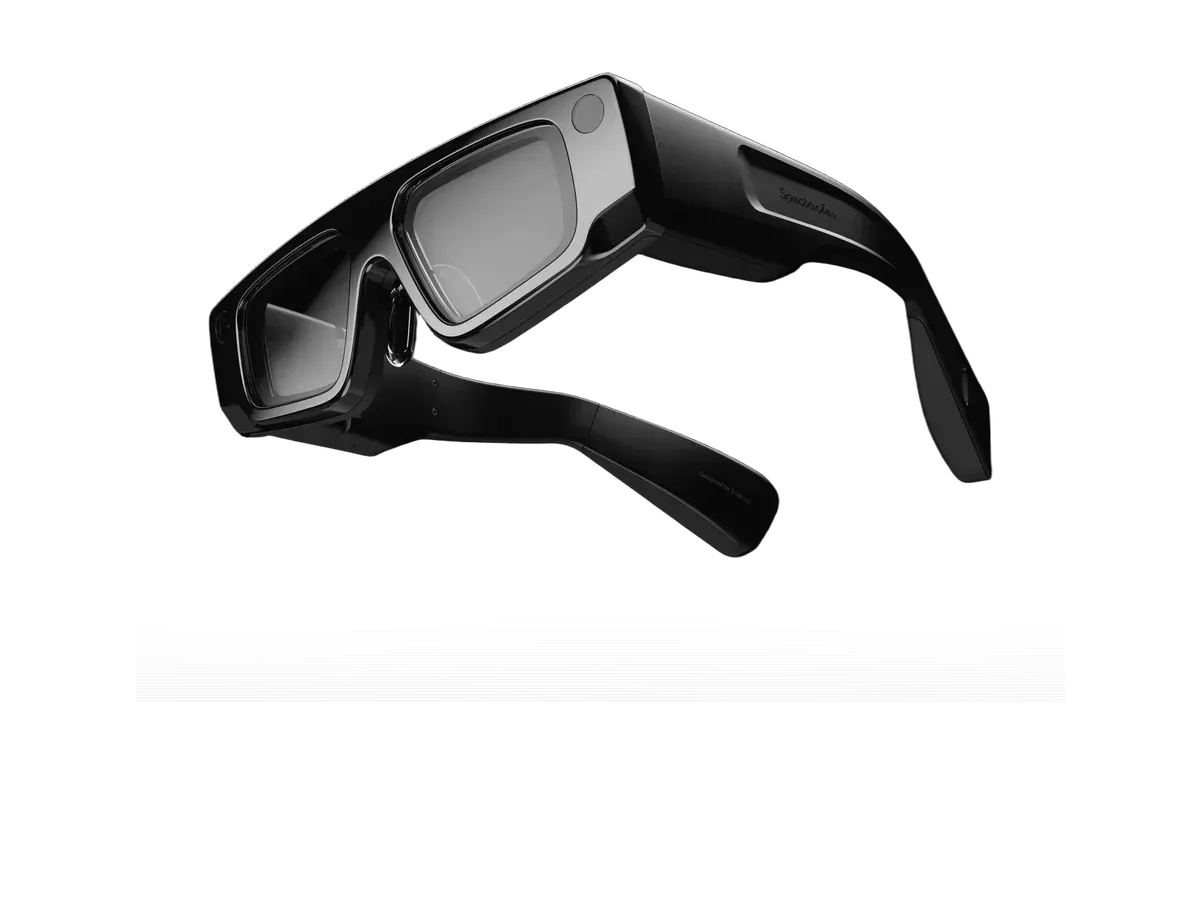
At a glance
- Display type
- Micro-LED waveguide
- Field of view
- 46°
- Weight
- 226 g
- Battery
- 0.75 hr
- True AR overlay with full-color waveguide display
- 46-degree FOV -- widest in consumer AR form factor
- Only ~45 minutes of battery life during active AR use
- 226 grams is noticeably heavy for glasses
Snap Spectacles Gen 5
Snap
6.5/10 “According to the aggregated consensus of reviewers, the Snap Spectacles Gen 5 is the most convincing standalone AR yet shown -- UploadVR called it 'the best see-through AR demo I've ever seen' -- and every source agrees it is a devkit, not a product. Engadget found the gesture interface surprisingly intuitive and the display crisp and bright, AR Insider reports tight tracking and a display that stood up to the L.A. sun, while The Ghost Howls documents rainbow artifacts, soreness within ten minutes, and a demo unit dying mid-session. At a recorded 226 grams with roughly 45 minutes of battery, rented at $99 a month on a 12-month commitment, these are glasses for people building the AR future, not living in it. Scores below are an editorial aggregate of that cited coverage, not AR Compare hands-on measurements.” Read the full reviewPrice not announced
Buy at Snap Store- Field of view
- 46°
- Weight
- 226 g
- Battery
- 0.75 hr
The Snap Spectacles Gen 5 are true augmented reality glasses with a 46-degree field of view, full-color waveguide display, hand tracking, and 6DoF spatial awareness. Built on the Snap Lens Studio ecosystem, they overlay interactive 3D content onto the real world -- available to developers for $99/month.
Our review
By AR Compare Team ·
According to the aggregated consensus of reviewers, the Snap Spectacles Gen 5 is the most convincing standalone AR yet shown -- UploadVR called it 'the best see-through AR demo I've ever seen' -- and every source agrees it is a devkit, not a product. Engadget found the gesture interface surprisingly intuitive and the display crisp and bright, AR Insider reports tight tracking and a display that stood up to the L.A. sun, while The Ghost Howls documents rainbow artifacts, soreness within ten minutes, and a demo unit dying mid-session. At a recorded 226 grams with roughly 45 minutes of battery, rented at $99 a month on a 12-month commitment, these are glasses for people building the AR future, not living in it. Scores below are an editorial aggregate of that cited coverage, not AR Compare hands-on measurements.
- Display quality
- 7.5/10
- Comfort
- 4/10
- Battery life
- 2/10
- Value for money
- 4/10
- Build quality
- 7/10
- Software
- 8.5/10
The Snap Spectacles Gen 5 is the rare piece of true augmented reality that actually ships: see-through AR glasses that run standalone — no phone tether, no compute puck — rented to developers at $99 a month rather than sold. Snap announced the fifth generation in September 2024, and the hands-on record is unusually rich for a device the public cannot buy. This review aggregates that record from Engadget, UploadVR, AR Insider, The Ghost Howls, and Road to VR. AR Compare has not performed hands-on testing of this device; every observation below is attributed to the cited sources, and the category scores are an editorial aggregate of cited reviewer sentiment. Product facts were cross-checked against AR Compare’s spec record for the Spectacles Gen 5 (a recorded 226 grams, a 46-degree field of view, roughly 45 minutes of active battery, $99 per month).
How This Review Was Compiled
Four independent hands-on reports and one specialist outlet’s reporting anchor this page. The Ghost Howls’ Antony Vitillo logged the longest single session, at AWE Europe in November 2024, and filed the most critical read. Engadget’s Karissa Bell, UploadVR’s Ian Hamilton, and AR Insider’s Mike Boland all went hands-on at the September 2024 launch, with Boland’s demo running about an hour. Road to VR’s Ben Lang documented the full spec sheet at announcement, and the same outlet’s June 2026 follow-up covers the consumer successor; the two Road to VR pieces are treated as one voice in any consensus counting. Where the sources disagree — comfort and hand-tracking quality are the genuine conflicts — both readings are reported below rather than smoothed over.
See-Through AR That Survives Sunlight: Why the Spectacles Exist
Unlike display glasses that float a virtual monitor in front of the eyes, the Spectacles anchor digital objects to the physical world: see-through waveguides driven by liquid-crystal-on-silicon (LCoS) micro-projectors, per Road to VR’s spec breakdown, across a recorded 46-degree diagonal field of view that Snap equates to a 100-inch display. At 37 pixels per degree, Engadget’s reviewer could not pick out individual pixels or the fuzzy borders common on other AR hardware, and called the content crisp and bright. The consensus standout is outdoor performance. The lenses dim automatically like transition sunglasses, and AR Insider reports the display “stood up to the L.A. sun” — a claim almost nothing else in consumer-shaped AR can make. Snap does not publish a brightness figure, so none is recorded here.
Recorded Specifications
Weight: 226 grams
Field of View: 46 degrees, 37 pixels per degree
Tracking: 6DoF spatial, hand and head tracking
Processing: Standalone on-device, dual Snapdragon processors (model unspecified)
Battery: Roughly 45 minutes of active AR use
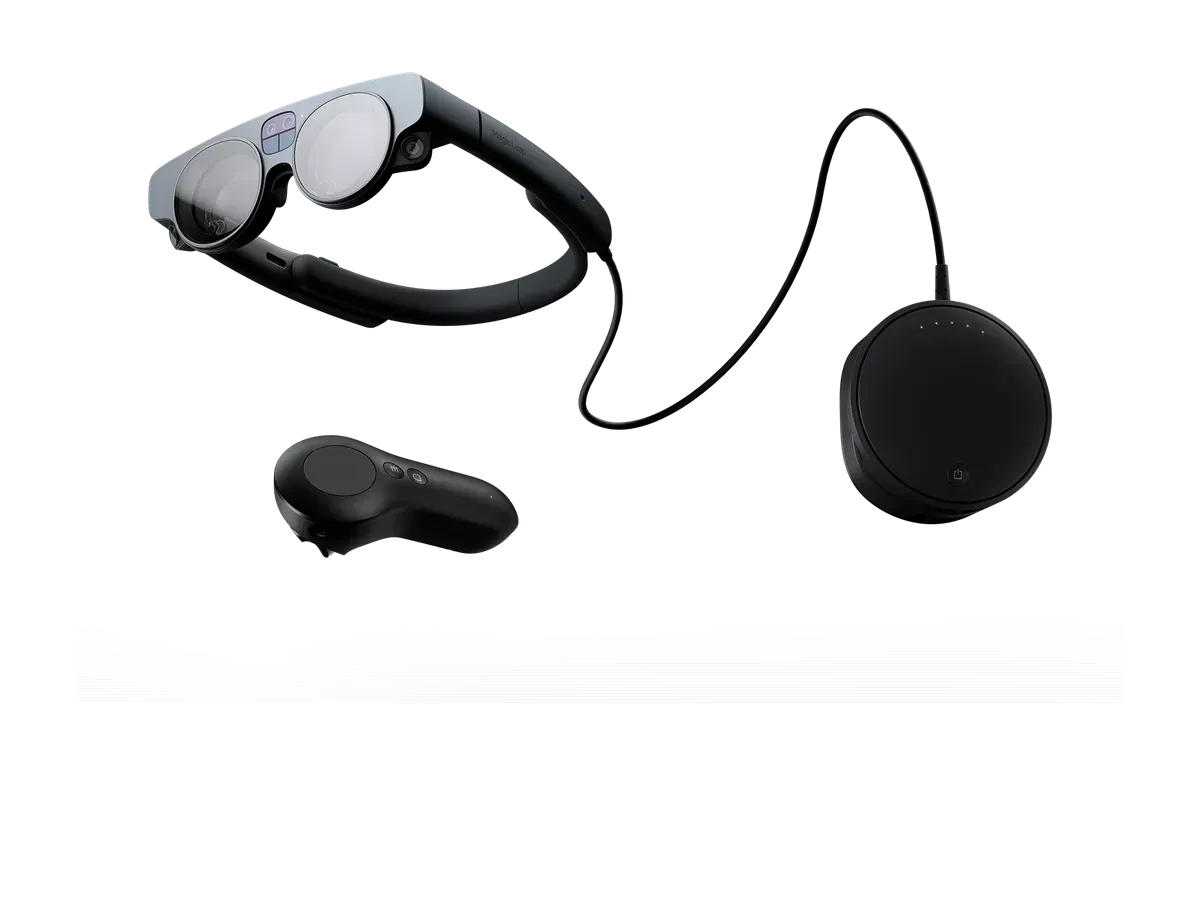
The dissent belongs to The Ghost Howls, whose session logged waveguide “rainbow” artifacts in the lower corner of vision, color separation during head rotation, and visible smearing in fast movement. The same review calls the 46-degree window genuinely constraining — the image ends in a hard cut-out edge — and Engadget likewise could not take in a life-size anatomy model without physically stepping back. The record agrees on the conclusion even where impressions differ: this is a best-in-class see-through image, in AR Insider’s and UploadVR’s telling, inside a deliberately small window. The enterprise route to a wider view remains the Magic Leap 2, with a recorded 70-degree field of view at several times the yearly cost.
226 Grams: The Comfort Split
The recorded 226 grams is several times the weight of ordinary sunglasses, and the frames are “almost comically large” in Engadget’s words — wider than the reviewer’s face, with arms extending past her head. How much that matters is the record’s most genuine disagreement. The Ghost Howls reports the top of the nose aching after roughly ten minutes and the tall, thick frames bending the top of the reviewer’s ear; AR Insider, by contrast, found them comfortable across an hour-long demo, crediting the flexible rubber mantle that fits varied head sizes. The comfort score of 4 holds both readings rather than smoothing them over.
Battery splits nobody. The recorded rating is roughly 45 minutes of active AR — up from 30 on the previous generation, per Engadget — and The Ghost Howls’ overworked demo unit warned of low power and died seconds later. AR Insider frames the runtime as workable for desk-based development with power nearby, which is the only usage pattern the record endorses. Every source lands in the same place: this is a session device, not an all-day wearable.
SnapOS: The Software Carries It
The interface is where the hands-on reports turn warm. SnapOS is built hand-first — a menu anchored to the palm, pinch and tap gestures — and Engadget found it “felt surprisingly intuitive,” with software that never seemed buggy or unresponsive even when precise moves, like placing toy bricks, got fiddly. AR Insider judged positional tracking and plane detection “tight,” with correct occlusion and dimensionally accurate visuals. UploadVR files the partial dissent: it observed drift, with virtual objects rendered offset from the physical geometry they should sit on and correcting over time, plus struggles during fast movement — while still judging Snap’s companion app more fully featured and easier to use than either of Meta’s phone apps. The Ghost Howls adds that hand tracking is short of best-in-class, adequate for menus but too laggy for a boxing lens. Both readings stand: the platform is polished, and the tracking is good rather than flawless.
The toolchain is Lens Studio 5.0, building Snapchat-style “lenses” in JavaScript and TypeScript. The Ghost Howls’ Vitillo, a Unity developer by trade, criticizes the lock-in as making the device feel like a Snapchat accessory rather than a general AR platform. Road to VR notes Snap takes no revenue cut from developers — and also that there is currently no way to sell software or reach a paying audience on the device at all. Compute is a pair of Snapdragon processors, model unspecified in Snap’s disclosures, per Road to VR’s spec sheet.
Value: Renting the Future at $99 a Month
The terms are unlike anything else in the category: $99 a month, developers only, a 12-month minimum, and the hardware goes back to Snap at the end. Across the mandatory year that is roughly $1,200 to never own the device — and The Ghost Howls’ pointed question stands: why an independent XR developer should spend that with no path to earning a dollar back on the platform. Engadget adds context that cuts both ways, citing reporting that each pair costs thousands of dollars to produce — the subscription is heavily subsidized, and still hard to justify without a company R&D budget, an existing Snap creator audience, or a direct relationship with Snap. For funded teams evaluating spatial platforms the calculation is easy; for hobbyists, every source lands on no.
The Consumer Specs Change the Question
Snap has since answered the question hanging over the Gen 5. At AWE in June 2026, per Road to VR, Snap revealed the consumer Specs: a 51-degree field of view, a claimed 40% weight reduction to the 132-136 gram range, up to 4 hours of mixed-use battery, and pre-orders open at $2,195 ahead of a fall 2026 ship window. That launch reframes the Gen 5 rental. It is the developer on-ramp to a platform Snap is now committing consumer hardware to, which strengthens the case for teams that want their content ready at launch — and removes any reason for consumers to chase the developer program in the meantime.
Who Should Buy the Snap Spectacles Gen 5
Per the aggregated consensus: funded AR teams and studios evaluating spatial computing platforms, developers with an existing Snap creator audience, and anyone who wants working content ready before the consumer Specs arrive — for that group the record’s praise is unambiguous. Who should skip: consumers entirely, since the record is unanimous that 45-minute sessions and 226-gram frames rule out daily wear; independent developers without a funding source, per The Ghost Howls’ unanswered economics; and anyone needing prescription support, which the platform does not offer.
Scores are aggregates of the cited reviews and hands-on reports, not AR Compare hands-on results.
out of 10
Our Verdict
According to the aggregated consensus of reviewers, the Snap Spectacles Gen 5 is the most convincing standalone AR yet shown -- UploadVR called it 'the best see-through AR demo I've ever seen' -- and every source agrees it is a devkit, not a product. Engadget found the gesture interface surprisingly intuitive and the display crisp and bright, AR Insider reports tight tracking and a display that stood up to the L.A. sun, while The Ghost Howls documents rainbow artifacts, soreness within ten minutes, and a demo unit dying mid-session. At a recorded 226 grams with roughly 45 minutes of battery, rented at $99 a month on a 12-month commitment, these are glasses for people building the AR future, not living in it. Scores below are an editorial aggregate of that cited coverage, not AR Compare hands-on measurements.
Sources
- The Ghost Howls — Snap Spectacles 5 hands-on review
- Engadget — Snap’s fifth-generation Spectacles bring your hands into augmented reality
- UploadVR — Snap Spectacles hands-on: Peridot and the Pokemon question
- AR Insider — Snap uplevels AR: hands-on with Spectacles Gen 5
- Road to VR — Snapchat Spectacles ‘24 AR glasses: specs, price and release date
- Road to VR — Snap reveals next-gen Specs AR glasses, priced at $2,200
- Snap — Spectacles official page
What other reviewers say
3 reviews from outside outlets.
Scores from other outlets, as published — not our rating.
| Source | Score |
|---|---|
| AR Insider | stood up to the L.A. sun |
| Engadget | felt surprisingly intuitive |
| UploadVR | the best see-through AR demo I've ever seen |
Pros & cons
Pros
- True AR overlay with full-color waveguide display
- 46-degree FOV -- widest in consumer AR form factor
- Hand tracking and 6DoF spatial awareness for natural interaction
- Standalone processing -- no phone tether needed
- Access to rich Snap Lens Studio AR development ecosystem
- Automatic lens dimming keeps AR content legible even in direct sunlight, a rarity reviewers single out
- Hand-first interface that hands-on reports describe as intuitive and never buggy
- Multi-user co-located AR and phone spectator modes are built into the platform
- 37 pixels per degree of sharpness -- hands-on reviewers could not pick out individual pixels
Cons
- Only ~45 minutes of battery life during active AR use
- 226 grams is noticeably heavy for glasses
- Subscription-only pricing at $99/month (no purchase option)
- Developer-focused -- limited consumer app library
- No prescription lens support currently available
- Waveguide artifacts -- rainbow streaks and smearing on fast head turns -- reported by the most critical hands-on
- Frames sit far wider than a normal face, with soreness setting in within minutes for one reviewer
- A 12-month minimum commitment with the hardware returned at the end -- renting, not owning
- No way yet to sell software or reach a real audience on the device, a sore point for independent developers
Full specifications
Specs last verified
| Display | |
|---|---|
| Display type | Micro-LED waveguide |
| Pixels per degree | 37 |
| Field of view (°) | 46 |
| Virtual screen size (in) | 100 |
| HDR support | ✕ No |
| Color support | Full color |
| Not published: Resolution, Refresh rate, Brightness | |
| Optics | |
| Optics type | waveguide |
| Transparency level | see-through AR overlay |
| Prescription support | ✓ Yes |
| Prescription options | Inserts / lens frame via Lensabl; Lensology, -5.00 to +1.00 total power |
| Not published: Dimming control | |
| Physical | |
| Weight (g) | 226 |
| Frame style | wraparound |
| Color options | Matte Black |
| Foldable | ✕ No |
| Not published: IP rating | |
| Battery & power | |
| Battery life (hours) | 0.75 |
| Charging method | USB-C charging case |
| Charging time (min) | 1.5 |
| Connectivity | |
| Connectivity | Bluetooth 5.2, WiFi 6, USB-C |
| Tethered | ✕ No |
| Compatible devices | iOS, Android |
| Computing | |
| Processing type | on-device |
| Operating system | Snap OS |
| Chipset | Qualcomm Snapdragon AR2 Gen 1 |
| Sensors & input | |
| Camera | 12MP (2×) |
| Microphones | 4 |
| Speakers | open-ear · spatial audio |
| Tracking | 6DoF, hand, head |
| Gesture control | ✓ Yes |
| Voice control | ✓ Yes |
Prescription options
The documented prescription routes for the Snap Spectacles Gen 5, from the maker and named-partner documentation recorded in our database.
- Inserts / lens frame via Lensabl; Lensology, -5.00 to +1.00 total power Source: support.spectacles.com documentation
Maker documentation as recorded 2026-09-17. Ranges are the maker's published limits, not medical advice — confirm your exact prescription with your optician before ordering.
Where to buy
Price verified
Snap Spectacles Gen 5 specs: quick answers
- What is the Snap Spectacles Gen 5's field of view?
- The Snap Spectacles Gen 5 has a 46-degree field of view.
- How much does the Snap Spectacles Gen 5 weigh?
- The Snap Spectacles Gen 5's glasses weigh 226g according to the manufacturer specification.
- How long does the Snap Spectacles Gen 5's battery last?
- The Snap Spectacles Gen 5 is rated for about 0.75 hours of battery life.
- Does the Snap Spectacles Gen 5 have a camera?
- Yes, the Snap Spectacles Gen 5 has 2 built-in cameras. The recorded camera resolution is 12MP.
Snap Spectacles Gen 5: FAQs
What field of view does the Snap Spectacles Gen 5 have?
The Snap Spectacles Gen 5 has a recorded field of view of 46 degrees.
How much does the Snap Spectacles Gen 5 weigh?
The Snap Spectacles Gen 5 weighs 226g according to the manufacturer specification.
How long does the battery last on the Snap Spectacles Gen 5?
The Snap Spectacles Gen 5 has a rated battery life of 0.75 hours.
Can I use the Snap Spectacles Gen 5 with prescription lenses?
Yes, the Snap Spectacles Gen 5 supports prescription lenses. The recorded diopter range is Optical inserts via Lensabl (NA) / Lensology (EU); total power +1.00 to -5.00 (SPH+CYL combined).
Does the Snap Spectacles Gen 5 have a camera?
Yes, the Snap Spectacles Gen 5 has a built-in camera (12MP).
What devices work with the Snap Spectacles Gen 5?
The Snap Spectacles Gen 5 lists compatibility with: iOS, Android.
Similar products
What shoppers cross-check with the Snap Spectacles Gen 5 — from our navigation records and closest spec matches.
Ranked in these buying guides
Where the Snap Spectacles Gen 5 lands in our recorded-spec rankings.
Related Comparisons
Snap Spectacles Gen 5 vs RayNeo X3 Pro
Snap vs RayNeo
Snap Spectacles Gen 5 vs Snap Specs (Consumer Edition)
Snap
Snap Spectacles Gen 5 vs TCL RayNeo X2
Snap vs RayNeo
Snap Spectacles Gen 5 vs Magic Leap 2
Snap vs Magic Leap
Snap Spectacles Gen 5 vs XREAL Air 2 Ultra
Snap vs XREAL
Snap Spectacles Gen 5 vs DigiLens ARGO Smart Glasses
Snap vs DigiLens
Snap Spectacles Gen 5 vs Dream Glass Lead Pro
Snap vs Dreamworld
Snap Spectacles Gen 5 vs Epson Moverio BT-45C
Snap vs Epson
Snap Spectacles Gen 5 vs Inmo Air2
Snap vs Inmo
Snap Spectacles Gen 5 vs INMO Air3 All-in-One Full-Color Waveguide AR Glasses
Snap vs Inmo
Snap Spectacles Gen 5 vs Lenovo ThinkReality A3
Snap vs Lenovo
Snap Spectacles Gen 5 vs Mad Gaze Glow Plus
Snap vs Mad Gaze
Snap Spectacles Gen 5 vs Microsoft HoloLens 2
Snap vs Microsoft
Snap Spectacles Gen 5 vs Rokid AR Spatial
Snap vs Rokid
Snap Spectacles Gen 5 vs Vuzix Blade 2
Snap vs Vuzix
Snap Spectacles Gen 5 vs XREAL Aura
Snap vs XREAL