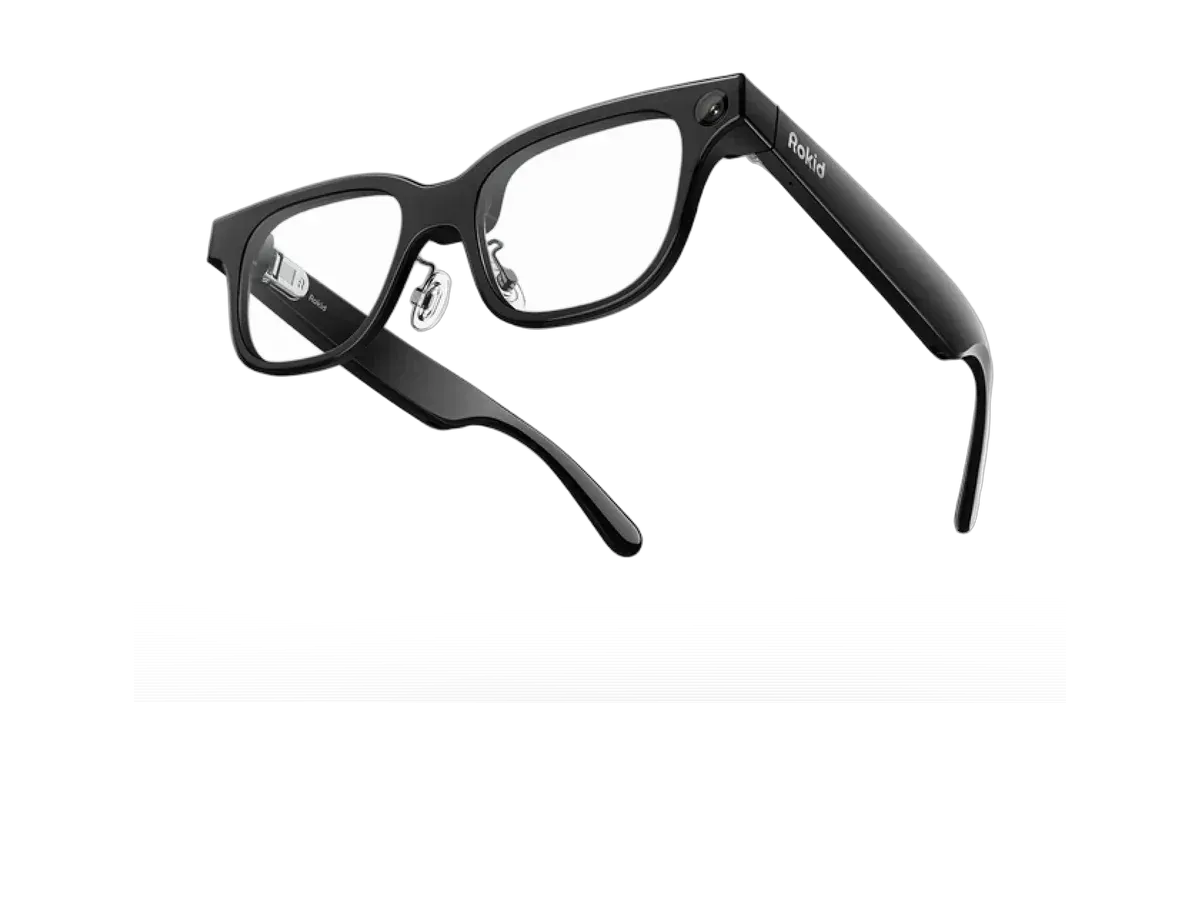
At a glance
- Display type
- dual green MicroLED light engines (JBD Hummingbird Mini II) into diffractive waveguides, binocular
- Resolution
- 480x400
- Field of view
- 30°
- Brightness
- 1500 nits
- Weight
- 49 g
- Battery
- 9 hr
- Binocular MicroLED waveguide display plus 12MP camera and speakers in one 49 g frame
- On-board Snapdragon AR1 with multi-LLM support (ChatGPT, Gemini, DeepSeek, user models)
- Monochrome green display, modest 30-degree FOV
- Kickstarter fulfillment plagued by delays, missing accessories and poor communication into 2026
Rokid Glasses
Rokid
7/10 “According to the aggregated consensus of reviewers, the Rokid Glasses are the most complete display-equipped rival yet to Meta's smart glasses -- and the most divisive on design. Tom's Guide, after two months of daily wear, calls them a real Meta Ray-Ban Display rival: light, feature-packed, with a bright green heads-up display and a choice of ChatGPT or Gemini. Trusted Reviews agrees on the smarts but not the look, saying the bulky frame and cheap-feeling plastic mean it would not wear them out of the house, and PhoneArena documented an unnerving bug -- photos and audio captured without permission -- plus battery life far short of the rating. The record reads as a strong, fast-evolving first generation that rewards patient early adopters. Scores below are an editorial aggregate of that cited coverage, not AR Compare hands-on measurements.” Read the full review$699
Buy at Rokid Store- Field of view
- 30°
- Weight
- 49 g
- Battery
- 9 hr
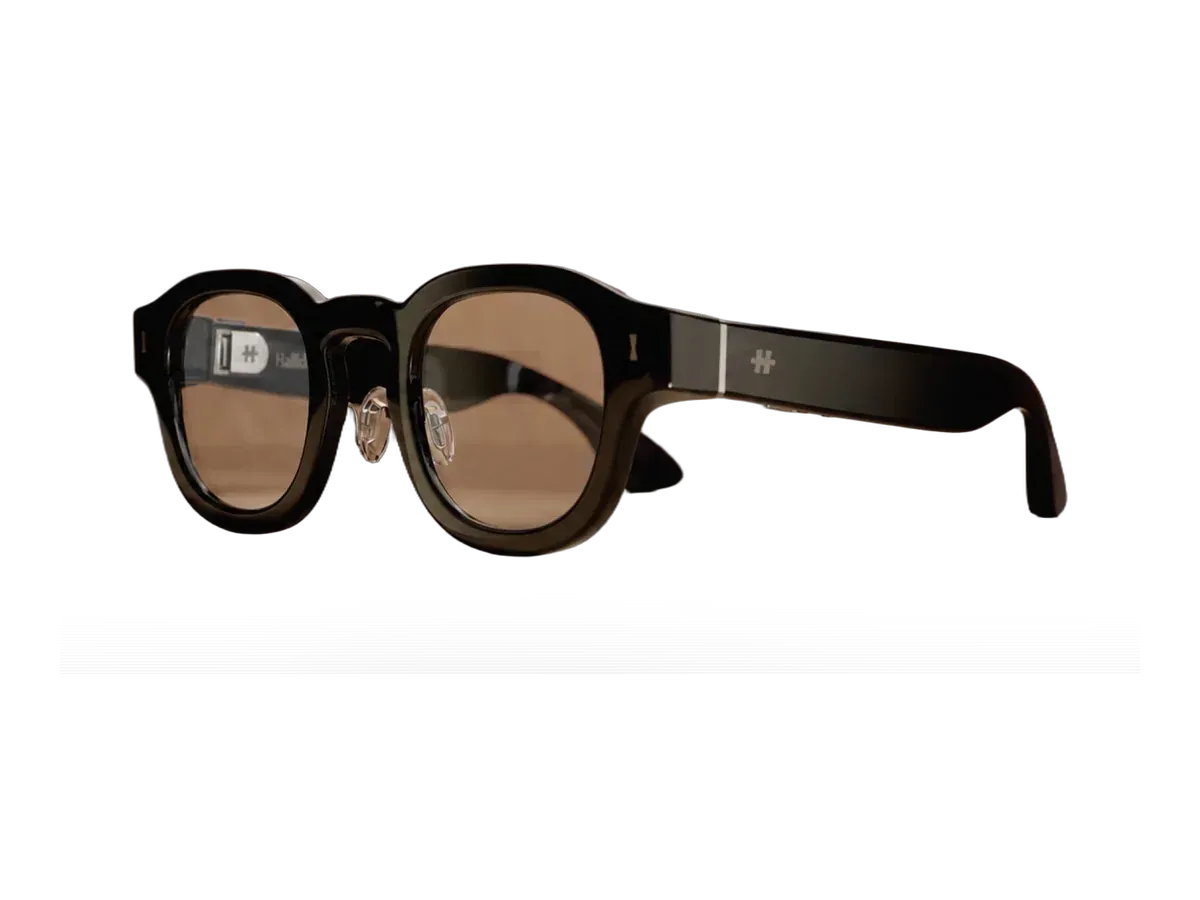
The Rokid Glasses (2025 consumer AI+AR glasses) are smart glasses with a heads-up display from Rokid, released 2025-11. They feature a 480x400 per-eye dual green MicroLED light engines (JBD Hummingbird Mini II) into diffractive waveguides, binocular, 30° field of view, 1500 nits perceived brightness. Weight is 49g. Best for: Early adopters wanting the most complete camera+display+audio AI glasses package under $700.
Our review
By AR Compare Team ·
According to the aggregated consensus of reviewers, the Rokid Glasses are the most complete display-equipped rival yet to Meta's smart glasses -- and the most divisive on design. Tom's Guide, after two months of daily wear, calls them a real Meta Ray-Ban Display rival: light, feature-packed, with a bright green heads-up display and a choice of ChatGPT or Gemini. Trusted Reviews agrees on the smarts but not the look, saying the bulky frame and cheap-feeling plastic mean it would not wear them out of the house, and PhoneArena documented an unnerving bug -- photos and audio captured without permission -- plus battery life far short of the rating. The record reads as a strong, fast-evolving first generation that rewards patient early adopters. Scores below are an editorial aggregate of that cited coverage, not AR Compare hands-on measurements.
- Display quality
- 7/10
- Comfort
- 8.5/10
- Battery life
- 5.5/10
- Value for money
- 6/10
- Build quality
- 6/10
- Software
- 6.5/10
The Rokid Glasses are Rokid’s consumer AI glasses with a real display: a binocular green MicroLED heads-up screen in an otherwise ordinary-looking frame, with a 12MP camera, speakers, and a choice of AI assistants, shipped worldwide from late 2025 after a crowdfunding run PhoneArena puts north of $4 million. This review aggregates the hands-on record — Tom’s Guide’s two-month review, Trusted Reviews’ full review, PhoneArena’s several-week review, and Gizmodo’s early hands-on — alongside Rokid’s published specifications. AR Compare has not performed hands-on testing of this device; every observation below is attributed to the cited sources, and the category scores are an editorial aggregate of cited reviewer sentiment. Product facts were cross-checked against AR Compare’s spec record for the Rokid Glasses (a recorded dual green MicroLED waveguide display, a recorded 30-degree field of view, a recorded 1,500 nits, a 12MP camera, roughly 49 grams, IPX4, Snapdragon AR1, $699).
How This Review Was Compiled
Tom’s Guide’s Jason England has the deepest record — 62 days of daily wear across 5,000 miles of travel — and the warmest verdict. Trusted Reviews’ Lewis Painter wrote the fullest critical review, PhoneArena’s several-week test contributed the most detailed feature-by-feature accounting including the battery and privacy findings, and Gizmodo’s James Pero supplied the earliest hands-on, from a launch-window demo when the software was rawest. Where the sources disagree — design, battery life, and navigation are all genuine splits — both readings are reported below rather than smoothed over.
Rokid Glasses vs Rokid AI Glasses: Which Rokid Is Which?
Search results blur two different Rokid products, so the distinction comes first. The Rokid Glasses reviewed here are the display model: green MicroLED waveguide screens in both lenses show navigation, translations, a teleprompter, and AI answers in front of your eyes. The Rokid AI Glasses Style is a separate, cheaper product with no display at all — a camera-and-audio Ray-Ban Meta rival that answers only by voice. If you want words floating in your vision, this is the Rokid to research; if you want lighter, screen-free camera glasses, it is the other one.
Does Rokid Glasses Have a Display — and Is It Any Good?
Yes — and it is the reason these glasses exist. The recorded 1,500-nit monochrome green MicroLED display stays legible outdoors, which PhoneArena calls precisely what it always wanted from AR glasses, crediting the single-color choice for the everywhere-visible brightness — though Tom’s Guide notes the green can get lost against grass and trees, and the record lists a modest 30-degree field of view. What it shows earned specific praise: Tom’s Guide calls the navigation HUD clear and easy to follow, singles out the on-lens camera viewfinder as an underrated gem no camera-glasses rival offers, and Gizmodo watched the teleprompter scroll in step with a speaker’s voice in a noisy room and called it no small feat. The honest limits are software and subtlety: PhoneArena found the screen can only be nudged vertically — no resizing, no repositioning, no sound-only mode — so content sometimes sits in your way, and Trusted Reviews notes the lens squares reflect visible green light to people around you, plus a baffling lack of auto-brightness.
The AI, the App, and the Privacy Bug
The software story is an arc. In Gizmodo’s launch-window demo the Hi Rokid wake word was basically broken for English speakers while working for Mandarin ones. The shipping product the full reviews describe is different: Trusted Reviews calls the assistant very fast and near-flawless at voice pickup, and Tom’s Guide praises the choice of ChatGPT or Gemini as a real win — switching models to suit the task, Gemini for image and location queries, ChatGPT for quick reasoning. Live translation covers a recorded 89 languages with a connection, and the beamforming microphones impressed every source; Gizmodo half-joked they picked up conversations across the room its reviewer could not hear.
The caveats are real. PhoneArena’s unit captured two photos and a roughly minute-long voice clip without any request or touch it could identify — possibly a bug in software that updates constantly, but exactly the failure a camera-on-your-face product cannot afford, and the assistant flatly denied such captures were possible. The record also flags the phone side: the companion app must run in the background and drains the host phone noticeably per Trusted Reviews, iOS support involves hoops Android users skip per Tom’s Guide, and PhoneArena found navigation abroad — an emulated, voice-only Google Maps layer with no touch input or saved places — effectively unusable, even as Tom’s Guide and Trusted Reviews rated the same navigation better than Even Realities’ alternative. Features arrive and change monthly; PhoneArena’s framing is the fairest: a work in progress with real promise.
Comfort, Prescriptions, Battery, and Charging
Comfort is the one column where every source lines up. At a recorded 49 grams the frame is barely heavier than ordinary glasses per Trusted Reviews, PhoneArena often forgot it was wearing them, and Tom’s Guide calls them the lightest smart glasses it has tested, with stems that do not dig in like the Even Realities G2’s. The build divides: Trusted Reviews likens the glossy plastic to cheap seaside sunglasses and says the frame sits oddly high on the face, while PhoneArena’s gripes are the fingerprint-prone finish and an exposed magnetic charging connector. Prescription wearers are covered by a clip-in insert on a rigid titanium sub-frame with a wide correction range per Tom’s Guide — at a cost of $120 to nearly $200 on top.
Battery is where the record genuinely splits. Tom’s Guide got a full casual day but under two hours of heavy live captioning; Trusted Reviews averaged about eight hours of mixed use against an up-to-12-hour claim; PhoneArena, hardest on it, measured half the charge gone in two hours of intermittent use and roughly four hours of active life from the small cell — well short of the eight hours Rokid advertises. All three agree on the consolations: charging is very fast — flat to full in about half an hour — and the drain depends heavily on how hard the display and camera run. Unlike Meta’s glasses, no charging case comes in the box; the case is a roughly $99 add-on, which PhoneArena argues should have been bundled at this price.
Value
At $699 through Rokid’s store per AR Compare’s spec record, pricing is the muddiest part of the record: Tom’s Guide and PhoneArena both reviewed at a $599 list price, while Trusted Reviews quotes $799 — worth checking at purchase, and AR Compare’s record carries the current store figure. Every source frames the same comparison: roughly double a camera-only Ray-Ban Meta, for the addition of a working display. Tom’s Guide judges that trade worth it and calls the package a first real stab at AI display glasses pulled off rather great; Trusted Reviews says the smarts justify attention but the build does not justify the price; PhoneArena lands at not yet — pay extra for potential, or buy the established rival. Against the Even Realities G2, the aggregated answer is capability versus subtlety: the Rokid adds the camera, speakers, and stronger navigation the G2 deliberately omits, while the G2 stays closer to invisible. Against Meta’s Ray-Ban Display, Tom’s Guide gives Rokid the wearability edge over Meta’s more cumbersome frame.
Who Should Buy the Rokid Glasses
Per the aggregated consensus: early adopters who want the most complete display-plus-camera-plus-AI package currently shipping, travelers who will lean on the on-lens translation and teleprompter, Android users — the cleaner pairing per the record — and presenters who want scrolling notes nobody hands them. Who should skip: anyone privacy-sensitive enough that one documented unauthorized capture is disqualifying, style-first buyers the Trusted Reviews design verdict speaks for, iPhone owners unwilling to babysit a background app, heavy-display users who will hit the two-hour battery floor, and shoppers who want a settled product rather than a fast-moving first generation.
Scores are aggregates of the cited reviews and hands-on reports, not AR Compare hands-on results.
Sources
- Tom’s Guide — Rokid Glasses review: A real Meta Ray-Ban display rival
- Trusted Reviews — Rokid Glasses Review: All of the smarts, none of the style
- PhoneArena — Rokid Glasses review: AI glasses with a screen
- Gizmodo — Rokid Glasses Hands-On: Smart Glasses, Buggy Voice Assistant
- Rokid — Rokid Glasses official product page (specifications)
What other reviewers say
1 review from an outside outlet.
Scores from other outlets, as published — not our rating.
| Source | Score |
|---|---|
| Tom's Guide | the sheer convenience and usefulness of these specs far outweigh these small niggles |
Pros & cons
Pros
- Binocular MicroLED waveguide display plus 12MP camera and speakers in one 49 g frame
- On-board Snapdragon AR1 with multi-LLM support (ChatGPT, Gemini, DeepSeek, user models)
- 89-language translation (5 offline), teleprompter, turn-by-turn navigation
- Cheaper and lighter than Meta Ray-Ban Display while offering both eyes a display
- Passed a real-world stealth test: one reviewer's friends never clocked them as smart glasses, unlike bulkier display rivals
- A camera viewfinder on the lens display, called an underrated gem that ends the guess-framing of camera glasses
- Beamforming microphones that picked up voices one reviewer could not make out with his own ears
- A teleprompter that auto-scrolls by listening to your speech, working smoothly even in a crowded demo room
- Charges from flat to full in roughly half an hour, among the fastest turnarounds reviewers have recorded in the category
Cons
- Monochrome green display, modest 30-degree FOV
- Kickstarter fulfillment plagued by delays, missing accessories and poor communication into 2026
- Prescription requires clip-in insert rather than direct Rx lenses
- Only 2 h battery with always-on display; AI features use paid credit system
- One review documented photos and a voice clip captured without the reviewer's permission, a privacy bug the record cannot yet explain
- The record splits hard on battery: all-day casual wear for one reviewer, half a charge gone in two hours for another
- Design is the dividing line, with one outlet refusing to wear them out of the house over glossy plastic and a high sit on the face
- Navigation runs an emulated, voice-only maps flow that one reviewer abroad found impossible to use
- No charging case in the box; the add-on case runs about $99 more
- Prescription inserts add $120 to nearly $200 on top of the sticker
Full specifications
| Optics | |
|---|---|
| Optics type | waveguide |
| Dimming control | ✓ Yes |
| Prescription support | ✓ Yes |
| Prescription options | Inserts / lens frame via Rokid's official optical service partner, -16.00 to 0.00, $39.00 USD frame; lens cost via partner store (undocumented on rokid.com) |
| Not published: Transparency level | |
| Physical | |
| Weight (g) | 49 |
| Foldable | ✕ No |
| IP rating | IPX4 |
| Not published: Frame style, Color options | |
| Battery & power | |
| Battery life (hours) | 9 |
| Not published: Charging method, Charging time | |
| Connectivity | |
| Compatible devices | iOS, Android |
| Not published: Connectivity, Tethered | |
| Computing | |
| Operating system | Rokid AI (supports ChatGPT, Gemini, DeepSeek, Microsoft Translator, Google Maps integrations); 89-language translation, 5 offline |
| Chipset | Qualcomm Snapdragon AR1 + NXP RT600 low-power co-processor, on-device |
| Not published: Processing type | |
| Sensors & input | |
| Camera | 12MP |
| Speakers | open-ear |
| Tracking | 0DoF |
| Not published: Microphones, Gesture control, Voice control | |
Prescription options
The documented prescription routes for the Rokid Glasses (2025 consumer AI+AR glasses), from the maker and named-partner documentation recorded in our database.
- Inserts / lens frame via Rokid's official optical service partner, -16.00 to 0.00, $39.00 USD frame; lens cost via partner store (undocumented on rokid.com) Source: global.rokid.com documentation
Maker documentation as recorded 2026-09-17. Ranges are the maker's published limits, not medical advice — confirm your exact prescription with your optician before ordering.
Read the Rokid prescription guide for every documented option, model by model.
Where to buy
Price checked
Rokid Glasses specs: quick answers
- What is the Rokid Glasses (2025 consumer AI+AR glasses)'s field of view?
- The Rokid Glasses (2025 consumer AI+AR glasses) has a 30-degree field of view.
- What is the Rokid Glasses (2025 consumer AI+AR glasses)'s display resolution?
- The Rokid Glasses (2025 consumer AI+AR glasses)'s recorded per-eye display resolution is 480x400.
- How bright is the Rokid Glasses (2025 consumer AI+AR glasses)'s display?
- The Rokid Glasses (2025 consumer AI+AR glasses) has a rated peak brightness of 1500 nits.
- How much does the Rokid Glasses (2025 consumer AI+AR glasses) weigh?
- The Rokid Glasses (2025 consumer AI+AR glasses)'s glasses weigh 49g according to the manufacturer specification.
- How long does the Rokid Glasses (2025 consumer AI+AR glasses)'s battery last?
- The Rokid Glasses (2025 consumer AI+AR glasses) is rated for about 9 hours of battery life.
- Does the Rokid Glasses (2025 consumer AI+AR glasses) have a camera?
- Yes, the Rokid Glasses (2025 consumer AI+AR glasses) has a built-in camera. The recorded camera resolution is 12MP.
- How much does the Rokid Glasses (2025 consumer AI+AR glasses) cost?
- The Rokid Glasses (2025 consumer AI+AR glasses) costs $699.
Rokid Glasses: FAQs
How much does the Rokid Glasses (2025 consumer AI+AR glasses) cost?
The Rokid Glasses (2025 consumer AI+AR glasses) costs $699 (USD). It is available from 1 retailer listed on this page.
What field of view does the Rokid Glasses (2025 consumer AI+AR glasses) have?
The Rokid Glasses (2025 consumer AI+AR glasses) has a recorded field of view of 30 degrees.
How much does the Rokid Glasses (2025 consumer AI+AR glasses) weigh?
The Rokid Glasses (2025 consumer AI+AR glasses) weighs 49g according to the manufacturer specification.
How long does the battery last on the Rokid Glasses (2025 consumer AI+AR glasses)?
The Rokid Glasses (2025 consumer AI+AR glasses) has a rated battery life of 9 hours.
Can I use the Rokid Glasses (2025 consumer AI+AR glasses) with prescription lenses?
Yes, the Rokid Glasses (2025 consumer AI+AR glasses) supports prescription lenses. The recorded diopter range is yes, via magnetic clip-in corrective lens frame.
Does the Rokid Glasses (2025 consumer AI+AR glasses) have a camera?
Yes, the Rokid Glasses (2025 consumer AI+AR glasses) has a built-in camera (12MP).
What devices work with the Rokid Glasses (2025 consumer AI+AR glasses)?
The Rokid Glasses (2025 consumer AI+AR glasses) lists compatibility with: iOS, Android.
What resolution does the Rokid Glasses (2025 consumer AI+AR glasses) have?
The Rokid Glasses (2025 consumer AI+AR glasses) has a recorded per-eye resolution of 480x400.
Is the Rokid Glasses (2025 consumer AI+AR glasses) worth it?
The Rokid Glasses (2025 consumer AI+AR glasses) is priced at $699 (USD). For that you get a 30-degree field of view, 1500 nits of brightness, a 480x400 per-eye resolution, and 9 hours of rated battery life. It weighs 49g. The full spec breakdown on this page shows what the price includes.
Similar products
What shoppers cross-check with the Rokid Glasses — from our navigation records and closest spec matches.

Ranked in these buying guides
Where the Rokid Glasses lands in our recorded-spec rankings.
- Best AR Glasses for iPhone Users
- Prescription Smart Glasses
- Best Everyday Smart Glasses
- Sport Smart Glasses: Best for Running & Fitness
- The Best Smart Glasses of 2026
- Smart Glasses With a Display
- Lightest Smart Glasses
- Best Teleprompter Glasses
- HUD Glasses: Every Heads-Up Display, Ranked
- Widest FOV AR Glasses
- Brightest Smart Glasses
- Smart Glasses Battery Life, Ranked
- Smart Glasses with a Camera
Related Comparisons
Rokid Glasses (2025 consumer AI+AR glasses) vs Even Realities G2
Rokid vs Even Realities
Rokid Glasses (2025 consumer AI+AR glasses) vs Meta Ray-Ban Display
Rokid vs Meta
Rokid Glasses (2025 consumer AI+AR glasses) vs VITURE Luma Ultra XR/AR Glasses
Rokid vs VITURE
Rokid Glasses (2025 consumer AI+AR glasses) vs Almer Arc 2 AR Glasses
Rokid vs Almer
Rokid Glasses (2025 consumer AI+AR glasses) vs Amazon Echo Frames (3rd Gen)
Rokid vs Amazon
Rokid Glasses (2025 consumer AI+AR glasses) vs Brilliant Labs Frame
Rokid vs Brilliant Labs
Rokid Glasses (2025 consumer AI+AR glasses) vs Brilliant Labs Halo AI Glasses
Rokid vs Brilliant Labs
Rokid Glasses (2025 consumer AI+AR glasses) vs Chamelo Music Shield
Rokid vs Chamelo
Rokid Glasses (2025 consumer AI+AR glasses) vs Even Realities G1
Rokid vs Even Realities
Rokid Glasses (2025 consumer AI+AR glasses) vs Halliday AI Glasses
Rokid vs Halliday
Rokid Glasses (2025 consumer AI+AR glasses) vs Halliday G2
Rokid vs Halliday
Rokid Glasses (2025 consumer AI+AR glasses) vs HTC Vive Eagle
Rokid vs HTC
Rokid Glasses (2025 consumer AI+AR glasses) vs Inmo GO
Rokid vs Inmo
Rokid Glasses (2025 consumer AI+AR glasses) vs INMO GO3 AI Translation Glasses
Rokid vs Inmo
Rokid Glasses (2025 consumer AI+AR glasses) vs Lucyd Lyte (2025)
Rokid vs Lucyd
Rokid Glasses (2025 consumer AI+AR glasses) vs Meta Adventurer
Rokid vs Meta
Rokid Glasses (2025 consumer AI+AR glasses) vs Meta Fury
Rokid vs Meta
Rokid Glasses (2025 consumer AI+AR glasses) vs Oakley Meta HSTN Performance AI Glasses
Rokid vs Oakley
Rokid Glasses (2025 consumer AI+AR glasses) vs Oakley Meta Vanguard
Rokid vs Oakley
Rokid Glasses (2025 consumer AI+AR glasses) vs OPPO Air Glass 3
Rokid vs OPPO
Rokid Glasses (2025 consumer AI+AR glasses) vs Ray-Ban Meta Audio
Rokid vs Meta
Rokid Glasses (2025 consumer AI+AR glasses) vs Ray-Ban Meta AI Glasses (Gen 1)
Rokid vs Meta
Rokid Glasses (2025 consumer AI+AR glasses) vs Ray-Ban Meta Gen 2
Rokid vs Meta
Rokid Glasses (2025 consumer AI+AR glasses) vs Ray-Ban Meta (Gen 3)
Rokid vs Meta
Rokid Glasses (2025 consumer AI+AR glasses) vs RayNeo iO
Rokid vs RayNeo
Rokid Glasses (2025 consumer AI+AR glasses) vs RealWear Navigator 520
Rokid vs RealWear
Rokid Glasses (2025 consumer AI+AR glasses) vs Rokid AI Glasses Style
Rokid
Rokid Glasses (2025 consumer AI+AR glasses) vs Samsung Smart Glasses
Rokid vs Samsung
Rokid Glasses (2025 consumer AI+AR glasses) vs Solos AirGo 3
Rokid vs Solos
Rokid Glasses (2025 consumer AI+AR glasses) vs Solos AirGo Vision Smart Glasses
Rokid vs Solos
Rokid Glasses (2025 consumer AI+AR glasses) vs Thunderbird V3 AI Shooting Glasses
Rokid vs Thunderbird Innovation
Rokid Glasses (2025 consumer AI+AR glasses) vs Vuzix M400 Smart Glasses
Rokid vs Vuzix
Rokid Glasses (2025 consumer AI+AR glasses) vs Vuzix Ultralite Pro
Rokid vs Vuzix
Rokid Glasses (2025 consumer AI+AR glasses) vs Vuzix Z100
Rokid vs Vuzix
Rokid Glasses (2025 consumer AI+AR glasses) vs Warby Parker Intelligent Eyewear
Rokid vs Warby Parker
Rokid Glasses (2025 consumer AI+AR glasses) vs Xiaomi AI Glasses
Rokid vs Xiaomi
Rokid Glasses (2025 consumer AI+AR glasses) vs Snap Specs (Consumer Edition)
Rokid vs Snap