At a glance
- Display type
- Diffractive waveguide with dynamic dimming, binocular see-through
- Resolution
- 1440x1760
- Field of view
- 70°
- Refresh rate
- 120 Hz
- Brightness
- 2000 nits
- Weight
- 260 g
- Battery
- 3.5 hr
- 70-degree FOV is the widest of any commercially available AR headset
- World's first dynamic dimming makes virtual content appear solid in any lighting
- $3,299-$4,999 price range limits to well-funded enterprise deployments
- Visor form factor is still conspicuous -- not wearable as regular glasses
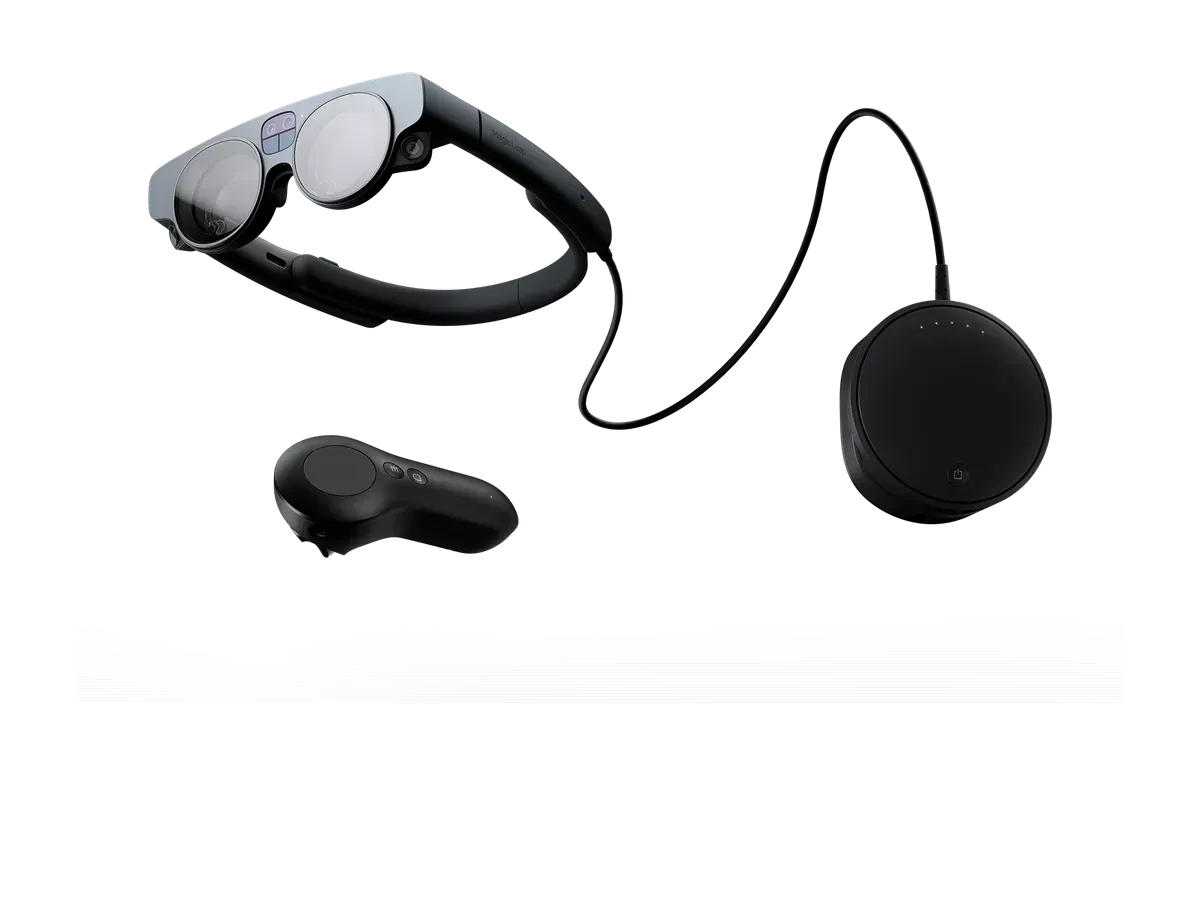
Magic Leap 2
Magic Leap
7.5/10 “According to the aggregated consensus of reviewers, the Magic Leap 2 was the most capable optical see-through AR headset of its generation, and its standout feature is dynamic dimming. Engadget called it the best AR headset yet and described switching on the global dimmer as a shadowy cloud blotting out the fluorescent lights -- the trick that lets the display effectively add the color black instead of only projecting light, making holograms feel solid. The recorded 70-degree field of view is praised as dramatically larger than the original, and at a recorded 260 grams the headset feels more like glasses, with the compute moved to a body-worn pack. The honest caveats are its context: this is a $3,299 enterprise device, not a consumer one, with a recorded 3.5-hour battery and a tethered compute pack, and the AR Compare record now marks it discontinued as teams wait for next-generation waveguide glasses.” Read the full reviewContact manufacturer for pricing
See current alternatives- Field of view
- 70°
- Weight
- 260 g
- Battery
- 3.5 hr
The Magic Leap 2 is an enterprise-focused standalone AR headset featuring the world's first dynamic dimming technology, a 70-degree diagonal field of view with 1536x1856 resolution per eye, 11 cameras for comprehensive tracking, and an AMD Zen2 x86 processor -- delivering the widest FOV in any AR headset at just 260 grams.
Our review
By AR Compare Team ·
According to the aggregated consensus of reviewers, the Magic Leap 2 was the most capable optical see-through AR headset of its generation, and its standout feature is dynamic dimming. Engadget called it the best AR headset yet and described switching on the global dimmer as a shadowy cloud blotting out the fluorescent lights -- the trick that lets the display effectively add the color black instead of only projecting light, making holograms feel solid. The recorded 70-degree field of view is praised as dramatically larger than the original, and at a recorded 260 grams the headset feels more like glasses, with the compute moved to a body-worn pack. The honest caveats are its context: this is a $3,299 enterprise device, not a consumer one, with a recorded 3.5-hour battery and a tethered compute pack, and the AR Compare record now marks it discontinued as teams wait for next-generation waveguide glasses.
- Display quality
- 8.5/10
- Comfort
- 7.5/10
- Battery life
- 4.5/10
- Value for money
- 5/10
- Build quality
- 8/10
- Software
- 7.5/10
The Magic Leap 2 is an enterprise-focused optical see-through AR headset, and its review record is written for business buyers — surgeons, engineers, and defense teams — rather than consumers. This review aggregates that record: Engadget’s in-depth review, ArborXR’s business evaluation, VR Expert’s and Magnopus’s enterprise writeups, Smart Glass Logic’s aggregated review, and — following a September 2026 re-check — Magic Leap’s own published end-of-sale notices, TechCrunch’s reporting on this generation’s wind-down, and UploadVR’s coverage of the company’s pivot to supplying optics. AR Compare has not performed hands-on testing of this device; every observation below is attributed to the cited sources, and the category scores are an editorial aggregate of cited reviewer sentiment. Product facts were cross-checked against AR Compare’s spec record for the Magic Leap 2 (diffractive waveguide with dynamic dimming, a recorded 70-degree field of view, a recorded 1440x1760 per eye at a recorded 120Hz, a recorded 2,000-nit peak, roughly 260 grams, a recorded 3.5-hour battery, $3,299). The record marks the device discontinued, and the end-of-life is now dated in Magic Leap’s own documents; both are treated honestly throughout.
How This Review Was Compiled
Sources include Engadget’s technical review, ArborXR’s business-focused evaluation, VR Expert’s review, Magnopus’s enterprise assessment, and Smart Glass Logic’s aggregated scoring. The September 2026 additions are of a different kind: primary documents — Magic Leap’s Terms of Sale and its customer-care availability notice, which put exact dates on the end of sales and support — plus TechCrunch’s reporting on the fates of this headset’s generation and UploadVR’s account of what Magic Leap became instead. Because deployments vary widely by industry, the review focuses on the hardware capabilities reviewers agree on rather than any single vertical, and treats the dated wind-down record as essential buying context rather than a footnote.
Dynamic Dimming: The Feature Everyone Leads With
The headline is the dimming. Engadget describes activating the global dimmer as if a shadowy cloud was blotting out the sickly fluorescent lights overhead, cutting incoming light by a large factor and producing an almost VR-like experience. The deeper point reviewers make is that this lets the Magic Leap 2 do something most AR displays cannot: because it can subtract real-world light, it can effectively render the color black, so holograms read as solid objects rather than translucent overlays — a genuine advantage under the bright lighting of an operating theater or a factory floor.
Field of View and Display
The recorded 70-degree field of view is the other consensus strength. Engadget frames the jump from the original — which felt like viewing AR through a cramped rear window — to the Magic Leap 2 as standing in front of an open doorway, and calls the result almost aggressively immersive, with the enlarged vertical area doing much of the work. Paired with a recorded 1440x1760 per-eye resolution and a recorded 2,000-nit peak, reviewers rate holograms and text as crisp and stable, which is what enterprise use cases like surgical navigation and engineering visualization demand.
Design, Comfort, and Compute
Weight and form factor improved markedly over the first generation. At a recorded 260 grams the headset is roughly half the weight of a Microsoft HoloLens 2, and Engadget notes it feels more like glasses, with flatter lenses and slimmer arms. The trade-off is the compute: the processing unit — built on an AMD Zen 2 CPU with RDNA 2 graphics — lives in a separate pack worn across the body like a messenger bag and tethered to the headset by a cable. That keeps the head-worn weight down but adds a wire and a body-worn component, and the recorded 3.5-hour battery limits how long a single untethered session can run.
Software and Enterprise Fit
The software foundation is a business one: an Android AOSP-based platform with OpenXR, Unity, and Unreal support, which reviewers credit for stability and for an ecosystem of enterprise applications — most notably FDA-cleared and FDA-registered surgical navigation tools from partners in the medical space. This is not a plug-and-play consumer device; it expects enterprise deployment, managed content, and a use case that justifies the investment.
Value and Status
At $3,299 the Magic Leap 2 is explicitly not aimed at consumers — Engadget is clear the pitch is to doctors wanting AR assistance during surgery and engineers viewing schematics beside machinery. The aggregate value verdict is therefore conditional on the vertical: immense for organizations with a defined optical-AR workflow, hard to justify for anyone else. The important honesty note is status: the AR Compare record marks the Magic Leap 2 discontinued, and reviewers observe that many teams evaluating see-through AR now wait for the next generation of lightweight waveguide glasses rather than deploying it new. Buyers should treat this as a benchmark of what its generation achieved rather than a current purchase recommendation.
The Dated Wind-Down: What Magic Leap’s Own Documents Say
The end-of-life is no longer a status flag; it is a published schedule. Magic Leap’s Terms of Sale state that direct sales of Magic Leap 2 products ended on March 31, 2026, that authorized resellers may continue delivering units through December 31, 2026, and that a unit sold or delivered after that date is not eligible for Customer Care support and carries a void warranty. The company’s availability notice adds the horizon that matters most for anyone still running fleets: support and warranty for existing devices continue through December 31, 2027. What happens to the hardware after that is the open question the record cannot yet answer, and the precedent is not reassuring — TechCrunch reported that when the original Magic Leap 1 reached its own end-of-life date of December 31, 2024, cloud services, apps, and general functionality effectively ceased.
The context is generational, not just corporate. Microsoft quietly discontinued the HoloLens 2 — the headset this review’s weight and field-of-view comparisons are measured against — in October 2024, with its own security support also running out at the end of 2027, and TechCrunch notes no successor is in sight. Both flagships of the optical see-through generation are now closed platforms on the same countdown. Magic Leap itself did not vanish: UploadVR reports the company extended its partnership with Google by three years in October 2025 and now supplies waveguide optics — paired with Google’s Raxium microLED light engine — as a reference design for Android XR glasses, with Google’s XR chief praising a level of clarity and stability that is rare in AR today. The pointed detail in that report: the prototype shown is explicitly not a Magic Leap 3. The optics live on; the headset line ends here.
Who Should Buy the Magic Leap 2
Per the aggregated consensus: enterprise and clinical teams with a specific optical see-through AR workflow — surgical navigation, industrial visualization, defense — who need the widest field of view and the dynamic dimming that makes holograms solid under bright light, who can support body-worn compute and enterprise deployment, and who can complete a deployment inside the supported window that Magic Leap’s own documents close at the end of 2027. Who should skip: consumers, anyone who wants an untethered all-day battery, buyers who need a plug-and-play experience, anyone offered a unit delivered after December 31, 2026 (no Customer Care support, void warranty, per the Terms of Sale), and organizations that, given the discontinued status, would be better served evaluating current-generation hardware.
Scores are aggregates of the cited reviews and enterprise evaluations, not AR Compare hands-on results.
Sources
- Engadget — Magic Leap 2 is the best AR headset yet, but will an enterprise focus save the company?
- ArborXR — We Reviewed the Magic Leap 2 AR Headset for Business
- VR Expert — Magic Leap 2 Review
- Magnopus — Magic Leap 2: The most immersive AR headset for enterprise
- Smart Glass Logic — Magic Leap 2 Review
- UploadVR — Magic Leap & Google Extend Partnership And Show HUD Glasses Prototype
- TechCrunch — Microsoft HoloLens 2 discontinued with no successor in sight
- TechCrunch — Magic Leap’s original headset will stop working at the end of 2024
- Magic Leap — Terms of Sale (Magic Leap 2 end-of-sale dates)
- Magic Leap — Magic Leap 2 Availability (support and warranty through 2027)
Pros & cons
Pros
- 70-degree FOV is the widest of any commercially available AR headset
- World's first dynamic dimming makes virtual content appear solid in any lighting
- 260g is significantly lighter than HoloLens 2 at 566g
- 120Hz refresh rate and 2,000-nit brightness for smooth, bright AR content
- 12.6MP camera with 4K video for high-quality content capture
- Dynamic dimming that darkens the real world to make holograms solid, letting the display uniquely render black rather than only add light
- A recorded 2,000-nit peak and a recorded 1440x1760 per-eye resolution that keep holograms and text crisp under bright lighting
- Android AOSP foundation with OpenXR, Unity, and Unreal support, and a track record in FDA-cleared surgical navigation apps
Cons
- $3,299-$4,999 price range limits to well-funded enterprise deployments
- Visor form factor is still conspicuous -- not wearable as regular glasses
- AMD Zen2 x86 processor generates heat during extended use
- Magic Leap's uncertain financial history raises longevity concerns
- Controller battery lasts only 3 hours -- separate from headset battery
- The compute lives in a separate pack worn on the body, tethered to the headset by a cable
- A recorded 3.5-hour battery limits untethered sessions
- The AR Compare record marks it discontinued, and reviewers note many teams now wait for next-generation waveguide glasses
- It requires enterprise deployment and content, not a plug-and-play consumer experience
Full specifications
Specs last verified
| Display | |
|---|---|
| Display type | Diffractive waveguide with dynamic dimming, binocular see-through |
| Resolution | 1440x1760 |
| Field of view (°) | 70 |
| Refresh rate (Hz) | 120 |
| Brightness (nits) | 2000 |
| HDR support | ✕ No |
| Color support | Full color |
| Not published: Pixels per degree, Virtual screen size | |
| Optics | |
| Optics type | waveguide |
| Dimming control | ✓ Yes |
| Transparency level | dynamic dimming (0-100%) |
| Prescription support | ✓ Yes |
| Prescription options | Inserts / lens frame via Frame of Choice |
| Physical | |
| Weight (g) | 260 |
| Frame style | visor with headband |
| Color options | Black |
| Foldable | ✕ No |
| Not published: IP rating | |
| Battery & power | |
| Battery life (hours) | 3.5 |
| Charging method | USB-C |
| Not published: Charging time | |
| Connectivity | |
| Connectivity | Bluetooth 5.0, WiFi 6, WiFi 6E, USB-C |
| Tethered | ✕ No |
| Compatible devices | Standalone |
| Computing | |
| Processing type | on-device |
| Operating system | Android AOSP-based (ML OS); OpenXR, Unity, Unreal support |
| Chipset | Tethered Compute Pack (425 g): AMD quad-core Zen 2 x86, 16GB RAM, 256GB storage |
| Sensors & input | |
| Camera | 12.6MP (9×) |
| Microphones | 4 |
| Speakers | directional · spatial audio |
| Tracking | 6DoF, head, eye, hand, SLAM |
| Gesture control | ✓ Yes |
| Voice control | ✓ Yes |
Prescription options
The documented prescription routes for the Magic Leap 2, from the maker and named-partner documentation recorded in our database.
- Inserts / lens frame via Frame of Choice — range not published by the maker Source: magicleap.care documentation
Maker documentation as recorded 2026-09-17. Ranges are the maker's published limits, not medical advice — confirm your exact prescription with your optician before ordering.
Where to buy
Magic Leap 2 specs: quick answers
- What is the Magic Leap 2's field of view?
- The Magic Leap 2 has a 70-degree field of view.
- What is the Magic Leap 2's display resolution?
- The Magic Leap 2's recorded per-eye display resolution is 1440x1760.
- How bright is the Magic Leap 2's display?
- The Magic Leap 2 has a rated peak brightness of 2000 nits.
- How much does the Magic Leap 2 weigh?
- The Magic Leap 2's glasses weigh 260g according to the manufacturer specification.
- How long does the Magic Leap 2's battery last?
- The Magic Leap 2 is rated for about 3.5 hours of battery life.
- Does the Magic Leap 2 have a camera?
- Yes, the Magic Leap 2 has 9 built-in cameras. The recorded camera resolution is 12.6MP.
- How much does the Magic Leap 2 cost?
- The Magic Leap 2 launched at $3,299 for the base model, with the Developer Pro at $4,099 and the Enterprise edition at $4,999 -- sold through enterprise quotes rather than a consumer store. Direct sales ended on March 31, 2026, so any remaining units now come only through authorized resellers. Source: AR Compare's Magic Leap 2 review ↗
- Is the Magic Leap 2 still available?
- The Magic Leap 2 is discontinued. Magic Leap's own Terms of Sale ended direct sales on March 31, 2026, authorized resellers may deliver remaining stock only through December 31, 2026, and the official store listing is no longer live. Source: AR Compare's Magic Leap 2 review ↗
- How long will the Magic Leap 2 be supported?
- Magic Leap's published availability notice runs support and warranty for existing devices through December 31, 2027. A unit sold or delivered after December 31, 2026 is not eligible for Customer Care support and carries a void warranty under the Terms of Sale. Source: AR Compare's Magic Leap 2 review ↗
- What should Magic Leap 2 buyers consider instead?
- Its generational rival, the Microsoft HoloLens 2, was discontinued in October 2024 with security support also running out at the end of 2027, so teams weighing either platform are choosing between two closed countdowns. AR Compare's Magic Leap 2 vs HoloLens 2 comparison breaks the two headsets down side by side for anyone still evaluating used or reseller units. Source: Magic Leap 2 vs HoloLens 2 ↗
Magic Leap 2: FAQs
What field of view does the Magic Leap 2 have?
The Magic Leap 2 has a recorded field of view of 70 degrees.
How much does the Magic Leap 2 weigh?
The Magic Leap 2 weighs 260g according to the manufacturer specification.
How long does the battery last on the Magic Leap 2?
The Magic Leap 2 has a rated battery life of 3.5 hours.
Can I use the Magic Leap 2 with prescription lenses?
Yes, the Magic Leap 2 supports prescription lenses. The recorded diopter range is Prescription inserts available.
Does the Magic Leap 2 have a camera?
Yes, the Magic Leap 2 has a built-in camera (12.6MP).
What devices work with the Magic Leap 2?
The Magic Leap 2 lists compatibility with: Standalone.
What resolution does the Magic Leap 2 have?
The Magic Leap 2 has a recorded per-eye resolution of 1440x1760. It refreshes at 120Hz.
Similar products
What shoppers cross-check with the Magic Leap 2 — from our navigation records and closest spec matches.
Related Comparisons
Magic Leap 2 vs Microsoft HoloLens 2
Magic Leap vs Microsoft
Magic Leap 2 vs RayNeo X3 Pro
Magic Leap vs RayNeo
Magic Leap 2 vs Lenovo ThinkReality A3
Magic Leap vs Lenovo
Magic Leap 2 vs XREAL Air 2 Ultra
Magic Leap vs XREAL
Magic Leap 2 vs Epson Moverio BT-45C
Magic Leap vs Epson
Magic Leap 2 vs Vuzix Blade 2
Magic Leap vs Vuzix
Magic Leap 2 vs Snap Spectacles Gen 5
Magic Leap vs Snap
Magic Leap 2 vs TCL RayNeo X2
Magic Leap vs RayNeo
Magic Leap 2 vs DigiLens ARGO Smart Glasses
Magic Leap vs DigiLens
Magic Leap 2 vs Dream Glass Lead Pro
Magic Leap vs Dreamworld
Magic Leap 2 vs Inmo Air2
Magic Leap vs Inmo
Magic Leap 2 vs INMO Air3 All-in-One Full-Color Waveguide AR Glasses
Magic Leap vs Inmo
Magic Leap 2 vs Mad Gaze Glow Plus
Magic Leap vs Mad Gaze
Magic Leap 2 vs Rokid AR Spatial
Magic Leap vs Rokid
Magic Leap 2 vs Snap Specs (Consumer Edition)
Magic Leap vs Snap
Magic Leap 2 vs XREAL Aura
Magic Leap vs XREAL