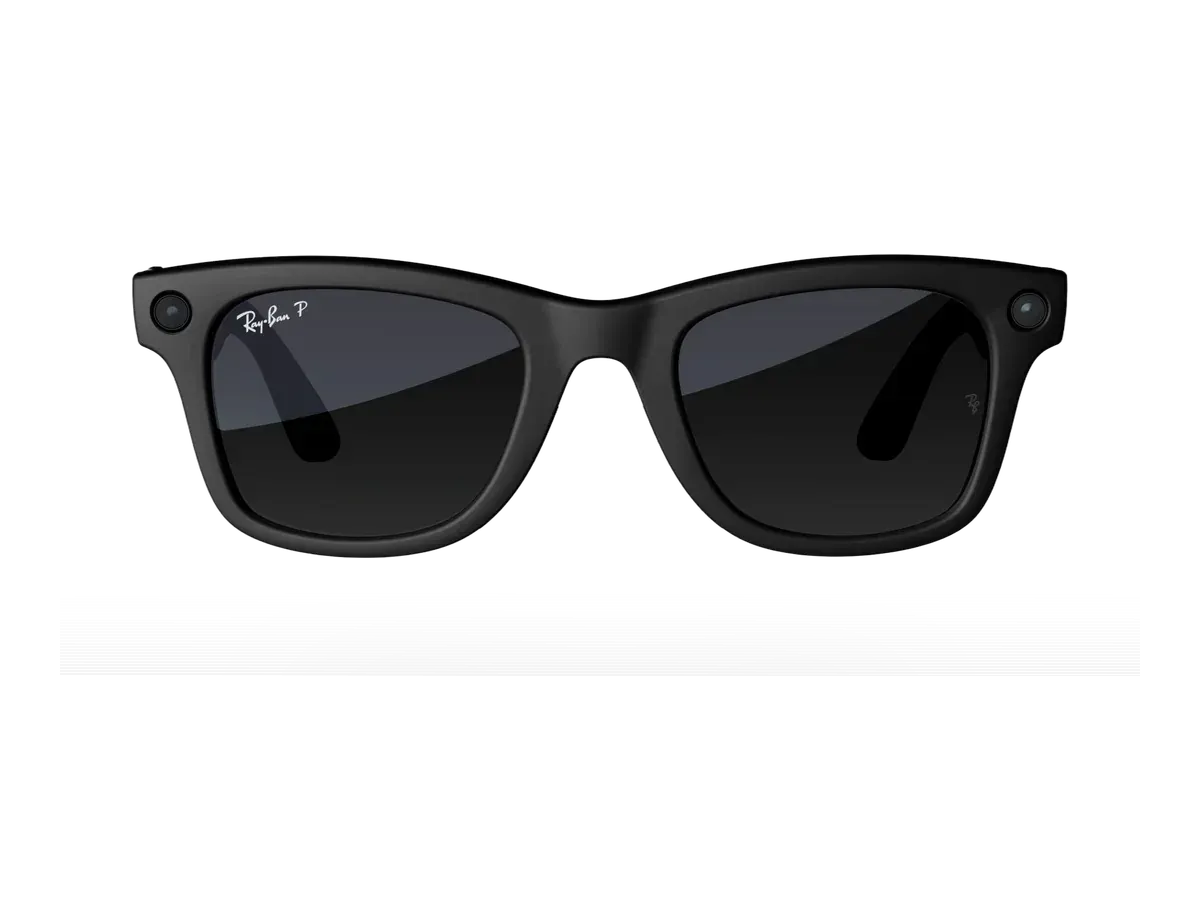
At a glance
- Weight
- 49 g
- Battery
- 4 hr
- Cheapest entry into the Ray-Ban Meta line at $299 list, often discounted to ~$225-250
- Classic Wayfarer/Skyler/Headliner styling at near-normal glasses weight (~49g)
- Only ~4 hours moderate-use battery (154 mAh) vs 8 hours on Gen 2
- Video capped at 1080p/30fps vs 3K/60fps on Gen 2
Ray-Ban Meta AI Glasses
Meta
7.8/10 “According to the aggregated consensus of reviewers, the Ray-Ban Meta Gen 1 is the pair of camera glasses that made smart glasses mainstream -- in Moor Insights & Strategy's words, 'a clear winner' -- and it remains a credible budget pick now that Gen 2 has replaced it at the top of the line. CGMagazine scored a long-term unit 8/10, and the record consistently praises near-normal Ray-Ban styling at a recorded 49 grams, call audio reviewers found remarkably clear, and hands-free capture that beats pulling out a phone. The gripes never change either: battery life reviewers put at three to four hours, video capped at 1080p that the sequel doubles past, and an assistant launch reviewers found underwhelming until software updates widened it. Scores below are an editorial aggregate of that cited coverage, not AR Compare hands-on measurements.” Read the full review$224
Check price at Amazon- Weight
- 49 g
- Battery
- 4 hr
- Camera
- 12MP
The Ray-Ban Meta AI Glasses (Gen 1) are AI-powered camera glasses from Meta, released 2023-10. There's no display: everything comes back as audio. Weight is 49g. Best for: Budget-conscious buyers who want Meta camera/AI glasses and can live with shorter battery and 1080p video.
Our review
By AR Compare Team ·
According to the aggregated consensus of reviewers, the Ray-Ban Meta Gen 1 is the pair of camera glasses that made smart glasses mainstream -- in Moor Insights & Strategy's words, 'a clear winner' -- and it remains a credible budget pick now that Gen 2 has replaced it at the top of the line. CGMagazine scored a long-term unit 8/10, and the record consistently praises near-normal Ray-Ban styling at a recorded 49 grams, call audio reviewers found remarkably clear, and hands-free capture that beats pulling out a phone. The gripes never change either: battery life reviewers put at three to four hours, video capped at 1080p that the sequel doubles past, and an assistant launch reviewers found underwhelming until software updates widened it. Scores below are an editorial aggregate of that cited coverage, not AR Compare hands-on measurements.
- Display quality
- 1/10
- Comfort
- 8/10
- Battery life
- 4/10
- Value for money
- 8/10
- Build quality
- 7.5/10
- Software
- 6/10
The Ray-Ban Meta Gen 1 is the pair of camera glasses that made smart glasses a mainstream product: classic Ray-Ban frames carrying a recorded 12MP camera, open-ear speakers, and Meta’s voice assistant, with no display of any kind. Meta and Ray-Ban launched it on October 17, 2023 at a $299 list price, and since its successor arrived it has sold as the budget entry to the line. This review aggregates the hands-on record: Engadget’s launch review, Moor Insights & Strategy’s analyst review, Tom’s Hardware’s full review, Guiding Tech’s daily-wear review, and CGMagazine’s scored long-term review. AR Compare has not performed hands-on testing of this device; every observation below is attributed to the cited sources, and the category scores are an editorial aggregate of cited reviewer sentiment. Product facts were cross-checked against AR Compare’s spec record for the Gen 1 (a recorded 12MP camera, roughly 49 grams, a 4-hour battery rating, IPX4 water resistance, Snapdragon AR1 Gen 1, $224).
How This Review Was Compiled
The cited coverage spans the product’s whole life. Engadget’s Karissa Bell published the launch-week review in October 2023, Moor Insights & Strategy’s Anshel Sag wrote the fullest early assessment that December after close to a month of near-daily wear, Guiding Tech’s Sumukh Rao reviewed them as everyday prescription eyewear through 2024, CGMagazine’s Dayna Eileen scored a long-term unit 8/10 in December 2024, and Tom’s Hardware’s Brandon Hill filed the latest full review in February 2025, including a measured battery run. Where the sources disagree — real-world battery life and how many recharges the case holds are the genuine conflicts — both readings are reported below rather than smoothed over.
The Camera: Why the Gen 1 Took Off
Every source treats hands-free capture as the reason these glasses exist, and the consensus on quality is consistent: good enough to share, short of a phone. Engadget judged the upgraded camera not as sharp as most phones but more than adequate for social media, a verdict Tom’s Hardware repeated in 2025 — stills a tad underexposed yet fine for a quick post, recorded video surprisingly clear and crisp. Guiding Tech is the most enthusiastic in daylight — the recorded 12MP camera captures excellent colors and dynamic range — and the most specific about the limit: photos and videos get noisy and grainy once the light drops. Stabilization is a genuine strength across the record: Moor Insights & Strategy calls it incredibly good, smooth enough that walking and driving footage stays watchable, and Guiding Tech independently describes it as top-notch. The ceilings are just as consistent: video records at 1080p and 30fps, clips run one minute by default and three minutes at most, and the capture LED that alerts bystanders cannot be switched off. The glasses also livestream directly to Instagram or Facebook, which Engadget found far easier than holding up a phone.
Audio and Calls: The Quiet Strength
The audio story drew some of the record’s warmest language. Engadget reports the open-ear speakers are 50 percent louder than the previous generation’s and no longer distort at higher volumes, and CGMagazine found the sound quality surprisingly good considering it was coming from a pair of sunglasses. Tom’s Hardware adds the honest qualifier: lacking in bass, but with excellent, distortion-free clarity. Calls may be the single most praised feature — per Tom’s Hardware, speech processing was impeccable and callers heard a loud, clear voice, while Guiding Tech reports the microphone array picks up voices impressively well, with the expected open-ear trade-off of some sound leaking to people nearby at volume.
Meta AI: Underwhelming at Launch, Better With Age
Software is where the record moved the most. At launch, Engadget’s reviewer was mostly underwhelmed by interactions with Meta AI, and Moor Insights & Strategy agreed the assistant felt fairly limited in what it could do. The later reviews read differently, because the Gen 1 kept gaining features through software: multimodal Meta AI, Live AI, and translation all arrived after launch. By Tom’s Hardware’s February 2025 review the assistant was correctly identifying dog breeds, foods, and household objects through the camera and handling hands-free calls and messages, and Guiding Tech concluded that Meta AI had made daily life genuinely easier. None of this appears on a screen, because there is no screen: every response arrives through the speakers, and the display score of 1 follows this site’s convention for display-free devices. The software score sits mid-scale for the same reason the record splits — launch reviewers met a limited assistant, and only patient owners got the better one. CGMagazine’s arc captures the turn: the glasses really felt like a gimmick, in the reviewer’s words, until regular use changed her mind.
Battery Life: Where the Record Genuinely Disagrees
The recorded rating is 4 hours of moderate use, and how close reviewers got to it is the record’s most honest split. Tom’s Hardware’s measured run matched Meta’s estimate — an hour of mixed photos, assistant queries, and music took the battery from 100 to 75 percent — but heavy recording of three-minute videos burned 50 percent in a single hour. Moor Insights & Strategy is blunter, reporting roughly three hours of real-world life, and CGMagazine measured about 3.5 hours of constant audio playback, all from a cell Tom’s Hardware notes is just 154 mAh. The case is its own disagreement: Engadget’s launch review recorded four additional charges, while Tom’s Hardware counts eight full recharges and Guiding Tech seven to eight. The conclusion is shared even where the numbers are not: battery life is not the glasses’ strong suit, in Tom’s Hardware’s flat phrasing, and every source treats the charging case as mandatory kit, with Guiding Tech crediting it for stretching use across a full week.
Gen 1 vs Gen 2: Where the Original Stands in 2026
AR Compare’s catalog is candid about this product’s position: it is superseded by the Ray-Ban Meta Gen 2 and likely to be phased out. The Gen 2 arrived in September 2025 at $379 with the two fixes the Gen 1 record begged for — a battery rating doubled to 8 hours and 3K video in place of 1080p — on the same 12MP sensor, styling, and open-ear formula. What the Gen 1 keeps is the price gap and, notably, the software: the post-launch updates that brought multimodal AI, Live AI, and translation went to the older pair too, so the assistant experience is closer than the hardware gap suggests. The spec-by-spec answer lives on the Gen 1 vs Gen 2 comparison, and the Ray-Ban Meta roadmap tracks where the family goes next. In 2026 the honest framing is that the Gen 1 is the previous generation of the category’s best-selling product: still updated, still capable, and worth buying only while it costs meaningfully less.
Value
At $224, the Gen 1 is the cheapest way into Meta’s camera glasses, a $155 saving against the Gen 2’s $379. Moor Insights & Strategy called it an exceptional value back at the $299 launch price, and the discount has only strengthened that case for buyers whose ambitions match the hardware: social clips, calls, music, and an assistant, not all-day battery or crisp video. The conditional advice follows directly from the record’s complaints — anyone who expects to record often or spend long days away from the case should pay the difference for the Gen 2; everyone else is buying the same core experience for considerably less.
Who Should Buy the Ray-Ban Meta Gen 1
Per the aggregated consensus: budget-first buyers who want real camera glasses at the lowest price in the Meta line; everyday glasses and sunglasses wearers — prescription support is recorded — who mostly want calls, music, and quick social clips; and the curious, for whom this is the cheapest credible way to find out whether smart glasses fit their life. Who should skip: frequent video shooters, who will hit the 1080p ceiling, the clip caps, and the battery drain in the same afternoon; travelers who need all-day battery rather than three to four hours plus a case; privacy-conscious buyers uneasy with a Meta account and an always-wearable camera; and anyone who can stretch to the Gen 2, which fixes both of this product’s biggest recorded weaknesses.
Scores are aggregates of the cited reviews and hands-on reports, not AR Compare hands-on results.
Sources
- Engadget — Ray-Ban Meta smart glasses review: Instagram-worthy shades
- Moor Insights & Strategy — Ray-Ban Meta Smart Glasses Review: Better, Cooler and More Useful Than Ever
- Tom’s Hardware — Ray-Ban Meta Glasses review: AI-infused smart glasses for the masses
- Guiding Tech — Ray-Ban Meta Smart Glasses Review: Should You Buy It?
- CGMagazine — Ray-Ban Meta Glasses Review (8/10)
Pros & cons
Pros
- Cheapest entry into the Ray-Ban Meta line at $299 list, often discounted to ~$225-250
- Classic Wayfarer/Skyler/Headliner styling at near-normal glasses weight (~49g)
- Gained major features post-launch via software: Meta AI multimodal, Live AI, translation
- Direct livestreaming to Instagram/Facebook
- Call and voice quality reviewers describe as impeccable, with people on the other end hearing a loud, clear voice
- Video stabilization reviewers call top-notch, keeping walking and driving footage smooth and watchable
- Open-ear speakers 50 percent louder than the prior generation that reviewers say stay clear and distortion-free at volume
- Hands-free capture reviewers found faster and less intrusive than pulling out a phone at real-life moments
- A charging case reviewers credit with stretching real-world use across a full week of wear
Cons
- Only ~4 hours moderate-use battery (154 mAh) vs 8 hours on Gen 2
- Video capped at 1080p/30fps vs 3K/60fps on Gen 2
- Superseded by Gen 2; likely to be phased out
- No display; voice/audio-only interface
- Display score of 1 follows the site convention for devices with no screen of any kind
- Real-world battery ran below the official rating for some reviewers, one of whom reported roughly three hours
- Photos and videos turn noisy and grainy in low light, a limit reviewers hit after dark
- Clips cap at one minute by default and three minutes at most, and heavy recording drains the charge fast
- The assistant struck launch reviewers as limited and underwhelming, with its best features arriving only through later software updates
Full specifications
Specs last verified
| Optics | |
|---|---|
| Dimming control | ✓ Yes |
| Prescription support | ✓ Yes |
| Prescription options | Prescription lenses in the frame via Meta.com / Ray-Ban.com / participating certified retailers, -12.00 to +6.00 total power |
| Not published: Optics type, Transparency level | |
| Physical | |
| Weight (g) | 49 |
| Foldable | ✕ No |
| IP rating | IPX4 |
| Not published: Frame style, Color options | |
| Battery & power | |
| Battery life (hours) | 4 |
| Not published: Charging method, Charging time | |
| Connectivity | |
| Compatible devices | iOS, Android |
| Not published: Connectivity, Tethered | |
| Computing | |
| Operating system | Meta AI app (iOS/Android companion) |
| Chipset | Qualcomm Snapdragon AR1 Gen 1 |
| Not published: Processing type | |
| Sensors & input | |
| Camera | 12MP |
| Microphones | 5 |
| Speakers | open-ear |
| Tracking | 0DoF |
| Not published: Gesture control, Voice control | |
Prescription options
The documented prescription routes for the Ray-Ban Meta AI Glasses (Gen 1), from the maker and named-partner documentation recorded in our database.
- Prescription lenses in the frame via Meta.com / Ray-Ban.com / participating certified retailers, -12.00 to +6.00 total power Source: meta.com documentation
Maker documentation as recorded 2026-09-17. Ranges are the maker's published limits, not medical advice — confirm your exact prescription with your optician before ordering.
Where to buy
Ray-Ban Meta AI Glasses specs: quick answers
- How much does the Ray-Ban Meta AI Glasses (Gen 1) weigh?
- The Ray-Ban Meta AI Glasses (Gen 1)'s glasses weigh 49g according to the manufacturer specification.
- How long does the Ray-Ban Meta AI Glasses (Gen 1)'s battery last?
- The Ray-Ban Meta AI Glasses (Gen 1) is rated for about 4 hours of battery life.
- Does the Ray-Ban Meta AI Glasses (Gen 1) have a camera?
- Yes, the Ray-Ban Meta AI Glasses (Gen 1) has a built-in camera. The recorded camera resolution is 12MP.
- How much does the Ray-Ban Meta AI Glasses (Gen 1) cost?
- The Ray-Ban Meta AI Glasses (Gen 1) costs $224.
Ray-Ban Meta AI Glasses: FAQs
How much does the Ray-Ban Meta AI Glasses (Gen 1) cost?
The Ray-Ban Meta AI Glasses (Gen 1) costs $224 (USD). It is available from 1 retailer listed on this page.
How much does the Ray-Ban Meta AI Glasses (Gen 1) weigh?
The Ray-Ban Meta AI Glasses (Gen 1) weighs 49g according to the manufacturer specification.
How long does the battery last on the Ray-Ban Meta AI Glasses (Gen 1)?
The Ray-Ban Meta AI Glasses (Gen 1) has a rated battery life of 4 hours.
Can I use the Ray-Ban Meta AI Glasses (Gen 1) with prescription lenses?
Yes, the Ray-Ban Meta AI Glasses (Gen 1) supports prescription lenses. The recorded diopter range is -12.00 to +6.00 total power (family-level; via Meta.com, Ray-Ban.com or certified retailers).
Does the Ray-Ban Meta AI Glasses (Gen 1) have a camera?
Yes, the Ray-Ban Meta AI Glasses (Gen 1) has a built-in camera (12MP).
What devices work with the Ray-Ban Meta AI Glasses (Gen 1)?
The Ray-Ban Meta AI Glasses (Gen 1) lists compatibility with: iOS, Android.
Is the Ray-Ban Meta AI Glasses (Gen 1) worth it?
The Ray-Ban Meta AI Glasses (Gen 1) is priced at $224 (USD). For that you get 4 hours of rated battery life. It weighs 49g. The full spec breakdown on this page shows what the price includes.
Similar products
What shoppers cross-check with the Ray-Ban Meta AI Glasses — from our navigation records and closest spec matches.
Ranked in these buying guides
Where the Ray-Ban Meta AI Glasses lands in our recorded-spec rankings.
- Best AR Glasses for iPhone Users
- Best Budget AR Glasses & Smart Glasses
- Prescription Smart Glasses
- Best Everyday Smart Glasses
- Sport Smart Glasses: Best for Running & Fitness
- The Best Smart Glasses of 2026
- AR Glasses Under $300
- Lightest Smart Glasses
- Bluetooth Glasses: Every Audio Pair, Ranked
- Smart Glasses Battery Life, Ranked
- Smart Glasses with a Camera
Related Comparisons
Ray-Ban Meta AI Glasses (Gen 1) vs Ray-Ban Meta Gen 2
Meta
Ray-Ban Meta AI Glasses (Gen 1) vs Almer Arc 2 AR Glasses
Meta vs Almer
Ray-Ban Meta AI Glasses (Gen 1) vs Amazon Echo Frames (3rd Gen)
Meta vs Amazon
Ray-Ban Meta AI Glasses (Gen 1) vs Brilliant Labs Frame
Meta vs Brilliant Labs
Ray-Ban Meta AI Glasses (Gen 1) vs Brilliant Labs Halo AI Glasses
Meta vs Brilliant Labs
Ray-Ban Meta AI Glasses (Gen 1) vs Chamelo Music Shield
Meta vs Chamelo
Ray-Ban Meta AI Glasses (Gen 1) vs Even Realities G1
Meta vs Even Realities
Ray-Ban Meta AI Glasses (Gen 1) vs Even Realities G2
Meta vs Even Realities
Ray-Ban Meta AI Glasses (Gen 1) vs Halliday AI Glasses
Meta vs Halliday
Ray-Ban Meta AI Glasses (Gen 1) vs Halliday G2
Meta vs Halliday
Ray-Ban Meta AI Glasses (Gen 1) vs HTC Vive Eagle
Meta vs HTC
Ray-Ban Meta AI Glasses (Gen 1) vs Inmo GO
Meta vs Inmo
Ray-Ban Meta AI Glasses (Gen 1) vs INMO GO3 AI Translation Glasses
Meta vs Inmo
Ray-Ban Meta AI Glasses (Gen 1) vs Lucyd Lyte (2025)
Meta vs Lucyd
Ray-Ban Meta AI Glasses (Gen 1) vs Meta Adventurer
Meta
Ray-Ban Meta AI Glasses (Gen 1) vs Meta Fury
Meta
Ray-Ban Meta AI Glasses (Gen 1) vs Oakley Meta HSTN Performance AI Glasses
Meta vs Oakley
Ray-Ban Meta AI Glasses (Gen 1) vs Oakley Meta Vanguard
Meta vs Oakley
Ray-Ban Meta AI Glasses (Gen 1) vs OPPO Air Glass 3
Meta vs OPPO
Ray-Ban Meta AI Glasses (Gen 1) vs Ray-Ban Meta Audio
Meta
Ray-Ban Meta AI Glasses (Gen 1) vs Meta Ray-Ban Display
Meta
Ray-Ban Meta AI Glasses (Gen 1) vs Ray-Ban Meta (Gen 3)
Meta
Ray-Ban Meta AI Glasses (Gen 1) vs RayNeo iO
Meta vs RayNeo
Ray-Ban Meta AI Glasses (Gen 1) vs RealWear Navigator 520
Meta vs RealWear
Ray-Ban Meta AI Glasses (Gen 1) vs Rokid AI Glasses Style
Meta vs Rokid
Ray-Ban Meta AI Glasses (Gen 1) vs Rokid Glasses (2025 consumer AI+AR glasses)
Meta vs Rokid
Ray-Ban Meta AI Glasses (Gen 1) vs Samsung Smart Glasses
Meta vs Samsung
Ray-Ban Meta AI Glasses (Gen 1) vs Solos AirGo 3
Meta vs Solos
Ray-Ban Meta AI Glasses (Gen 1) vs Solos AirGo Vision Smart Glasses
Meta vs Solos
Ray-Ban Meta AI Glasses (Gen 1) vs Thunderbird V3 AI Shooting Glasses
Meta vs Thunderbird Innovation
Ray-Ban Meta AI Glasses (Gen 1) vs Vuzix M400 Smart Glasses
Meta vs Vuzix
Ray-Ban Meta AI Glasses (Gen 1) vs Vuzix Ultralite Pro
Meta vs Vuzix
Ray-Ban Meta AI Glasses (Gen 1) vs Vuzix Z100
Meta vs Vuzix
Ray-Ban Meta AI Glasses (Gen 1) vs Warby Parker Intelligent Eyewear
Meta vs Warby Parker
Ray-Ban Meta AI Glasses (Gen 1) vs Xiaomi AI Glasses
Meta vs Xiaomi