At a glance
- Weight
- 48.5 g
- Battery
- 4.5 hr
- Choice of Google Gemini or OpenAI GPT — the most platform-agnostic AI glasses per the review consensus
- Privacy-first pipeline: on-device basics, de-identified encrypted cloud queries, data not used for AI training
- Video trails the Ray-Ban Meta Gen 2: 3K capped at 30 fps (early units shipped with a 1512x2016 ceiling)
- $120 more than the Ray-Ban Meta Gen 2's starting price
HTC Vive Eagle
HTC
7/10 “According to the aggregated consensus of reviewers, the HTC Vive Eagle is the first credible US alternative to Ray-Ban Meta, and its case rests on privacy and platform choice rather than camera muscle. How-To Geek scored it 7/10, praising the light hours-at-a-time comfort, surprisingly good open-ear speakers, and a well-designed app, while Moor Insights & Strategy calls it the most platform-agnostic smart glasses to date -- Gemini or ChatGPT running on HTC's servers, with user data never used for training. The limits are just as consistent: hands-on reviews record video below Ray-Ban Meta Gen 2's 3K ceiling, the battery is rated at 4.5 hours of music with no charging case, and every reviewer flags the price premium -- HardwareZone concludes Meta is still the more convincing buy for most people. Scores below are an editorial aggregate of that cited coverage, not AR Compare hands-on measurements.” Read the full review$499
Check price at Amazon- Weight
- 48.5 g
- Battery
- 4.5 hr
- Camera
- 12MP, up to 3K (2176x2944) vertical video @ 30fps
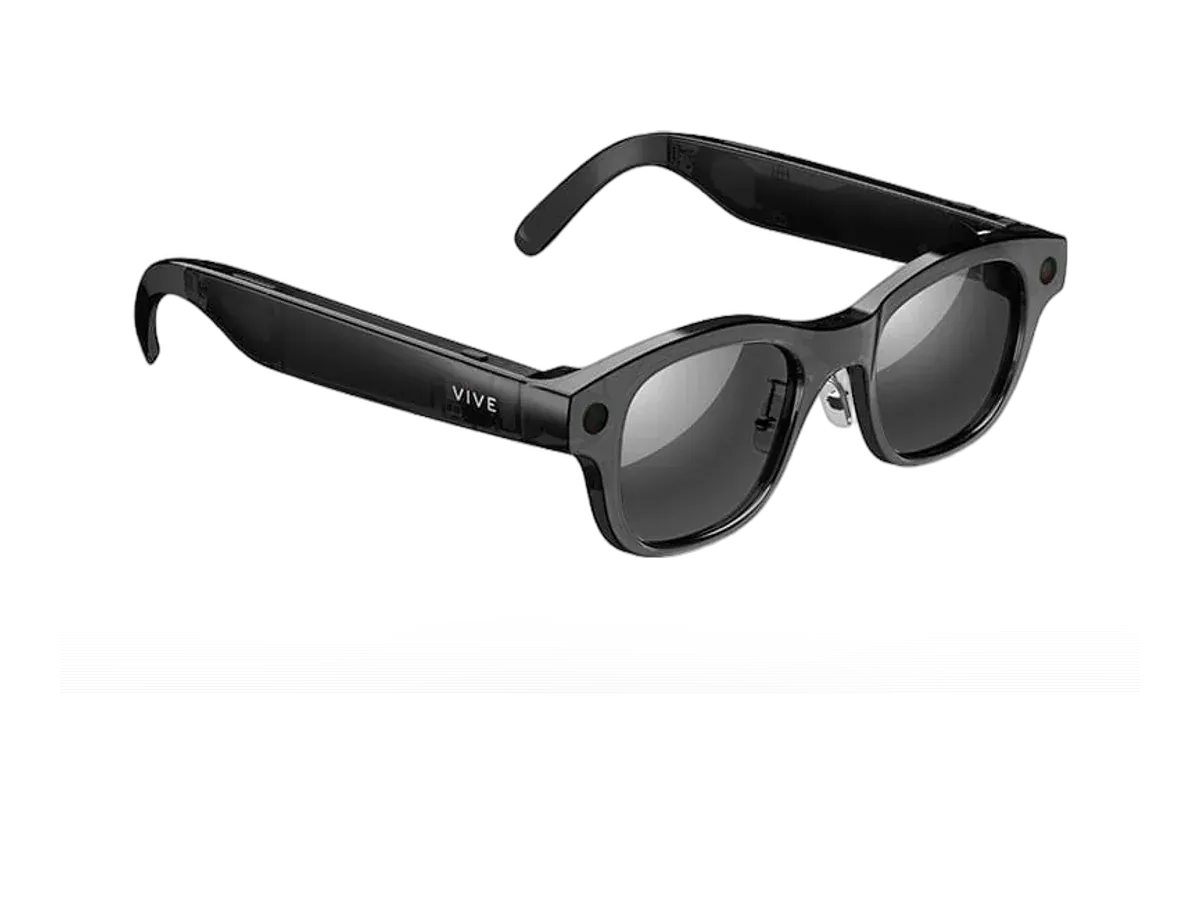
The HTC Vive Eagle are AI-powered camera glasses from HTC, launched in Taiwan in August 2025 and released in the US on 2026-09-01 at $499. A 12MP ultra-wide camera captures 3024x4032 photos and vertical video up to 3K at 30fps on a Snapdragon AR1 Gen 1, and the 48.5g frame carries ZEISS lenses, IP54 resistance, open-ear spatial sound, and magnetic fast charging (about 50% in 10 minutes). The buyer chooses Google Gemini or OpenAI GPT as Vive AI's underlying model; queries run de-identified and encrypted on HTC's servers and are not used for AI training. Best for: Buyers who want Ray-Ban Meta-class camera AI glasses without Meta — assistant choice and a privacy-first pipeline.
Our review
By AR Compare Team ·
According to the aggregated consensus of reviewers, the HTC Vive Eagle is the first credible US alternative to Ray-Ban Meta, and its case rests on privacy and platform choice rather than camera muscle. How-To Geek scored it 7/10, praising the light hours-at-a-time comfort, surprisingly good open-ear speakers, and a well-designed app, while Moor Insights & Strategy calls it the most platform-agnostic smart glasses to date -- Gemini or ChatGPT running on HTC's servers, with user data never used for training. The limits are just as consistent: hands-on reviews record video below Ray-Ban Meta Gen 2's 3K ceiling, the battery is rated at 4.5 hours of music with no charging case, and every reviewer flags the price premium -- HardwareZone concludes Meta is still the more convincing buy for most people. Scores below are an editorial aggregate of that cited coverage, not AR Compare hands-on measurements.
- Display quality
- 1/10
- Comfort
- 8/10
- Battery life
- 6/10
- Value for money
- 6/10
- Build quality
- 7.5/10
- Software
- 7/10
The HTC Vive Eagle is HTC’s Ray-Ban Meta rival: a camera-and-audio pair of AI smart glasses with no display, launched in Taiwan in August 2025 and on sale in the US since September 1, 2026 at $499, sold through Amazon. This review aggregates the hands-on record — How-To Geek’s scored review, the Moor Insights field notes, HardwareZone’s more critical long-term review, The Ghost Howls’ early hands-on, and the launch reporting from Android Authority and Engadget — alongside HTC’s published specifications. AR Compare has not performed hands-on testing of this device; every observation below is attributed to the cited sources, and the category scores are an editorial aggregate of cited reviewer sentiment. Product facts were cross-checked against AR Compare’s spec record for the Eagle (a recorded 12MP ultra-wide camera, roughly 48.5 grams, a 235mAh battery rated for 4.5 hours of music, Snapdragon AR1 Gen 1, IP54, $499).
How This Review Was Compiled
The record splits by depth. How-To Geek’s Joe Fedewa published the fullest US review (7/10), Moor Insights analyst Anshel Sag reviewed it with a focus on the privacy architecture, and HardwareZone’s Aaron Yip reviewed the earlier Asian release at length and most critically. The Ghost Howls contributed brief early hands-on impressions from a European event, and Android Authority and Engadget documented the US pricing and launch facts. Where the sources disagree — video resolution and real-world battery life are the two genuine conflicts — both readings are reported below rather than smoothed over.
Privacy and the Choice of AI: Why the Eagle Exists
Every reviewer frames these HTC smart glasses the same way: what Ray-Ban Meta does for capture, the Eagle tries to do for privacy and choice. Moor Insights calls them probably the most platform-agnostic glasses reviewed to date — full Android and iPhone support, plus a choice of Google Gemini or ChatGPT running behind HTC’s Vive AI layer on HTC’s own servers, with user data never sent to Google or OpenAI for training. How-To Geek reached the same conclusion from the software side, reporting that basic commands run on-device, complex queries are de-identified and encrypted, and the companion app is unusually well designed, with a transparent timeline of everything the AI has done. Two bystander protections drew specific praise: an optional feature halts recording when anyone nearby says ‘stop recording’ — a control Moor Insights suggests may eventually be mandated in some countries — and tampering with the recording LED blocks the camera outright. HardwareZone adds that captures are stored locally with AES-256 encryption.
The honest counterweight is that the AI itself is not yet the selling point. How-To Geek admits AI on glasses still is not particularly practical day to day, HardwareZone reports the features are situationally useful but did not change how the glasses got used, and Moor Insights notes that handing personal queries off to the phone’s assistant can slow interactions. Translation illustrates the tiering: live audio translation covers 13 languages on the included tier per the US launch reporting, while the paid Pro tier expands to 96 languages per Moor Insights — the source of the 90-plus-language figure HTC’s own page advertises. Two years of the VIVE AI Plus subscription are included in the purchase.
The Camera: Strong Photos, a Contested Video Ceiling
Photo capture holds up. The recorded 12MP ultra-wide sensor shoots 3024x4032 stills — the same photo resolution as Ray-Ban Meta Gen 2, as HardwareZone points out — and How-To Geek found the glasses earned their keep for hands-free moments, capturing nearly twenty photos and videos on a kayaking trip that a phone would have missed. The caveats are consistent: the ultra-wide lens makes subjects look distant, dim-light footage struggles, and How-To Geek treats the photos as starting points that want cropping and editing. Moor Insights is blunter, judging stills noticeably less sharp than a smartphone’s and behind Meta’s latest glasses, with video faring better.
Video resolution is where the record genuinely disagrees. HardwareZone and Android Authority both record video at 1512x2016 and 30fps, while HTC’s official page — and How-To Geek’s spec sheet — claim vertical video at up to 3K. Whichever figure a firmware revision ultimately settles, the reviewers agree on the conclusion: video is where Meta pulls ahead, in HardwareZone’s words, since Ray-Ban Meta Gen 2 records true 3K footage and the Eagle’s ceiling sits visibly below it.
Comfort, Audio, and Battery
Comfort is a consensus strength. At a recorded 48.5 grams starting weight (48.8 grams for the medium frame per HardwareZone, about 49 grams in How-To Geek’s testing notes), How-To Geek wore them for hours without issues, and Moor Insights rates the comfort and design on par with Meta’s glasses — close enough to be mistaken for them. The dissent is mild: HardwareZone felt pressure around the nose bridge on longer stretches, and The Ghost Howls found them lightweight but slightly heavy on the nose in a brief demo. Audio outperforms expectations: How-To Geek was startled by how full the speakers sound and made music and podcasts a favorite use, and The Ghost Howls could clearly hear a song played through them in the middle of a noisy party.
Battery is the trade-off. The 235mAh cell is rated for 4.5 hours of music, over 3 hours of calls, and 36-plus hours of standby, and Moor Insights measured roughly three to four hours of real use. Magnetic fast charging softens the number — about 50 percent in 10 minutes and 80 percent in 23 minutes, usable while charging — and the optional $50 Power Boost battery clips on magnetically, nearly invisibly, and charges the glasses while worn. But there is no charging case in the box: Moor Insights leaned on the add-on battery instead of the stationary cable, and HardwareZone prefers Meta’s case, which charges the glasses every time they are stored. The IP54 rating covers dust and splashes.
Value: The Price Question
At $499, the Eagle asks $120 more than the Ray-Ban Meta Gen 2’s $379 opening price, and every source lands on that gap. Android Authority warns the price tag is going to be a big hurdle, and The Ghost Howls made the same point about the original Taiwan pricing a year before the US release. The photochromic AdaptiveSun lens variant costs $599, and US lens options are otherwise sunglass-only ZEISS UV400 at launch, with blue-light and prescription routes coming through optical partners. The buying path is also unusual: Amazon is currently the only direct US retailer, with HTC’s own page pointing to retail partners rather than a cart. The aggregate advice mirrors How-To Geek’s verdict — a solid choice for buyers who want quality smart glasses without ties to Meta, priced with a real privacy premium — against HardwareZone’s caveat that the Ray-Ban Meta Gen 2 remains the more convincing buy for most people.
Who Should Buy the HTC Vive Eagle
Per the aggregated consensus: privacy-conscious buyers who want camera-and-audio AI glasses without joining Meta’s ecosystem, iPhone and Android users who value the choice of Gemini or ChatGPT with on-server processing, and streamers, who get native Twitch and YouTube support plus a swappable magnetic battery. Who should skip: video-first creators who will feel the gap below Ray-Ban Meta Gen 2’s 3K recording, value shoppers for whom the $120 premium buys no extra capture capability, anyone who wants a display or HUD of any kind, and buyers who need clear or prescription lenses today rather than the launch-window sunglass options.
Scores are aggregates of the cited reviews and hands-on reports, not AR Compare hands-on results.
Sources
- How-To Geek — HTC Vive Eagle Smart Glasses Review (7/10)
- Moor Insights & Strategy — HTC Vive Eagle AI Smart Glasses Review: Putting Privacy Back in Users’ Hands
- HardwareZone — HTC Vive Eagle AI smart glasses review
- The Ghost Howls — Vive Eagle hands-on impressions from UnitedXR Europe
- Android Authority — HTC Vive Eagle US pre-orders live ahead of the September 1 release
- Engadget — HTC takes on Meta with the Vive Eagle smart glasses
- HTC — Vive Eagle official US product page (specifications)
What other reviewers say
Scores from other outlets, as published — not our rating.
| Source | Score |
|---|---|
| HardwareZone | the Ray-Ban Meta Gen 2 remains the more convincing buy for now. |
| How-To Geek | 7/10 |
Pros & cons
Pros
- Choice of Google Gemini or OpenAI GPT — the most platform-agnostic AI glasses per the review consensus
- Privacy-first pipeline: on-device basics, de-identified encrypted cloud queries, data not used for AI training
- Light 48.5 g starting weight — reviewers wore it comfortably for hours
- Magnetic fast charge: about 50% in 10 minutes, about 80% in 23 minutes
- ZEISS lenses and IP54 dust/splash resistance
- 24 months of VIVE AI Plus included
- Open-ear speakers that genuinely surprised reviewers, clear enough for music and podcasts even in noisy settings
Cons
- Video trails the Ray-Ban Meta Gen 2: 3K capped at 30 fps (early units shipped with a 1512x2016 ceiling)
- $120 more than the Ray-Ban Meta Gen 2's starting price
- No display — feedback is audio-only
- Sunglass (UV400) lenses only at launch; clear and photochromic options come later
- Amazon is the only direct US buy path — the official page routes to retail partners
- Rated 4.5 hours of music playback, with reviewers reporting closer to three or four hours of real use and no charging case in the box
- Reviewers call the on-glasses AI situationally useful rather than habit-changing, and the ultra-wide camera makes subjects look distant in photos
Full specifications
| Optics | |
|---|---|
| Dimming control | ✕ No |
| Prescription support | ✓ Yes |
| Diopter range | Prescription lenses via optical partners (ZEISS) |
| Not published: Optics type, Transparency level | |
| Physical | |
| Weight (g) | 48.5 |
| Frame style | Pantos (round) or Square frames |
| Foldable | ✕ No |
| IP rating | IP54 |
| Not published: Color options | |
| Battery & power | |
| Battery life (hours) | 4.5 |
| Charging method | Magnetic fast charge (about 50% in 10 min) |
| Not published: Charging time | |
| Connectivity | |
| Connectivity | Bluetooth 5.3, Wi-Fi 6E |
| Tethered | ✕ No |
| Compatible devices | iOS, Android |
| Computing | |
| Processing type | phone |
| Operating system | VIVE Connect app (Android 10+ / iOS 17.6+) |
| Chipset | Qualcomm Snapdragon AR1 Gen 1 |
| Sensors & input | |
| Camera | 12MP, up to 3K (2176x2944) vertical video @ 30fps |
| Speakers | open-ear · spatial audio |
| Gesture control | ✕ No |
| Voice control | ✓ Yes |
| AI assistant | Vive AI (choice of Google Gemini or OpenAI GPT) |
| Not published: Microphones, Tracking | |
Where to buy
Price verified
HTC Vive Eagle specs: quick answers
- How much does the HTC Vive Eagle weigh?
- The HTC Vive Eagle's glasses weigh 48.5g according to the manufacturer specification.
- How long does the HTC Vive Eagle battery last?
- HTC rates the 235mAh battery at about 4.5 hours of continuous music, 3+ hours of calls, or 36+ hours of standby. Magnetic fast charging reaches about 50% in 10 minutes and about 80% in 23 minutes, and an optional Power Boost pack adds 120mAh. Source: HTC ↗
- Does the HTC Vive Eagle have a camera?
- Yes, the HTC Vive Eagle has a built-in camera. The recorded camera resolution is 12MP, up to 3K (2176x2944) vertical video @ 30fps.
- Does the HTC Vive Eagle have an AI assistant?
- Yes, the HTC Vive Eagle includes the Vive AI (choice of Google Gemini or OpenAI GPT) AI assistant.
- How much does the HTC Vive Eagle cost?
- The HTC Vive Eagle costs $499 in the US with ZEISS UV400 sunglass lenses; the photochromic AdaptiveSun lens variant is $599. Amazon is currently the only direct US buy path — HTC's official page routes to authorized retail partners. Source: Bloomberg ↗
- When did the HTC Vive Eagle come out in the US?
- The US version went on sale September 1, 2026, via Amazon. The Vive Eagle first launched in Taiwan in August 2025 and expanded through Europe and Asia before the US release. Source: Android Authority ↗
HTC Vive Eagle: FAQs
How much does the HTC Vive Eagle cost?
The HTC Vive Eagle costs $499 (USD). It is available from 1 retailer listed on this page.
How much does the HTC Vive Eagle weigh?
The HTC Vive Eagle weighs 48.5g according to the manufacturer specification.
How long does the battery last on the HTC Vive Eagle?
The HTC Vive Eagle has a rated battery life of 4.5 hours.
Can I use the HTC Vive Eagle with prescription lenses?
Yes, the HTC Vive Eagle supports prescription lenses. The recorded diopter range is Prescription lenses via optical partners (ZEISS).
Does the HTC Vive Eagle have a camera?
Yes, the HTC Vive Eagle has a built-in camera (12MP, up to 3K (2176x2944) vertical video @ 30fps).
What devices work with the HTC Vive Eagle?
The HTC Vive Eagle lists compatibility with: iOS, Android.
Is the HTC Vive Eagle worth it?
The HTC Vive Eagle is priced at $499 (USD). For that you get 4.5 hours of rated battery life. It weighs 48.5g. The full spec breakdown on this page shows what the price includes.
Ranked in these buying guides
Where the HTC Vive Eagle lands in our recorded-spec rankings.
Related Comparisons
HTC Vive Eagle vs Ray-Ban Meta Gen 2
HTC vs Meta
HTC Vive Eagle vs Rokid AI Glasses Style
HTC vs Rokid
HTC Vive Eagle vs Oakley Meta Vanguard
Oakley
HTC Vive Eagle vs INMO GO3 AI Translation Glasses
Inmo
HTC Vive Eagle vs Even Realities G1
Even Realities
HTC Vive Eagle vs Halliday AI Glasses
Halliday
HTC Vive Eagle vs RayNeo iO
RayNeo
HTC Vive Eagle vs Brilliant Labs Halo AI Glasses
Brilliant Labs