What Are Smart Glasses? How They Work, What They Do, and What They Cost
By AR Compare Team ·
Smart glasses are ordinary-looking eyewear with computing built into the frame — usually some mix of a camera, microphones, open-ear speakers, an AI voice assistant, and sometimes a small display in the lens. Instead of pulling out your phone, you glance, speak, or tap the temple. Across the 73 smart glasses from 35 brands in our database they split into three families that do very different jobs, which is the single most useful thing to understand before you shop.
Jump to what they do, how they work, how Meta’s glasses work, or what they cost.
What are smart glasses, exactly?
The label covers three distinct categories, and knowing which one you want settles most of the buying decision:
- AI and camera glasses. A camera and a voice assistant in a normal sunglasses or optical frame, with no screen. You capture photos and video, ask the assistant about what you are looking at, take calls, and listen to audio. The Ray-Ban Meta Gen 2 is the archetype.
- Heads-up display (HUD) glasses. An ultralight everyday frame that floats a small line of text — notifications, turn-by-turn navigation, live translation — in the corner of your vision. The Even Realities G2 is a good example of this “glanceable” style.
- Tethered display glasses. Glasses that plug into a phone, laptop, or handheld to project a large private screen for movies, gaming, or a portable monitor, such as the XREAL One Pro.
If instead you want fully immersive digital worlds or room-scale objects with spatial tracking, that is a headset, not glasses — the wider decision is covered in AR glasses vs VR headsets.
What do smart glasses do?
What a pair can do depends entirely on which family it belongs to, so the honest answer is a spread rather than a single feature list. Two hardware facts from our database anchor it: 27 of the 73 devices carry a built-in camera, and 65 of the 73 include a display of some kind. The other eight are camera-and-audio glasses with no screen.
Common capabilities, by how many of the three families support them:
- Capture and AI vision — photos, video, and asking an assistant to identify, translate, or explain what the camera sees. This is the core of the AI and camera family.
- Glanceable information — notifications, navigation, timers, and live translation shown as text, the whole point of the HUD family. The trade-offs behind those tiny displays are explained in birdbath vs waveguide.
- A private big screen — a virtual monitor for video and work, which is what the tethered display family exists for; start with the everyday wear or AI assistant rankings depending on your camp.
- Audio and calls — open-ear speakers and microphones, present on nearly every model regardless of family.
How do smart glasses work?
Every pair follows the same loop — capture, process, output — squeezed into a frame that has to stay light enough to wear on your nose:
- Capture. Cameras and microphones take in the scene and your voice; touch pads and a wake word handle input.
- Process. A low-power chip in the frame handles on-device work, and anything heavier is offloaded to a paired phone (or, for tethered models, the connected device) over Bluetooth and Wi-Fi. This split is why most AI glasses need your phone nearby.
- Output. Results come back as audio through open-ear speakers, or as an image through the lens optics — a magnified micro-display for tethered glasses, a waveguide overlay for HUD frames.
- Power and connection. All-day frames carry their own battery; tethered display glasses have no battery or standalone brain and draw both power and video from the device they plug into over USB-C DisplayPort Alt Mode.
Because the three families make different bets on that loop, they diverge on weight most of all: across our database, models run from a featherweight 28.5–566 g, with a median 77 g (n=68). The full spec database lets you sort on any of it.
How do Meta glasses work?
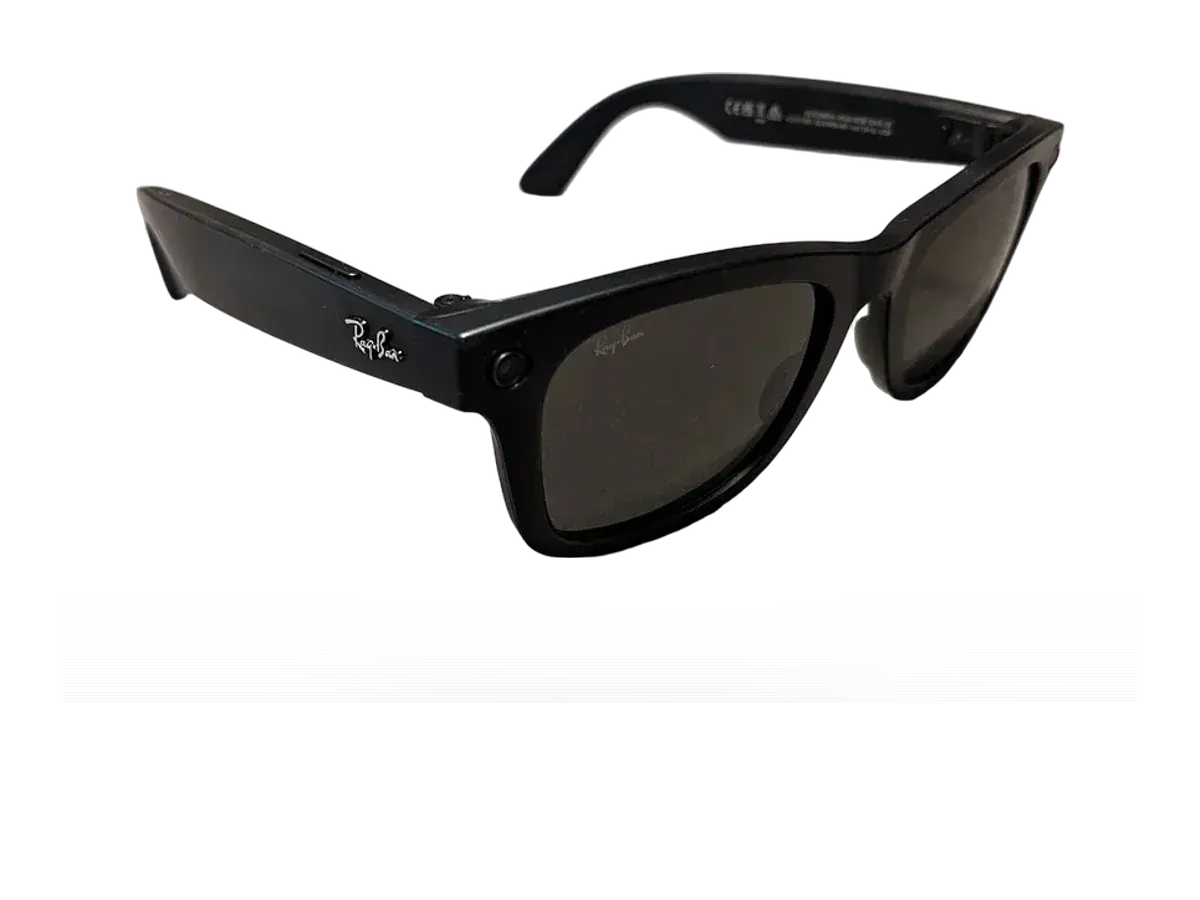
Meta’s glasses are the ones most people mean by “smart glasses,” so they deserve their own walkthrough. The Ray-Ban Meta Gen 2 has no display at all — it belongs to the AI-and-camera family, which is a common surprise. Here is the loop in practice:
- A 12MP camera and five microphones capture the scene and your voice when you tap the temple or say the wake phrase.
- A Qualcomm Snapdragon AR1 Gen 1 chip runs on-frame tasks, while heavier AI requests — “what am I looking at,” translation, questions — are sent to the Meta AI app on your paired phone over Bluetooth and Wi-Fi.
- Answers and audio return through open-ear speakers in the temples, so you hear them without blocking outside sound.
- The frame weighs 52 g, runs about eight hours of mixed use, and lists at $379.
So “how do Meta glasses work” comes down to this: the glasses are the eyes, ears, and voice; the phone is the brain for anything demanding. That is why they need a phone connection to do their most useful tricks. To see where they sit against a display-equipped Meta pair or a sport model, compare the Oakley Meta Vanguard vs Ray-Ban Meta Gen 2 or the Ray-Ban Meta Display vs Ray-Ban Meta Gen 2.
How much do smart glasses cost?
In our database the in-stock, one-time-purchase models span a wide $149–$3,150 (n=55). The shape of that range matters more than the extremes:
- Roughly $300–$500 buys most mainstream AI and camera glasses and many HUD frames — the volume of the market sits here.
- Under about $350 is where budget display glasses and entry HUD frames land; the best budget picks hub sorts that field cheapest-first.
- Four figures are enterprise, developer, and headset-class devices, not everyday eyewear — they pull the top of the range up but are a different product.
A subscription model exists too for a small number of devices, so the sticker price is not always the whole cost. Sort the live database by price, or narrow straight to a use case in the best-of hubs.
Which smart glasses are right for you?
Pick the family first, then the model:
- You want a camera and an assistant in a frame you can wear anywhere → AI and camera glasses; start with everyday wear or AI assistant.
- You want glanceable navigation and notifications, and to look normal → HUD glasses.
- You want a big private screen for movies or work → tethered display glasses; the optics choice is explained in birdbath vs waveguide.
- You are weighing glasses against a full headset → read AR glasses vs VR headsets first.
Once you know your camp, the data-ranked best smart glasses hub leads with a scored pick for each intent, and you can compare any two models side by side before you buy.
Frequently asked questions
What are smart glasses in simple terms?
Smart glasses are eyewear with computing built into the frame — some mix of a camera, microphones, open-ear speakers, an AI voice assistant, and sometimes a small display in the lens. They split into three families: AI and camera glasses (a camera and assistant in a normal-looking frame), heads-up display glasses (an ultralight frame that floats text and navigation in a corner of your vision), and tethered display glasses (that plug into a phone or laptop for a private big screen). Across the 73 smart glasses from 35 brands in our database, 27 include a built-in camera and 65 include some kind of display.
How do Meta's Ray-Ban glasses work?
The Ray-Ban Meta Gen 2 has no screen. A 12MP camera and five microphones capture what you see and say, a Qualcomm Snapdragon AR1 Gen 1 chip handles on-frame tasks, and heavier requests are sent to the Meta AI app on your paired phone over Bluetooth and Wi-Fi. Answers come back through open-ear speakers in the temples. It weighs 52 g and runs about eight hours of mixed use.
How much do smart glasses cost?
In our database the in-stock, one-time-purchase models run from $149 to $3,150 (n=55). Most mainstream AI and display glasses land between roughly $300 and $500; the four-figure prices are enterprise headset-class devices, not everyday frames.
What is the difference between smart glasses and AR glasses?
The terms overlap. In practice, most smart glasses add a layer of usefulness — a camera, assistant, or glanceable display — without changing what you see. True AR glasses go further, anchoring digital objects in the room with spatial tracking. The optics behind the display are explained in our birdbath vs waveguide guide, and the wider category decision in AR glasses vs VR headsets.
Do all smart glasses have a display?
No. Of the 73 devices in our database, 65 have some form of display and 8 are audio-and-camera glasses with no screen at all. The displays themselves range from a tiny monochrome heads-up readout to a magnified full-color virtual screen, which is why weight and price vary so widely — from 28.5 g up to 566 g.