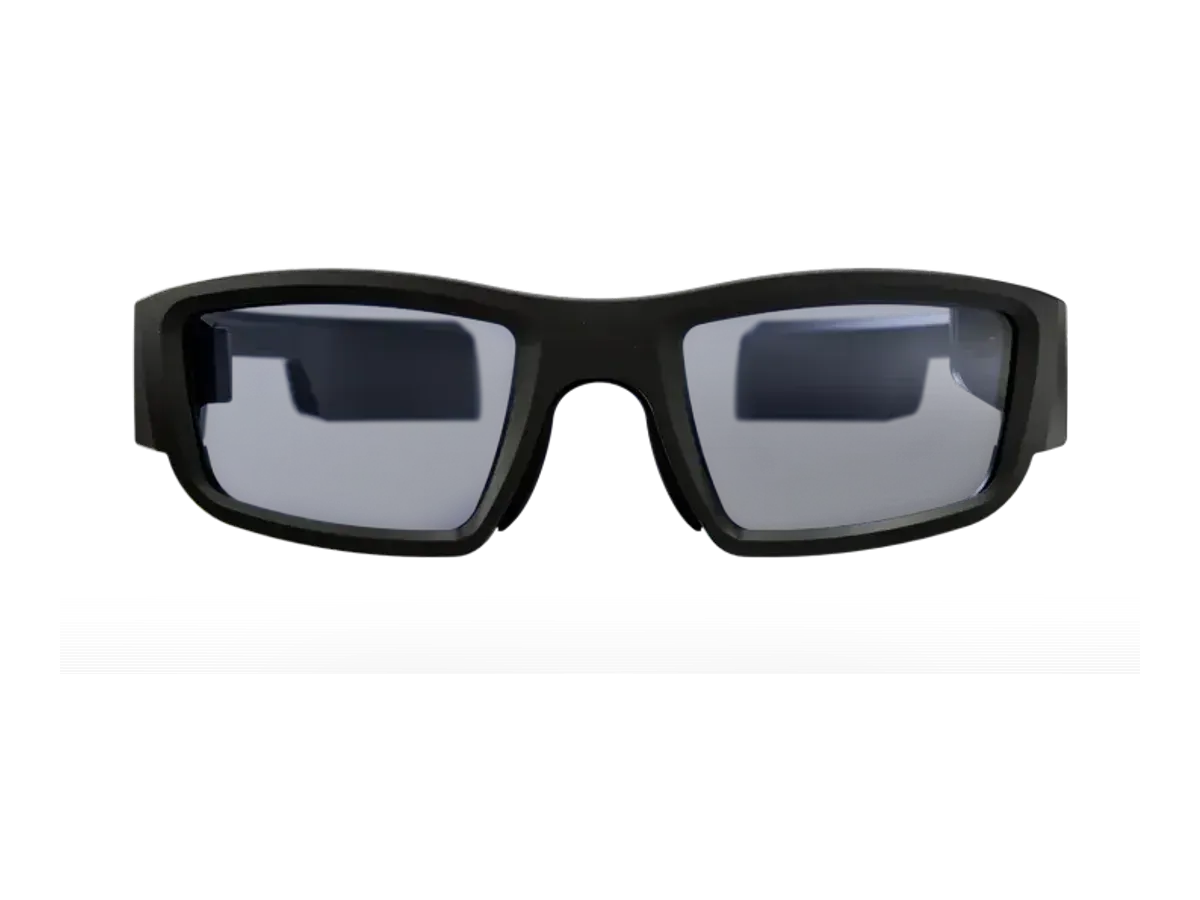
At a glance
- Display type
- Waveguide projection, full-color 24-bit, right eye only (monocular)
- Resolution
- 480x480
- Field of view
- 20°
- Brightness
- 2000 nits
- Weight
- 90 g
- Battery
- 3 hr
- ANSI Z87.1 safety glasses certified for industrial environments
- 2,000-nit brightness visible in direct sunlight
- 20-degree FOV is very narrow -- smallest among AR glasses
- 480x480 resolution is low by modern standards
Vuzix Blade 2
Vuzix
6.3/10 “According to the aggregated consensus of reviewers, the Vuzix Blade 2 is a capable industrial heads-up display that has aged out of Vuzix's own lineup. VR Expert's pros table calls it the 'best entry level smart glass', crediting a 2,000-nit picture that stays readable on sunlit job sites, and archaeologists who ran it through an excavation season judged the safety-glasses form factor right for a full field day. The trade-offs are just as consistent: a small 480x480 image in one eye, a balky touchpad, speech-to-text too weak for dictation, and first-time wearers in a usability study finding it complicated. With the official listing gone and the M400 now carrying Vuzix's enterprise line, it survives mainly as a pilot-project and secondhand buy. Scores below are an editorial aggregate of that cited coverage, not AR Compare hands-on measurements.” Read the full review$800
See current alternatives- Field of view
- 20°
- Weight
- 90 g
- Battery
- 3 hr
The Vuzix Blade 2 is an enterprise-focused standalone AR smart glasses featuring a full-color Micro-LED waveguide display with 2,000-nit brightness, ANSI Z87.1 safety certification, 8MP autofocus camera, and Android 11 OS -- all in a 90-gram glasses form factor designed for the deskless workforce.
Our review
By AR Compare Team ·
According to the aggregated consensus of reviewers, the Vuzix Blade 2 is a capable industrial heads-up display that has aged out of Vuzix's own lineup. VR Expert's pros table calls it the 'best entry level smart glass', crediting a 2,000-nit picture that stays readable on sunlit job sites, and archaeologists who ran it through an excavation season judged the safety-glasses form factor right for a full field day. The trade-offs are just as consistent: a small 480x480 image in one eye, a balky touchpad, speech-to-text too weak for dictation, and first-time wearers in a usability study finding it complicated. With the official listing gone and the M400 now carrying Vuzix's enterprise line, it survives mainly as a pilot-project and secondhand buy. Scores below are an editorial aggregate of that cited coverage, not AR Compare hands-on measurements.
- Display quality
- 6/10
- Comfort
- 7/10
- Battery life
- 4.5/10
- Value for money
- 5/10
- Build quality
- 7/10
- Software
- 5/10
The Vuzix Blade 2 is a pair of standalone enterprise smart glasses: safety-rated eyewear with a small transparent display projected into the right lens, built for warehouse, field-service, and inspection work rather than for consumers. Vuzix released it in September 2022, and AR Compare’s record prices it at $799.99, though the tracked store listing has since gone dead. This review aggregates VR Expert’s trade review, a peer-reviewed field study in the Journal of Computer Applications in Archaeology that used the glasses through an excavation season, a 2026 beta-testing study in JMIR Aging, an applications note from software partner XMReality, and Vuzix’s current product pages. AR Compare has not performed hands-on testing of this device; every observation below is attributed to the cited sources, and the category scores are an editorial aggregate of cited reviewer sentiment. Product facts were cross-checked against AR Compare’s spec record for the Blade 2 (a recorded 2,000 nits on a 480x480 waveguide display, a recorded 20-degree field of view, roughly 90 grams, a recorded 3-hour battery rating, $799.99).
How This Review Was Compiled
VR Expert’s Jakob Pii published the fullest trade review in March 2023, testing calls, apps, and audio in work settings. The Journal of Computer Applications in Archaeology contributes the longest real-world stretch: archaeologists Peter Cobb and Hayk Azizbekyan used the Blade 2 for data collection at a dig in Armenia. JMIR Aging adds the harshest test, a 2026 study that put the glasses on 14 first-time wearers, older adults with cognitive impairment, for short sessions. XMReality’s note comes from a software partner and is treated as vendor-adjacent context rather than an independent opinion. Where the sources disagree — battery and ease of use, mostly — both readings are reported below rather than smoothed over.
The Display: A 2,000-Nit Window, Not an AR Canvas
The headline is brightness. VR Expert calls the display the standout feature, reporting it “can now reach 2000 nits” — bright enough, per that review, for direct sunlight and harsh factory lighting. The field study agrees with a caveat, finding it “possible to use the screen in full sunlight, but clearer when looking towards a dark background.” What that brightness lights up is deliberately small: a recorded 480x480 full-color image in the right eye only, across a recorded 20-degree field of view at 24 pixels per degree, piped through waveguide optics — a thin transparent layer in the lens that keeps the glasses looking like normal eyewear. Within that little window, detail holds up: VR Expert reports even intricate details staying visible, like highlighting the root cause of a fault during a remote maintenance call. The dissent is about strain rather than sharpness. First-time wearers in the JMIR Aging study reported eye strain and double vision, with one participant saying “it bothers my eyes. It breaks your concentration.” The archaeology team’s summary lands in the middle: “perhaps the main downside at the moment is the screen.”
Built for the Job Site
The Blade 2’s clearest argument is that it can legally replace the safety glasses a worker already has to wear. It carries ANSI Z87.1 certification, the US occupational standard for protective eyewear, in a recorded 90-gram frame that VR Expert found comfortable across a couple of hours of continuous wear thanks to well-placed cushioning. The field study reached the same conclusion over longer stretches, judging that the form factor “would work very well for use throughout the excavation day at the trench.” The usability study is the outlier: its participants unanimously wished the glasses were smaller and lighter. On calls, the record is solid: VR Expert ran Microsoft Teams, Zoom, Cisco Webex, and TeamViewer on the glasses and reports everything ran smoothly, with the dual noise-cancelling microphones keeping voices clear over machinery and forklifts. The same review flags the limit: compared to the competition, the active noise cancellation “is not as thorough,” and it points anyone whose whole use case is loud-floor calling toward the RealWear Navigator 520, which AR Compare’s record lists at $3,150. The recorded 8MP autofocus camera drew no complaints, and the archaeologists found voice-activated photo capture genuinely useful with dirty hands.
Battery Life and a Micro-USB Reminder of 2022
The spec record lists a recorded 3-hour battery rating, and this is where the sources genuinely diverge. The archaeology team reports the battery “appears to last all day” — but their day was intermittent glanceable use in a trench, not continuous video streaming, and they note the point was never fully tested. XMReality’s partner note makes the same all-day claim in marketing language. The honest synthesis: for glanceable heads-up work a working day is plausible, while for sustained remote-assistance video the recorded 3-hour rating is the number to plan on. Charging is by Micro-USB rather than USB-C — a connector most phones abandoned years before this product shipped, and the clearest tell of the design’s age.
Software: Android 11 Underneath, Rough Edges on Top
The Blade 2 runs full Android 11 on-device with 40GB of storage, which is why device-management platforms and mainstream calling apps work at all. The rough edges show up at the input layer. VR Expert reports issues with the touchpad’s responsiveness. The archaeologists hit the same wall harder: the built-in mouse-cursor function was laggy and crashed, the stock speech-to-text was not accurate enough for regular use, and their original phone app was nearly unusable on the tiny screen until they rebuilt a simplified version with AI-supported voice recognition. The JMIR Aging study rounds out the picture from the novice end: none of its 14 participants picked the Blade 2 as their preferred device, describing it as complicated and hard to use, with an oversensitive touchpad that kept opening the wrong apps. That population and its short sessions are the hardest possible test, but the direction of the complaints matches what the trade and field reviewers found.
Where the Blade 2 Stands in 2026
Vuzix has moved on. The Blade 2’s official product URL now lands on a general smart-glasses page led by the LX1 and M400, with no Blade 2 on it, and AR Compare’s tracked store link is dead. No Blade 3 has been announced; buyers searching for one will find Vuzix’s line split instead between the rugged M400, which AR Compare’s record prices at $1,499.99, and the lightweight Z100 notification glasses the same record puts at $499.99. What the Blade 2 still owns, even superseded, is its combination: a true see-through waveguide in certified safety glasses at a recorded $799.99, in a category where safety-oriented rivals cost several times more. For a broader look at the current options, see the enterprise smart glasses guide. In 2026 the consensus reads the Blade 2 as a pilot-program device: still functional, but no longer the one its own maker recommends.
Value
AR Compare’s record prices the Blade 2 at $799.99, well under its launch-era positioning — VR Expert judged the roughly 1,380-euro price it reviewed at competitive precisely because it bundled certified eye protection with an assisted-reality display. That logic still holds at the lower figure, but only for the right buyer. An organization piloting hands-free workflows gets a cheap, standalone, safety-certified way to test whether a heads-up display helps its workers at all. A fleet buyer is standardizing on discontinued-in-practice hardware with an uncertain support horizon. Per the aggregated record, the Blade 2 is a sensible experiment and a questionable standardization.
Who Should Buy the Vuzix Blade 2
Per the aggregated consensus: teams running pilots of remote assistance or heads-up work instructions who want a standalone, safety-certified unit at the lowest recorded price in its class; field researchers and inspectors who need glanceable data and hands-free photos outdoors, where the 2,000-nit display and voice capture earned their keep; and workplaces where eyewear must double as ANSI-rated protection. Who should skip: anyone needing all-shift continuous video calling, given the recorded 3-hour rating and the noise-cancellation gap reviewers flagged; teams standardizing hardware for years of support, now that the model has left Vuzix’s lineup; anyone who needs accurate voice dictation out of the box; and first-time wearers sensitive to eye strain from a single-eye display.
Scores are aggregates of the cited reviews and hands-on reports, not AR Compare hands-on results.
Sources
- VR Expert — Vuzix Blade 2 Review
- Journal of Computer Applications in Archaeology — Experiments with Mixed and Augmented Reality (MR/AR) for Archaeological Data Collection and Use During Fieldwork: Vision for the Future
- JMIR Aging — Smart Glasses for Older Adults With Cognitive Impairment: Explanatory Mixed Methods Study
- XMReality — Vuzix Blade 2: designed with comfort in mind
- Vuzix — Smart glasses lineup page, formerly the Blade 2 product page (specifications)
What other reviewers say
1 review from an outside outlet.
Scores from other outlets, as published — not our rating.
| Source | Score |
|---|---|
| VR Expert | the Vuzix Blade 2 fills a need for enterprises and industrial workers with the safety glasses and assisted reality combination. |
Pros & cons
Pros
- ANSI Z87.1 safety glasses certified for industrial environments
- 2,000-nit brightness visible in direct sunlight
- Full Android 11 OS with enterprise MDM support
- 8MP camera with autofocus for remote assistance and documentation
- Standalone operation -- no phone tether required
- Comfortable across long stretches at a recorded 90 grams, with cushioning reviewers say spreads the weight so it wears like ordinary safety glasses
- Microsoft Teams, Zoom, Webex, and TeamViewer all ran smoothly in reviewer trials, with voices coming through clearly over machinery noise
- Voice commands reviewers and field testers found dependable for basic navigation and hands-free photo capture
- A picture reviewers describe as sharp enough to pick out fine detail, down to individual components during remote guidance calls
Cons
- 20-degree FOV is very narrow -- smallest among AR glasses
- 480x480 resolution is low by modern standards
- $799.99 price (down from $1,299.99 at launch) targets enterprise budgets, not consumers
- Micro-USB charging port instead of USB-C
- No gesture or hand tracking -- touch and voice only
- A touchpad reviewers describe as balky -- unresponsive at times for some testers, oversensitive for first-time wearers who landed in the wrong apps
- Built-in speech-to-text field testers judged too inaccurate for real note-taking, workable only for short commands
- On-board noise cancellation that reviewers say trails purpose-built rivals on loud industrial floors
- First-time wearers in a published usability trial reported eye strain and double vision from the one-eye image
- No longer part of Vuzix's current lineup, and the official store listing has gone dead
Full specifications
Specs last verified
| Display | |
|---|---|
| Display type | Waveguide projection, full-color 24-bit, right eye only (monocular) |
| Resolution | 480x480 |
| Pixels per degree | 24 |
| Field of view (°) | 20 |
| Brightness (nits) | 2000 |
| HDR support | ✕ No |
| Color support | Full color |
| Not published: Refresh rate, Virtual screen size | |
| Optics | |
| Optics type | waveguide |
| Dimming control | ✓ Yes |
| Transparency level | see-through AR overlay |
| Prescription support | ✓ Yes |
| Prescription options | Inserts / lens frame via Eyehub, $149.99 USD |
| Physical | |
| Weight (g) | 90 |
| Frame style | safety glasses |
| Color options | Black |
| Foldable | ✕ No |
| Not published: IP rating | |
| Battery & power | |
| Battery life (hours) | 3 |
| Charging method | Micro-USB |
| Not published: Charging time | |
| Connectivity | |
| Connectivity | Bluetooth 5.0, WiFi 5, Micro-USB |
| Tethered | ✕ No |
| Compatible devices | Standalone, iOS, Android |
| Computing | |
| Processing type | on-device |
| Operating system | Android 11 |
| Chipset | Quad-core ARM CPU, 40GB storage (standalone) |
| Sensors & input | |
| Camera | 8MP |
| Microphones | 2 |
| Speakers | open-ear |
| Tracking | 3DoF, head |
| Voice control | ✓ Yes |
| Not published: Gesture control | |
Prescription options
The documented prescription routes for the Vuzix Blade 2, from the maker and named-partner documentation recorded in our database.
- Inserts / lens frame via Eyehub, $149.99 USD — range not published by the maker Source: vuzix.com documentation
Maker documentation as recorded 2026-09-17. Ranges are the maker's published limits, not medical advice — confirm your exact prescription with your optician before ordering.
Where to buy
Vuzix Blade 2 specs: quick answers
- What is the Vuzix Blade 2's field of view?
- The Vuzix Blade 2 has a 20-degree field of view.
- What is the Vuzix Blade 2's display resolution?
- The Vuzix Blade 2's recorded per-eye display resolution is 480x480.
- How bright is the Vuzix Blade 2's display?
- The Vuzix Blade 2 has a rated peak brightness of 2000 nits.
- How much does the Vuzix Blade 2 weigh?
- The Vuzix Blade 2's glasses weigh 90g according to the manufacturer specification.
- How long does the Vuzix Blade 2's battery last?
- The Vuzix Blade 2 is rated for about 3 hours of battery life.
- Does the Vuzix Blade 2 have a camera?
- Yes, the Vuzix Blade 2 has a built-in camera. The recorded camera resolution is 8MP.
- How much does the Vuzix Blade 2 cost?
- The Vuzix Blade 2 costs $800.
Vuzix Blade 2: FAQs
How much does the Vuzix Blade 2 cost?
The Vuzix Blade 2 costs $800 (USD). It is available from 1 retailer listed on this page.
What field of view does the Vuzix Blade 2 have?
The Vuzix Blade 2 has a recorded field of view of 20 degrees.
How much does the Vuzix Blade 2 weigh?
The Vuzix Blade 2 weighs 90g according to the manufacturer specification.
How long does the battery last on the Vuzix Blade 2?
The Vuzix Blade 2 has a rated battery life of 3 hours.
Can I use the Vuzix Blade 2 with prescription lenses?
Yes, the Vuzix Blade 2 supports prescription lenses. The recorded diopter range is Prescription inserts available (~$149.99).
Does the Vuzix Blade 2 have a camera?
Yes, the Vuzix Blade 2 has a built-in camera (8MP).
What devices work with the Vuzix Blade 2?
The Vuzix Blade 2 lists compatibility with: Standalone, iOS, Android.
What resolution does the Vuzix Blade 2 have?
The Vuzix Blade 2 has a recorded per-eye resolution of 480x480.
Is the Vuzix Blade 2 worth it?
The Vuzix Blade 2 is priced at $800 (USD). For that you get a 20-degree field of view, 2000 nits of brightness, a 480x480 per-eye resolution, and 3 hours of rated battery life. It weighs 90g. The full spec breakdown on this page shows what the price includes.
Similar products
What shoppers cross-check with the Vuzix Blade 2 — from our navigation records and closest spec matches.
Related Comparisons
Vuzix Blade 2 vs Epson Moverio BT-45C
Vuzix vs Epson
Vuzix Blade 2 vs Magic Leap 2
Vuzix vs Magic Leap
Vuzix Blade 2 vs Lenovo ThinkReality A3
Vuzix vs Lenovo
Vuzix Blade 2 vs TCL RayNeo X2
Vuzix vs RayNeo
Vuzix Blade 2 vs DigiLens ARGO Smart Glasses
Vuzix vs DigiLens
Vuzix Blade 2 vs Dream Glass Lead Pro
Vuzix vs Dreamworld
Vuzix Blade 2 vs Inmo Air2
Vuzix vs Inmo
Vuzix Blade 2 vs INMO Air3 All-in-One Full-Color Waveguide AR Glasses
Vuzix vs Inmo
Vuzix Blade 2 vs Mad Gaze Glow Plus
Vuzix vs Mad Gaze
Vuzix Blade 2 vs Microsoft HoloLens 2
Vuzix vs Microsoft
Vuzix Blade 2 vs RayNeo X3 Pro
Vuzix vs RayNeo
Vuzix Blade 2 vs Rokid AR Spatial
Vuzix vs Rokid
Vuzix Blade 2 vs Snap Specs (Consumer Edition)
Vuzix vs Snap
Vuzix Blade 2 vs Snap Spectacles Gen 5
Vuzix vs Snap
Vuzix Blade 2 vs XREAL Aura
Vuzix vs XREAL