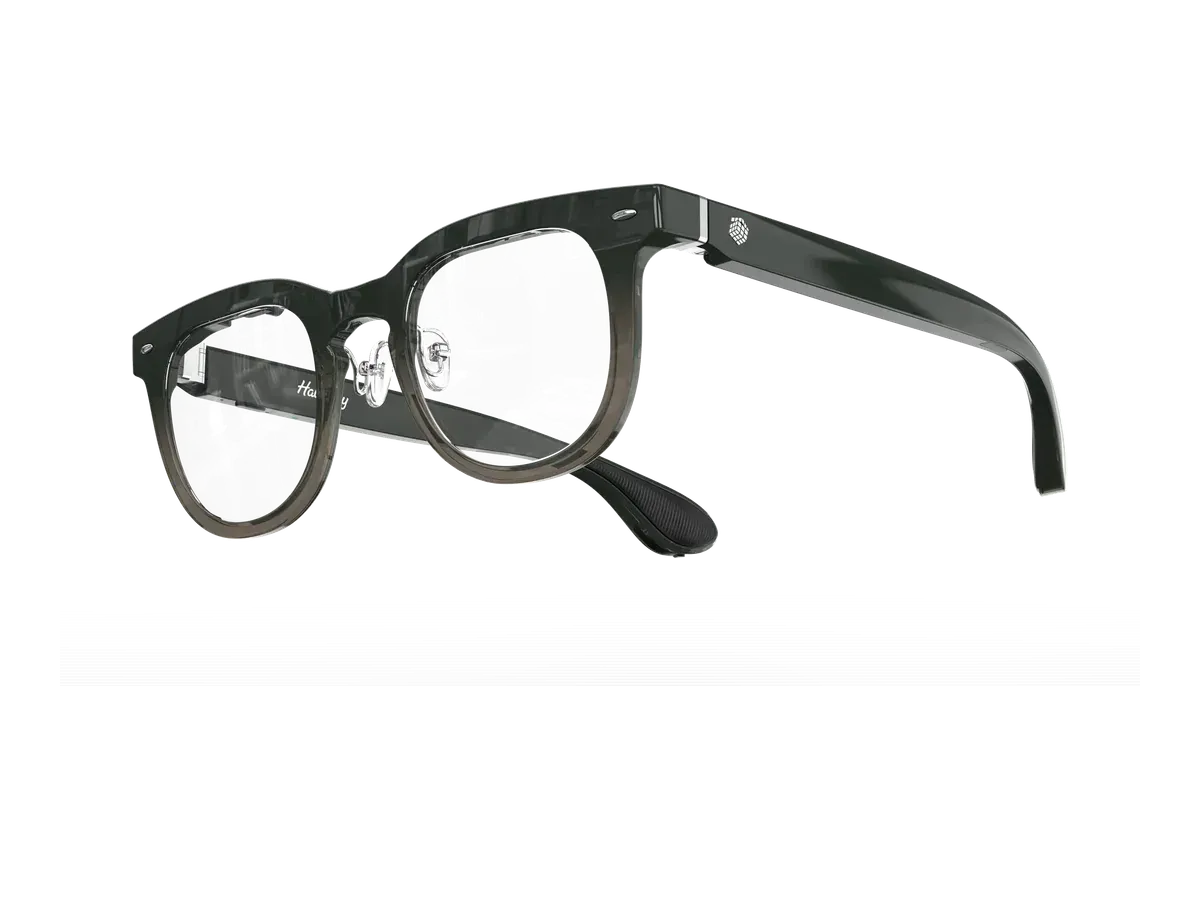
At a glance
- Display type
- DigiWindow 3.6 mm direct-view micro display module (monocular, above right eye) - not a waveguide, projects into eye directly
- Resolution
- monochrome green 3.6mm module
- Weight
- 35 g
- Battery
- 12 hr
- Ultra-lightweight 35g design looks like normal wayfarer glasses
- Prescription lenses included in the $499 price -- no extra cost
- Monochrome green display is hard to read for prescription lens users
- Build quality feels flimsy for the $499 price point
Halliday AI Glasses
Halliday
6/10 “According to the aggregated consensus of reviewers, the Halliday AI Glasses are a clever, genuinely novel idea that still feels first-generation in use. The DigiWindow -- a tiny projector that beams a monocular display above the right eye, visible only to the wearer -- lets Halliday skip pricey waveguide lenses, and CES hands-on reviewers were cautiously impressed by how light and discreet the glasses are at a recorded 35 grams. But longer reviews found real friction: Android Police scored them 5 out of 10, reporting that aligning the display is hard, that the website images are renders clearer than reality, that the recorded 12-hour battery claim is incredibly optimistic, that the control ring is a terrible misstep, and that the Proactive AI is too slow to be useful. The honest aggregate: an admirable concept for display-first early adopters, but most buyers are pointed toward more mature alternatives.” Read the full review$499
See current alternatives- Weight
- 35 g
- Battery
- 12 hr
The Halliday AI Glasses are the world's first smart glasses with a 'proactive' AI assistant and an invisible DigiWindow micro-display. At just 35 grams with prescription lenses included, they project a monochrome green display equivalent to a 3.5-inch screen using a 3.6mm microLED module, offering real-time translation in 40 languages, navigation, voice memos, and an always-listening AI that responds to ambient conversations.
Our review
By AR Compare Team ·
According to the aggregated consensus of reviewers, the Halliday AI Glasses are a clever, genuinely novel idea that still feels first-generation in use. The DigiWindow -- a tiny projector that beams a monocular display above the right eye, visible only to the wearer -- lets Halliday skip pricey waveguide lenses, and CES hands-on reviewers were cautiously impressed by how light and discreet the glasses are at a recorded 35 grams. But longer reviews found real friction: Android Police scored them 5 out of 10, reporting that aligning the display is hard, that the website images are renders clearer than reality, that the recorded 12-hour battery claim is incredibly optimistic, that the control ring is a terrible misstep, and that the Proactive AI is too slow to be useful. The honest aggregate: an admirable concept for display-first early adopters, but most buyers are pointed toward more mature alternatives.
- Display quality
- 5/10
- Comfort
- 8.5/10
- Battery life
- 5/10
- Value for money
- 5.5/10
- Build quality
- 7.5/10
- Software
- 5/10
The Halliday AI Glasses launched at CES 2025 around a single novel idea: the DigiWindow, a tiny projector mounted above the right lens that beams a small monocular display straight at the eye, so only the wearer sees it and no waveguide lens is required. This review aggregates the coverage that idea generated — Android Police’s full review, Tom’s Guide’s and 9to5Google’s hands-on impressions, TechCrunch’s launch report, and TrustedReviews’ and TechRadar’s writeups. AR Compare has not performed hands-on testing of this device; every observation below is attributed to the cited sources, and the category scores are an editorial aggregate of cited reviewer sentiment. Product facts were cross-checked against AR Compare’s spec record (a DigiWindow monocular monochrome-green display module, no camera, roughly 35 grams, a recorded 12-hour battery claim, around $499).
How This Review Was Compiled
The record splits cleanly by format. Early CES hands-on pieces (Tom’s Guide, 9to5Google, TrustedReviews) were cautiously impressed by the display trick; the longer lived-with reviews (Android Police, TechRadar) found the friction that hands-on demos miss. Both are reported below so the picture is balanced rather than either the launch hype or the harshest verdict alone.
The DigiWindow: A Clever, Fiddly Display
The DigiWindow is the reason the glasses exist. Rather than a waveguide, it is a tiny projector set on the frame above the right lens, showing green monochrome text — the operating system, AI features, and notifications — that only the wearer can see. 9to5Google likened it to Google Glass but easier to glance at, and called the experience surprisingly good. Tom’s Guide, trying live translation, reported words appearing in the mini display almost immediately after they were spoken, and noted how light the glasses felt.
The consistent problem is alignment. Android Police found getting the screen into the right position with the right zoom really hard, with parts of the screen unviewable and the need to look sharply upward becoming uncomfortable quickly. The same review flagged an honesty issue with Halliday’s marketing: the example images on the website are renders that show a far clearer, wider view than the real display delivers. TechCrunch hit a related fit problem — a high nose bridge kept the DigiWindow out of the reviewer’s line of sight. So the crowdsourced verdict on the display is that the idea is real and clever, but the execution demands fussy adjustment.
Comfort, Camera, and Battery
Comfort is the clearest strength. At a recorded 35 grams bare (about 40 grams with prescription lenses, per Android Police), the glasses are among the lightest reviewers have worn, and design and comfort are repeatedly called the product’s biggest strengths. A notable honest differentiator: there is no front camera, unlike Ray-Ban Meta, which reviewers note removes the social friction of being filmed and makes the display the headline rather than capture.
Battery is a weak point. Against Halliday’s recorded 12-hour all-day-use claim, Android Police called the figure incredibly optimistic, expected at most a few hours of general use, and watched one mixed session fall from full to about a third. Buyers should plan around a fraction of the headline number.
Software and the Control Ring
The software draws the harshest criticism. Android Police judged the Proactive AI too slow to be useful in normal conversation, with prompts that felt almost entirely unhelpful, and flagged the separate touch-ring controller as a terrible misstep that testers ended up disliking for its lag and free-spinning imprecision. Ongoing AI use also carries a running cost in credits beyond the hardware price — a recurring-cost caveat reviewers call out explicitly.
Value
At around $499 (launched at $489), the Halliday sits in premium AI-glasses territory, and the aggregate value verdict is cautious. The lightness, discreetness, and camera-free display are genuinely differentiated, but the alignment fuss, weak real-world battery, disliked ring, and underwhelming AI lead most reviewers to point everyday buyers toward more mature options — Ray-Ban Meta for capture and audio, or a display-glasses pair for a real screen — while reserving the Halliday for early adopters who specifically want a discreet, camera-free heads-up display.
Who Should Buy the Halliday AI Glasses
Per the aggregated consensus: display-first early adopters who specifically want a discreet, camera-free monocular heads-up display for glanceable notifications and translation, and who will tolerate first-generation alignment fuss. The use cases that keep this formula relevant — captions in the lens and assistive hands-free wear — are sized across the whole field in our captioning glasses guide and our smart glasses accessibility guide. Who should skip: buyers who want a reliable all-day battery, anyone expecting the crisp wide display shown in Halliday’s renders, users who dislike a separate control ring, those who want capable proactive AI today, and mainstream buyers better served by Ray-Ban Meta or a full display-glasses pair.
Scores are aggregates of the cited reviews and hands-on reports, not AR Compare hands-on results.
Sources
- Android Police — Halliday Glasses review: Buzzword-laden curiosity I stopped wanting to wear (5/10)
- Tom’s Guide — I just went hands-on with the Halliday smart glasses with an invisible display
- TechCrunch — Halliday’s $489 smart glasses beam a tiny screen to your eye
- 9to5Google — Hands-on: Halliday smart glasses project a display on your eye, and they look good
- TrustedReviews — Halliday’s AI glasses are equipped with a tiny, invisible display (CES 2025)
- TechRadar — I can’t decide if I love or hate Halliday Smart Glasses
Pros & cons
Pros
- Ultra-lightweight 35g design looks like normal wayfarer glasses
- Prescription lenses included in the $499 price -- no extra cost
- Proactive AI surfaces contextual information without being prompted
- Real-time translation supports 40 languages on the micro-display
- 12-hour battery life with USB-C fast charging
- The DigiWindow projects a tiny monocular display above the right eye that only the wearer sees, avoiding pricier waveguide optics
- No front camera, which reviewers note removes the social friction that follows camera glasses like Ray-Ban Meta
- Slim, discreet frames that CES hands-on reviewers said barely read as smart glasses
Cons
- Monochrome green display is hard to read for prescription lens users
- Build quality feels flimsy for the $499 price point
- Single microphone produces poor call and voice command audio
- Proactive AI can be inaccurate and intrusive
- Control ring is an extra accessory to manage and keep charged
- The display is fiddly to align: reviewers say getting the screen in the right place is really hard and can require looking uncomfortably upward
- The marketing images are renders that show a clearer, wider view than the real monochrome-green display delivers
- The recorded 12-hour battery claim is called incredibly optimistic, with reviewers expecting only a few hours of real use
- The separate control ring is described as a terrible misstep that testers ended up disliking
- The Proactive AI is judged slow and largely unhelpful, and ongoing AI use costs extra credits
Full specifications
Specs last verified
| Optics | |
|---|---|
| Optics type | direct-view micro display |
| Dimming control | ✓ Yes |
| Prescription support | ✓ Yes |
| Prescription options | Built-in dials, -8.00 to +2.00 · Prescription lenses in the frame |
| Not published: Transparency level | |
| Physical | |
| Weight (g) | 35 |
| Frame style | wayfarer |
| Color options | Black, Gradient, Tortoiseshell |
| Foldable | ✓ Yes |
| Not published: IP rating | |
| Battery & power | |
| Battery life (hours) | 12 |
| Charging method | USB-C (temple tip) |
| Charging time (min) | 1 |
| Connectivity | |
| Connectivity | Bluetooth 5.3 |
| Tethered | ✕ No |
| Compatible devices | iOS, Android |
| Computing | |
| Processing type | phone |
| Operating system | Halliday app with Proactive AI agent, 40-language translation, teleprompter/cheat-sheet, navigation, notifications |
| Chipset | phone-tethered; cloud proactive AI (credit-based: ~$10 per 1,000 credits / ~5 h Proactive AI) |
| Sensors & input | |
| Camera | ✕ No |
| Microphones | 1 |
| Speakers | open-ear |
| Gesture control | ✓ Yes |
| Voice control | ✓ Yes |
| Not published: Tracking | |
| AI | |
| AI assistant | Halliday AI (proactive + reactive) |
| Not published: AI model, Wake word, AI capabilities | |
Prescription options
The documented prescription routes for the Halliday AI Glasses, from the maker and named-partner documentation recorded in our database.
- Built-in dials, -8.00 to +2.00 Source: application.hallidayglobal.com documentation
- Prescription lenses in the frame — range not published by the maker Source: application.hallidayglobal.com documentation
Maker documentation as recorded 2026-09-17. Ranges are the maker's published limits, not medical advice — confirm your exact prescription with your optician before ordering.
Where to buy
Halliday AI Glasses specs: quick answers
- What is the Halliday AI Glasses's display resolution?
- The Halliday AI Glasses's recorded per-eye display resolution is monochrome green 3.6mm module.
- How much does the Halliday AI Glasses weigh?
- The Halliday AI Glasses's glasses weigh 35g according to the manufacturer specification.
- How long does the Halliday AI Glasses's battery last?
- The Halliday AI Glasses is rated for about 12 hours of battery life.
- Does the Halliday AI Glasses have an AI assistant?
- Yes, the Halliday AI Glasses includes the Halliday AI (proactive + reactive) AI assistant.
- How much does the Halliday AI Glasses cost?
- The Halliday AI Glasses costs $499.
Halliday AI Glasses: FAQs
How much does the Halliday AI Glasses cost?
The Halliday AI Glasses costs $499 (USD). It is available from 1 retailer listed on this page.
How much does the Halliday AI Glasses weigh?
The Halliday AI Glasses weighs 35g according to the manufacturer specification.
How long does the battery last on the Halliday AI Glasses?
The Halliday AI Glasses has a rated battery life of 12 hours.
Can I use the Halliday AI Glasses with prescription lenses?
Yes, the Halliday AI Glasses supports prescription lenses. The recorded diopter range is DigiWindow eyesight dial -8.00 to +2.00; frame compatible with any lenses (maker page).
What devices work with the Halliday AI Glasses?
The Halliday AI Glasses lists compatibility with: iOS, Android.
Is the Halliday AI Glasses worth it?
The Halliday AI Glasses is priced at $499 (USD). For that you get 12 hours of rated battery life. It weighs 35g. The full spec breakdown on this page shows what the price includes.
Similar products
What shoppers cross-check with the Halliday AI Glasses — from our navigation records and closest spec matches.
Ranked in these buying guides
Where the Halliday AI Glasses lands in our recorded-spec rankings.
Related Comparisons
Halliday AI Glasses vs Even Realities G2
Halliday vs Even Realities
Halliday AI Glasses vs Even Realities G1
Halliday vs Even Realities
Halliday AI Glasses vs Vuzix Z100
Halliday vs Vuzix
Halliday AI Glasses vs Brilliant Labs Frame
Halliday vs Brilliant Labs
Halliday AI Glasses vs OPPO Air Glass 3
Halliday vs OPPO
Halliday AI Glasses vs Solos AirGo 3
Halliday vs Solos
Halliday AI Glasses vs Ray-Ban Meta Gen 2
Halliday vs Meta
Halliday AI Glasses vs Almer Arc 2 AR Glasses
Halliday vs Almer
Halliday AI Glasses vs Amazon Echo Frames (3rd Gen)
Halliday vs Amazon
Halliday AI Glasses vs Brilliant Labs Halo AI Glasses
Halliday vs Brilliant Labs
Halliday AI Glasses vs Chamelo Music Shield
Halliday vs Chamelo
Halliday AI Glasses vs Halliday G2
Halliday
Halliday AI Glasses vs HTC Vive Eagle
Halliday vs HTC
Halliday AI Glasses vs Inmo GO
Halliday vs Inmo
Halliday AI Glasses vs INMO GO3 AI Translation Glasses
Halliday vs Inmo
Halliday AI Glasses vs Lucyd Lyte (2025)
Halliday vs Lucyd
Halliday AI Glasses vs Meta Adventurer
Halliday vs Meta
Halliday AI Glasses vs Meta Fury
Halliday vs Meta
Halliday AI Glasses vs Oakley Meta HSTN Performance AI Glasses
Halliday vs Oakley
Halliday AI Glasses vs Oakley Meta Vanguard
Halliday vs Oakley
Halliday AI Glasses vs Ray-Ban Meta Audio
Halliday vs Meta
Halliday AI Glasses vs Meta Ray-Ban Display
Halliday vs Meta
Halliday AI Glasses vs Ray-Ban Meta AI Glasses (Gen 1)
Halliday vs Meta
Halliday AI Glasses vs Ray-Ban Meta (Gen 3)
Halliday vs Meta
Halliday AI Glasses vs RayNeo iO
Halliday vs RayNeo
Halliday AI Glasses vs RealWear Navigator 520
Halliday vs RealWear
Halliday AI Glasses vs Rokid AI Glasses Style
Halliday vs Rokid
Halliday AI Glasses vs Rokid Glasses (2025 consumer AI+AR glasses)
Halliday vs Rokid
Halliday AI Glasses vs Samsung Smart Glasses
Halliday vs Samsung
Halliday AI Glasses vs Solos AirGo Vision Smart Glasses
Halliday vs Solos
Halliday AI Glasses vs Thunderbird V3 AI Shooting Glasses
Halliday vs Thunderbird Innovation
Halliday AI Glasses vs Vuzix M400 Smart Glasses
Halliday vs Vuzix
Halliday AI Glasses vs Vuzix Ultralite Pro
Halliday vs Vuzix
Halliday AI Glasses vs Warby Parker Intelligent Eyewear
Halliday vs Warby Parker
Halliday AI Glasses vs Xiaomi AI Glasses
Halliday vs Xiaomi