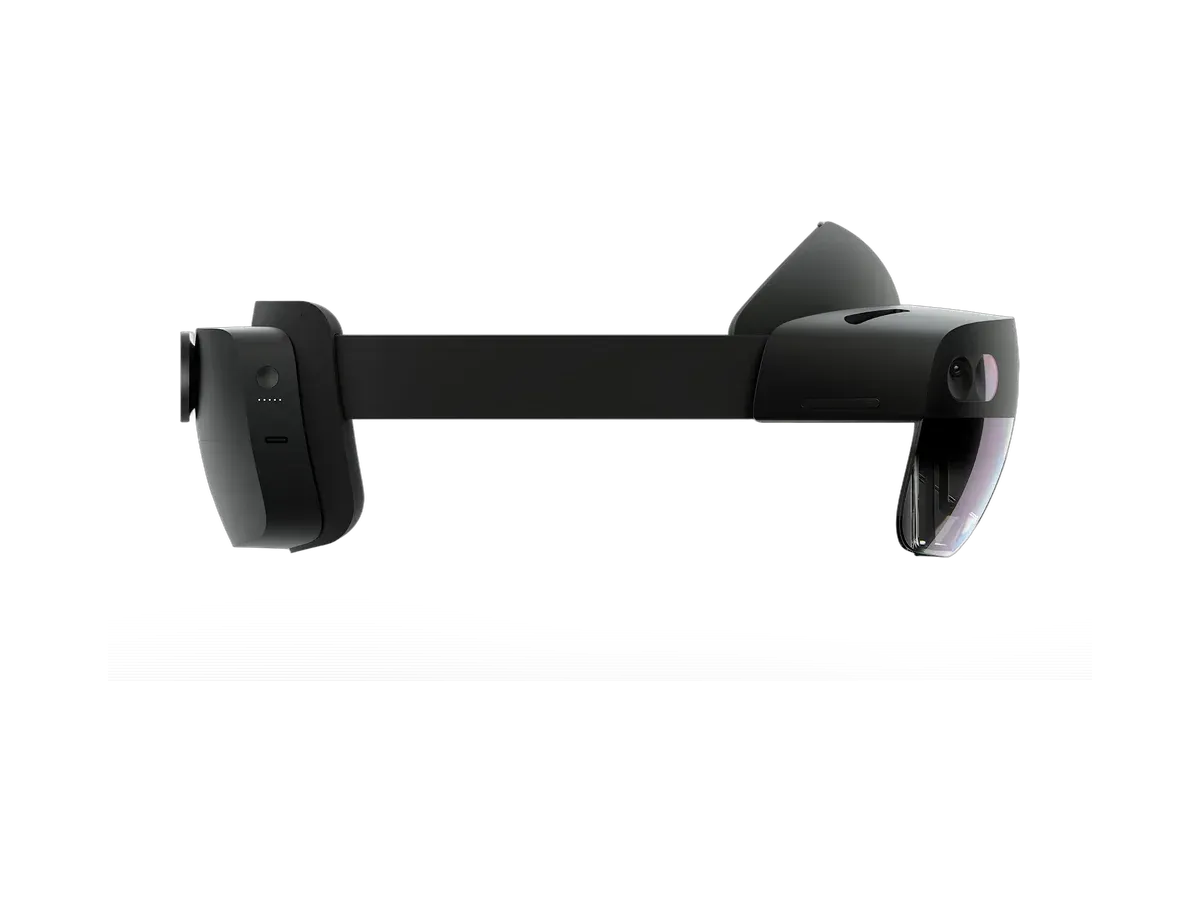
At a glance
- Display type
- See-through holographic waveguide lenses, 2k 3:2 light engines (laser-scanned MEMS)
- Resolution
- 2048x1080
- Field of view
- 52°
- Refresh rate
- 120 Hz
- Weight
- 566 g
- Battery
- 2.5 hr
- Most mature enterprise AR platform with extensive Azure mixed reality ecosystem
- Fully articulated hand tracking with no controllers -- industry-leading interaction model
- 566g headband visor is heavy and conspicuous -- not wearable glasses form factor
- $3,500 price targets enterprise procurement only
Microsoft HoloLens 2
Microsoft
7/10 “According to the aggregated consensus of reviewers, the Microsoft HoloLens 2 was the defining enterprise AR headset of its generation, and it now belongs to the historical record: Microsoft no longer manufactures it, and security updates run only through December 2027. VR Expert still called it the best AR headset on the market in 2022, UploadVR judged it ahead of its time for better and worse, and The Ghost Howls crowned its positional tracking the absolute king while faulting rainbow artifacts and glare. The consensus strengths -- hand tracking, spatial mapping, and comfort unusual for a 566-gram visor -- sit against a recorded 52-degree field of view reviewers found too small and a 2-3 hour battery, at a $3,500 list price that bought enterprise deployments, never consumers. Scores below are an editorial aggregate of that cited coverage, not AR Compare hands-on measurements.” Read the full reviewContact manufacturer for pricing
See current alternatives- Field of view
- 52°
- Weight
- 566 g
- Battery
- 2.5 hr
The Microsoft HoloLens 2 is a standalone mixed reality headset that projects holographic content into the real world via a laser-based waveguide display. Designed for enterprise applications including remote assistance, training, 3D design, and manufacturing, it features 6DoF inside-out tracking, articulated hand tracking, eye tracking, and spatial mapping -- all powered by a custom Holographic Processing Unit.
Our review
By AR Compare Team ·
According to the aggregated consensus of reviewers, the Microsoft HoloLens 2 was the defining enterprise AR headset of its generation, and it now belongs to the historical record: Microsoft no longer manufactures it, and security updates run only through December 2027. VR Expert still called it the best AR headset on the market in 2022, UploadVR judged it ahead of its time for better and worse, and The Ghost Howls crowned its positional tracking the absolute king while faulting rainbow artifacts and glare. The consensus strengths -- hand tracking, spatial mapping, and comfort unusual for a 566-gram visor -- sit against a recorded 52-degree field of view reviewers found too small and a 2-3 hour battery, at a $3,500 list price that bought enterprise deployments, never consumers. Scores below are an editorial aggregate of that cited coverage, not AR Compare hands-on measurements.
- Display quality
- 6.5/10
- Comfort
- 8/10
- Battery life
- 4/10
- Value for money
- 4.5/10
- Build quality
- 8/10
- Software
- 6/10
The Microsoft HoloLens 2 is a standalone mixed reality headset that projects holograms into the real world through laser-scanned waveguide lenses, and it defined enterprise AR when it launched in November 2019 at $3,500. It is also a finished story: Microsoft’s own release notes record that HoloLens devices are no longer manufactured, so what follows is a historical record of what the platform achieved rather than a current purchase recommendation. This review aggregates the hands-on record — UploadVR’s extended 2021 review, The Ghost Howls’ deep technical writeup, VR Expert’s later enterprise review, and Engadget’s launch hands-on — alongside Microsoft’s official hardware documentation and lifecycle statements. AR Compare has not performed hands-on testing of this device; every observation below is attributed to the cited sources, and the category scores are an editorial aggregate of cited reviewer sentiment. Product facts were cross-checked against AR Compare’s spec record for the HoloLens 2 (a recorded 52-degree diagonal field of view at a recorded 47 pixels per degree from 2K 3:2 light engines, roughly 566 grams, a recorded 2.5-hour active battery, $3,500).
How This Review Was Compiled
The record spans the device’s whole life. UploadVR’s Jamie Feltham reviewed it in 2021 with extended daily use, including Microsoft’s Mesh collaboration preview. The Ghost Howls’ Skarredghost spent several days with the unit the same year and published the deepest technical account, the source for the sharpest display criticisms below. VR Expert, a headset reseller, reviewed it in 2022 against the Magic Leap 1; that commercial interest is noted, and its judgments are weighed alongside the independent press. Engadget’s Devindra Hardawar wrote the launch-day hands-on in 2019, and Microsoft’s own documentation supplies the specifications and lifecycle dates. Where the sources disagree — the display is the one genuine split — both readings are reported below rather than smoothed over.
A Finished Platform: The Dates That Frame Everything Else
Status comes before specs for a product like this. Microsoft’s release notes state that as of December 2024, HoloLens devices are no longer manufactured, and that the November 2024 update — Windows Holographic version 24H1 — was the final feature release. Monthly security servicing continues through December 2027, and after that the platform’s updates end. The AR Compare record marks the HoloLens 2 discontinued accordingly, with no hardware successor announced. That context reframes every judgment below: reviewers were describing a live platform, but a reader in 2026 is looking at a closed one, and the closest like-for-like rival of its generation, the Magic Leap 2, sits in the same record with the same discontinued status; Magic Leap 2 vs HoloLens 2 sets the two closed platforms side by side, spec by spec.
Tracking and Hands: What Made It the Benchmark
If the HoloLens 2 is remembered as the benchmark of enterprise AR, the tracking is why. The Ghost Howls calls its positional tracking ‘the absolute king’ of the field, estimating the device gets 90 percent of the way to perfect hologram anchoring where rivals of the era managed closer to 60, and describes hologram persistence across sessions — a virtual object waiting where it was left days earlier — as working so well it feels like magic. Hand tracking draws the same superlatives from a different direction: UploadVR judges it ‘incredibly solid’, driven by a dedicated time-of-flight depth sensor, and The Ghost Howls notes it keeps tracking with fingers interlaced and even with the lights off. Eye tracking rounds out the input story, and Engadget’s launch verdict was that gaze selection ‘can almost function like telekinesis’. The caveats reviewers log are real but secondary: gesture response lags a controller, the hand-tracking camera coverage is narrower than the display, The Ghost Howls measures a small cursor offset, and spatial mapping resolves the room in coarse 10-to-15-centimeter patches that once rendered a PC ‘with the shape of a hill’.
The Display: Sharp Text, and the Record’s One Real Split
On paper the display was a generational step: 2K 3:2 light engines per eye at a recorded 47 pixels per degree, dense enough that text is genuinely readable, with a recorded 52-degree diagonal field of view that was wider than most AR glasses of its day. UploadVR and VR Expert both put the horizontal spread at 43 degrees, and that number is where the complaints start. Every source agrees the window is too small: UploadVR calls the borders ‘a real pain to try and work with’ and reports a browser window losing half its content up close, while The Ghost Howls says holograms hold together at a few meters but ‘as soon as you get close to them, the magic breaks’. The genuine split is over image quality. Engadget found the picture sharp at launch, and UploadVR describes holograms as anchored and believable with only occasional hitches. The Ghost Howls’ longer account is harsher: rainbow-like color banding across white content, glare around bright elements, a screen-door effect visible for the first time on an AR headset, and washed-out holograms anywhere near daylight. VR Expert corroborates the rainbow artifacts and screen-door effect from its own unit, so the criticism cannot be dismissed as one bad sample — the fairest reading is that the display rewarded dim rooms and punished bright ones.
Comfort, Battery, and the Visor
Comfort is a consensus strength, which is remarkable for a recorded 566-gram headset. The battery sits at the rear of the headband, so the weight balances instead of pressing on the nose; a dial fits it in seconds, it accommodates regular eyeglasses, and the visor flips up so the wearer can rejoin the room without taking anything off. Engadget’s launch impression was that it ‘felt like something I could wear for hours without much stress’, UploadVR rates it more comfortable than nearly any VR headset of the time, and The Ghost Howls reports no fatigue after more than an hour — the honest downsides being forehead sweat and the sheer conspicuousness of a visor computer. Battery is the opposite story. Microsoft rates active use at 2-3 hours with up to two weeks of standby, the recorded 2.5-hour figure sits in the middle of that range, and reviewers found the rating honest but thin: UploadVR saw roughly 2 hours under constant use in Mesh sessions, and The Ghost Howls argues a full workday deployment really wants twice the endurance.
Value at $3,500
The HoloLens 2 was never priced for individuals, and no reviewer pretends otherwise. Engadget’s launch line — ‘HoloLens 2 isn’t for Minecraft — it’s meant to get work done’ — captures the positioning, and the software record backs it: Dynamics 365 Remote Assist and Guides, Azure services, and a store UploadVR describes as tech demos plus gated enterprise apps, with unexpected restarts and browser lag in daily use. The Ghost Howls judges the $3,500 figure ‘clearly artificially high’ even for its capabilities, noting the industrial edition at roughly $5,000 and a $99-per-month rental path, while VR Expert points buyers who only need remote assistance toward far cheaper camera-first headsets like the RealWear Navigator 500 or Vuzix M400. The aggregate value verdict was conditional in 2022 and is largely academic now: with manufacturing ended and servicing running only through December 2027, the sensible comparison shopping happens among current-generation hardware, not here.
Who Should Buy the Microsoft HoloLens 2
Per the aggregated consensus: organizations already running HoloLens 2 fleets who need to extend existing Remote Assist, Guides, or custom MRTK deployments through the supported window, and researchers or interaction designers studying the hand-, eye-, and voice-input model that reviewers still treat as a reference point. Who should skip: everyone else. Consumers were never the market, new enterprise deployments face a platform whose final feature release has already shipped and whose security updates end after December 2027, and anyone evaluating see-through AR today is better served weighing current-generation waveguide glasses — with this review read as the record of the benchmark those newer devices are measured against, rather than a current purchase recommendation.
Scores are aggregates of the cited reviews and hands-on reports, not AR Compare hands-on results.
Sources
- UploadVR — HoloLens 2 Review: Ahead Of Its Time, For Better And Worse
- The Ghost Howls — HoloLens 2 Review: The Best In Class For AR, But…
- VR Expert — Microsoft HoloLens 2 Review
- Engadget — Microsoft’s HoloLens 2 is ready for work
- Microsoft — HoloLens 2 hardware (specifications)
- Microsoft — HoloLens 2 release notes (final feature release and servicing dates)
Pros & cons
Pros
- Most mature enterprise AR platform with extensive Azure mixed reality ecosystem
- Fully articulated hand tracking with no controllers -- industry-leading interaction model
- Eye tracking enables foveated rendering and natural gaze-based UI interactions
- 52-degree FOV is wider than most AR glasses at launch
- Real-time spatial mapping anchors holograms to physical world with centimeter accuracy
- Positional tracking reviewers rank as the best of its generation, with holograms locked in place and persisting across sessions in a way testers describe as close to magic
- Hands stay tracked even with interlaced fingers or in the dark, a robustness testers rank well ahead of the consumer VR headsets of the era
- A flip-up visor, rear-balanced battery, and fit over regular eyeglasses that made reviewers call it comfortable for hours despite the bulk
- Gaze plus voice input reviewers describe as close to telekinesis, selecting distant holograms hands-free
Cons
- 566g headband visor is heavy and conspicuous -- not wearable glasses form factor
- $3,500 price targets enterprise procurement only
- Discontinued in October 2024 -- no hardware successor announced
- 2-3 hour active battery life limits continuous use
- Snapdragon 850 chipset shows its age vs modern AR processors
- Holograms clip at the edges of the view as soon as objects come close, which testers say breaks the illusion the hardware exists to sell
- Rainbow-like color banding, glare, and a visible screen-door effect run through the most detailed display accounts
- Security servicing ends after December 2027, a hard deadline hanging over any new deployment
- An app catalog reviewers describe as gated enterprise software and tech demos, with restarts and browser lag reported in everyday use
Full specifications
Specs last verified
| Display | |
|---|---|
| Display type | See-through holographic waveguide lenses, 2k 3:2 light engines (laser-scanned MEMS) |
| Resolution | 2048x1080 |
| Pixels per degree | 47 |
| Field of view (°) | 52 |
| Refresh rate (Hz) | 120 |
| HDR support | ✕ No |
| Color support | Full color |
| Not published: Brightness, Virtual screen size | |
| Optics | |
| Optics type | waveguide |
| Dimming control | ✕ No |
| Transparency level | see-through AR overlay |
| Prescription support | ✓ Yes |
| Prescription options | Worn over glasses |
| Physical | |
| Weight (g) | 566 |
| Frame style | headband visor |
| Color options | Black |
| Foldable | ✕ No |
| Not published: IP rating | |
| Battery & power | |
| Battery life (hours) | 2.5 |
| Charging method | USB-C |
| Not published: Charging time | |
| Connectivity | |
| Connectivity | Bluetooth 5.0, WiFi 5, WiFi 6, USB-C |
| Tethered | ✕ No |
| Compatible devices | Standalone, Windows |
| Computing | |
| Processing type | on-device |
| Operating system | Windows Holographic OS (Windows 10-based; final feature release 24H1, Nov 2024) |
| Chipset | Qualcomm Snapdragon 850 + 2nd-gen custom Holographic Processing Unit (HPU), 4GB LPDDR4x, 64GB UFS 2.1 (untethered) |
| Sensors & input | |
| Camera | 8MP (5×) |
| Microphones | 5 |
| Speakers | directional · spatial audio |
| Tracking | 6DoF, head, eye, hand, SLAM |
| Gesture control | ✓ Yes |
| Voice control | ✓ Yes |
| AI | |
| AI assistant | Cortana |
| Not published: AI model, Wake word, AI capabilities | |
Prescription options
The documented prescription routes for the Microsoft HoloLens 2, from the maker and named-partner documentation recorded in our database.
- Worn over glasses — range not published by the maker Source: learn.microsoft.com documentation
Maker documentation as recorded 2026-09-17. Ranges are the maker's published limits, not medical advice — confirm your exact prescription with your optician before ordering.
Where to buy
Microsoft HoloLens 2 specs: quick answers
- What is the Microsoft HoloLens 2's field of view?
- The Microsoft HoloLens 2 has a 52-degree field of view.
- What is the Microsoft HoloLens 2's display resolution?
- The Microsoft HoloLens 2's recorded per-eye display resolution is 2048x1080.
- How much does the Microsoft HoloLens 2 weigh?
- The Microsoft HoloLens 2's glasses weigh 566g according to the manufacturer specification.
- How long does the Microsoft HoloLens 2's battery last?
- The Microsoft HoloLens 2 is rated for about 2.5 hours of battery life.
- Does the Microsoft HoloLens 2 have a camera?
- Yes, the Microsoft HoloLens 2 has 5 built-in cameras. The recorded camera resolution is 8MP.
- Does the Microsoft HoloLens 2 have an AI assistant?
- Yes, the Microsoft HoloLens 2 includes the Cortana AI assistant.
Microsoft HoloLens 2: FAQs
What field of view does the Microsoft HoloLens 2 have?
The Microsoft HoloLens 2 has a recorded field of view of 52 degrees.
How much does the Microsoft HoloLens 2 weigh?
The Microsoft HoloLens 2 weighs 566g according to the manufacturer specification.
How long does the battery last on the Microsoft HoloLens 2?
The Microsoft HoloLens 2 has a rated battery life of 2.5 hours.
Can I use the Microsoft HoloLens 2 with prescription lenses?
Yes, the Microsoft HoloLens 2 supports prescription lenses. The recorded diopter range is Fits over eyeglasses.
Does the Microsoft HoloLens 2 have a camera?
Yes, the Microsoft HoloLens 2 has a built-in camera (8MP).
What devices work with the Microsoft HoloLens 2?
The Microsoft HoloLens 2 lists compatibility with: Standalone, Windows.
What resolution does the Microsoft HoloLens 2 have?
The Microsoft HoloLens 2 has a recorded per-eye resolution of 2048x1080. It refreshes at 120Hz.
Similar products
What shoppers cross-check with the Microsoft HoloLens 2 — from our navigation records and closest spec matches.
Related Comparisons
Microsoft HoloLens 2 vs Magic Leap 2
Microsoft vs Magic Leap
Microsoft HoloLens 2 vs Lenovo ThinkReality A3
Microsoft vs Lenovo
Microsoft HoloLens 2 vs Epson Moverio BT-45C
Microsoft vs Epson
Microsoft HoloLens 2 vs DigiLens ARGO Smart Glasses
Microsoft vs DigiLens
Microsoft HoloLens 2 vs Dream Glass Lead Pro
Microsoft vs Dreamworld
Microsoft HoloLens 2 vs Inmo Air2
Microsoft vs Inmo
Microsoft HoloLens 2 vs INMO Air3 All-in-One Full-Color Waveguide AR Glasses
Microsoft vs Inmo
Microsoft HoloLens 2 vs Mad Gaze Glow Plus
Microsoft vs Mad Gaze
Microsoft HoloLens 2 vs RayNeo X3 Pro
Microsoft vs RayNeo
Microsoft HoloLens 2 vs Rokid AR Spatial
Microsoft vs Rokid
Microsoft HoloLens 2 vs Snap Specs (Consumer Edition)
Microsoft vs Snap
Microsoft HoloLens 2 vs Snap Spectacles Gen 5
Microsoft vs Snap
Microsoft HoloLens 2 vs TCL RayNeo X2
Microsoft vs RayNeo
Microsoft HoloLens 2 vs Vuzix Blade 2
Microsoft vs Vuzix
Microsoft HoloLens 2 vs XREAL Aura
Microsoft vs XREAL